


























Views
Downloads
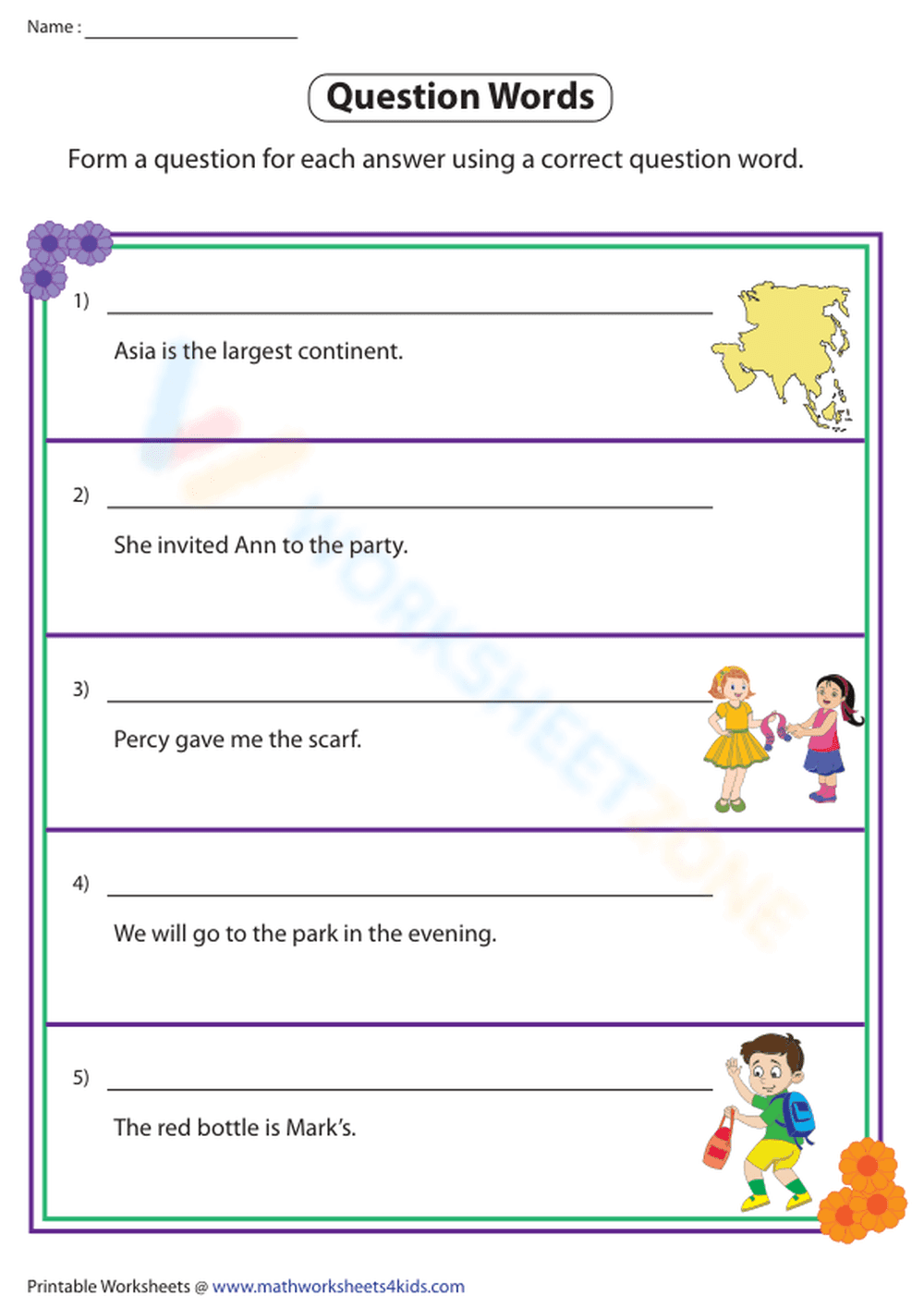

Essential WH Question Words Worksheet | Grades 1-3 ELA
Paste this activity's link or code into your existing LMS (Google Classroom, Canvas, Teams, Schoology, Moodle, etc.).
Students can open and work on the activity right away, with no student login required.
You'll still be able to track student progress and results from your teacher account.
Building strong interrogative skills is a cornerstone of early literacy and effective communication. This worksheet provides a direct method for students to practice forming questions using who, what, where, when, and whose based on provided answers. By reversing the typical question-and-answer flow, learners develop a deeper cognitive understanding of sentence structure and syntax.
At a Glance
- Grade: Grades 1–3 · Subject: English Language Arts
- Standard:
CCSS.ELA-LITERACY.L.1.1.J— Produce and expand complete simple and compound interrogative sentences in response to prompts- Skill Focus: Forming WH-questions from declarative statements
- Format: 1 page · 5 problems · Answer key included · PDF
- Best For: Grammar warm-ups and independent practice
- Time: 10–15 minutes
This single-page PDF features five distinct exercises that challenge students to identify the correct interrogative word to match a given declarative sentence. Each task is accompanied by a charming illustration to provide visual context, such as a map of Asia or children sharing a scarf. The layout is clean and spacious, providing ample room for young writers to construct their responses accurately and legibly.
The zero-prep workflow for this resource is designed for maximum efficiency in busy classrooms. Teachers can print the required number of copies in less than one minute. Distribution to students takes seconds, and the included answer key allows for a rapid whole-class review or self-correction session in under three minutes. This makes it an ideal choice for sudden sub plans, morning work, or transition periods between subjects.
This resource is explicitly aligned with CCSS.ELA-LITERACY.L.1.1.J. Students must demonstrate the ability to produce complete interrogative sentences that logically correspond to specific informational prompts. Mastery of this standard ensures that learners can effectively seek information and participate in academic discourse across all subjects. Both standard codes can be copied directly into lesson plans, IEP goals, or district curriculum mapping tools.
Use this worksheet as a formative assessment after a direct instruction lesson on wh-words. Observe how students handle possessive questions like whose, which are often more challenging than who or where. It also serves as an excellent morning work assignment to reinforce grammar skills. Most students will successfully complete all five tasks within a fifteen-minute window during independent rotations or literacy centers.
This resource is designed for students in grades 1 through 3 who are refining their understanding of English sentence mechanics. It is particularly beneficial for English Language Learners (ELL) who require structured practice with question formation and subject-verb agreement. Pair this worksheet with a grammar anchor chart or a short reading passage to provide a comprehensive literacy block that bridges reading and writing skills.
According to research by Fisher & Frey (2014), the gradual release of responsibility model is most effective when students are provided with structured independent practice that mirrors instructional goals. This Grade 2 ELA resource supports that transition by focusing on CCSS.ELA-LITERACY.L.1.1.J, requiring students to construct interrogative sentences from evidence-based declarative prompts. The five tasks included here help solidify the relationship between questions and answers, a skill identified by NAEP as critical for early reading comprehension and inquiry-based learning. By isolating the mechanics of question words, the worksheet allows students to focus on syntactic accuracy without the cognitive load of generating original content. This targeted approach ensures that the fundamental skill of inquiry is mastered, providing a reliable foundation for more complex writing and analytical tasks in later elementary grades.


