


























Views
Downloads
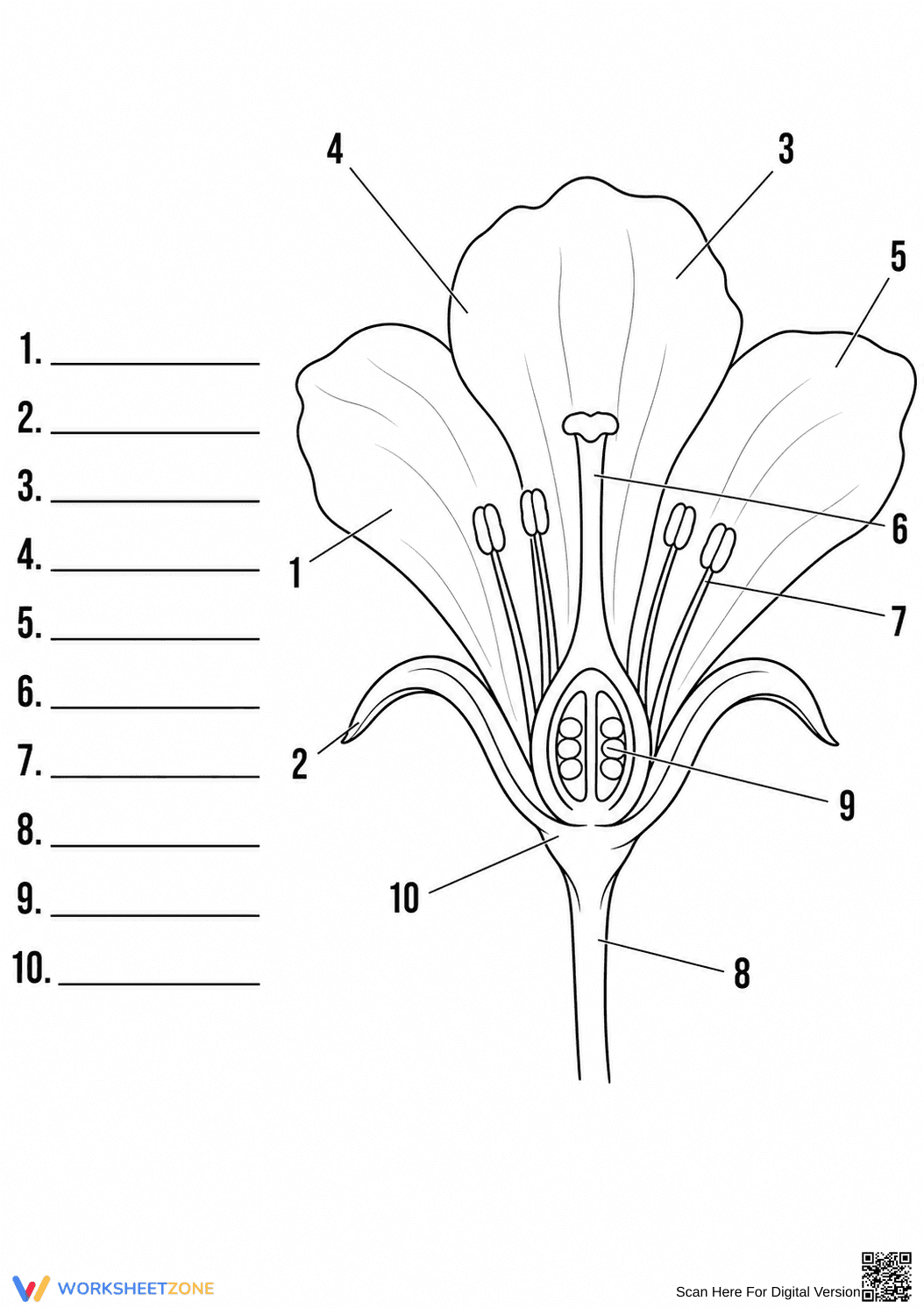

Grade 4 Flower Labeling — Printable No-Prep Worksheet
Paste this activity's link or code into your existing LMS (Google Classroom, Canvas, Teams, Schoology, Moodle, etc.).
Students can open and work on the activity right away, with no student login required.
You'll still be able to track student progress and results from your teacher account.
This Grade 4 science worksheet provides a clear, anatomical diagram for students to identify the internal and external structures of a flowering plant. By labeling ten distinct parts, learners develop a concrete understanding of plant reproduction and survival mechanisms. It is an essential tool for building foundational biological knowledge.
At a Glance
- Grade: 4 · Subject: Science
- Standard:
4-LS1-1— Identify internal and external plant structures- Skill Focus: Plant Anatomy & Labeling
- Format: 1 page · 10 problems · Answer key included · PDF
- Best For: Quick assessment or science center
- Time: 10–15 minutes
What's Inside
Inside this resource, you will find a high-quality line-art illustration of a flower cross-section. The diagram features ten numbered leader lines pointing to specific components, including the petals, sepals, pistil, and stamen. The clean layout ensures students have ample space to write their answers, while the single-page format makes it easy to manage in a busy classroom.
Zero-Prep Workflow
This worksheet is designed for a zero-prep workflow. Teachers can print the PDF in less than 30 seconds, distribute it to the class immediately, and review the answers together in under five minutes. Because the diagram is self-explanatory, total teacher prep time is under two minutes. It serves as an excellent grab-and-go resource for substitute folders or unexpected schedule changes.
Standards Alignment
This activity aligns with 4-LS1-1, which requires students to construct an argument that plants have internal and external structures that function to support survival, growth, behavior, and reproduction. By identifying parts like the ovary and anther, students gain the vocabulary needed to explain these biological processes. Both standard codes can be copied directly into lesson plans, IEP goals, or district curriculum mapping tools.
How to Use It
Use this worksheet during the "Explain" phase of a 5E lesson model after students have observed real flowers. It works well as a formative assessment to check for understanding of reproductive parts; watch to see if students confuse the stamen and pistil during independent work. Expect students to complete the labeling in 10 to 15 minutes. For a hands-on extension, have students color-code the male and female parts of the flower after labeling.
Who It's For
This resource is ideal for general education fourth-grade students, English Language Learners who benefit from visual aids, and students with IEPs requiring simplified tasks. It pairs naturally with a classroom flower dissection or an anchor chart detailing the functions of each plant part.
According to the EdReports 2024 analysis of science curriculum efficacy, visual-spatial tasks like labeling diagrams are critical for long-term retention of complex biological systems. This worksheet addresses the 4-LS1-1 standard by requiring students to identify internal and external plant structures that facilitate reproduction. By engaging with a ten-part diagram, learners move beyond surface-level recognition to a more detailed understanding of plant anatomy. Scaffolded visual tools help bridge the gap between vocabulary acquisition and conceptual mastery in the sciences. This printable resource provides that necessary bridge, ensuring students can accurately name and locate the parts of a flower. It serves as a reliable data point for teachers tracking student progress toward NGSS life science benchmarks. The inclusion of internal structures like the ovary and stamen allows for a comprehensive assessment of student knowledge regarding plant life cycles.


