


























Views
Downloads
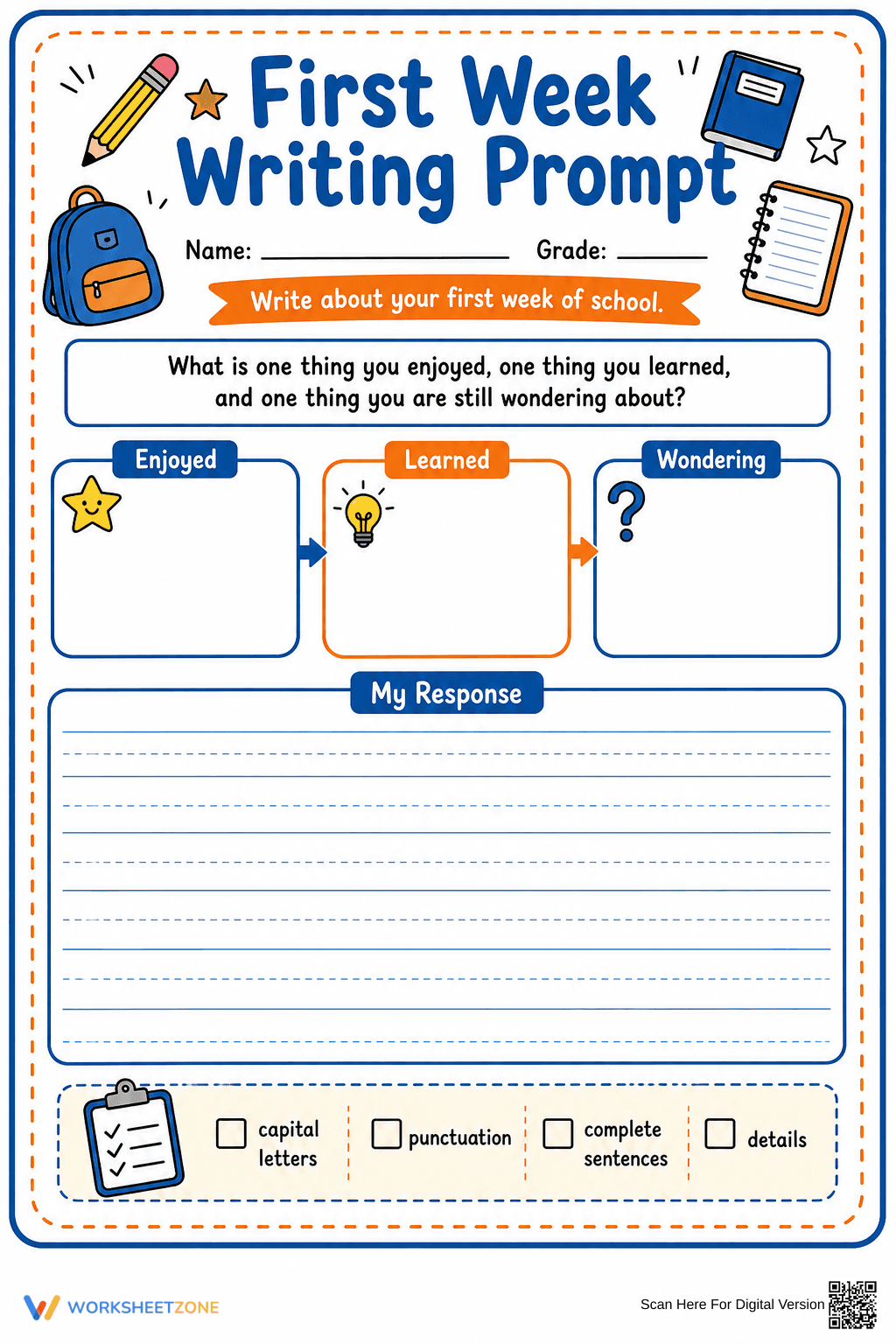

First Week Writing Prompt | Grade 3 Printable Worksheet
Paste this activity's link or code into your existing LMS (Google Classroom, Canvas, Teams, Schoology, Moodle, etc.).
Students can open and work on the activity right away, with no student login required.
You'll still be able to track student progress and results from your teacher account.
This Grade 3 writing prompt worksheet helps students reflect on their initial school experiences through structured planning and narrative response. By identifying specific highlights and questions, learners build confidence in routine writing tasks. It provides a clear framework for students to organize thoughts before drafting a cohesive paragraph about their first week.
At a Glance
- Grade: 3 · Subject: ELA
- Standard:
CCSS.ELA-LITERACY.W.3.10— Write routinely over shorter time frames for a range of tasks- Skill Focus: Reflective Narrative Writing
- Format: 1 page · 5 tasks · Self-checklist included · PDF
- Best For: Back-to-school icebreaker and baseline assessment
- Time: 20–30 minutes
The worksheet features a structured layout designed for elementary learners. It includes three distinct planning boxes labeled "Enjoyed," "Learned," and "Wondering" to scaffold the brainstorming process. Below the planning section, a large lined writing area with primary-style dashed lines supports neat handwriting. A built-in editing checklist at the bottom encourages students to self-correct for capitals, punctuation, and complete sentences.
Zero-Prep Workflow
- Print: Select the single-page PDF and print enough copies for your class in less than 30 seconds.
- Distribute: Hand out the sheets as a morning work assignment or a quiet reflection activity after a busy first-week assembly.
- Review: Use the completed responses to gauge student writing stamina and baseline conventions immediately. Total teacher preparation time is under 2 minutes.
Standards Alignment
This resource aligns with `CCSS.ELA-LITERACY.W.3.10`, which requires students to write routinely over shorter time frames for specific tasks and purposes. It also supports `CCSS.ELA-LITERACY.L.3.2` by providing a checklist for capitalization and punctuation. Both standard codes can be copied directly into lesson plans, IEP goals, or district curriculum mapping tools.
How to Use It
Use this worksheet as a formative assessment on the third or fourth day of school to see how students handle multi-step prompts. Observe if students can translate their three planning points into the final response area. It also works well as a "Friday Reflection" to close out the first week, taking approximately 25 minutes to complete.
Who It's For
This is designed for Grade 3 students but is adaptable for Grades 2 through 5. It is particularly helpful for English Language Learners who benefit from the visual icons and segmented planning boxes. Pair this with a "First Day" picture book or an anchor chart about sentence structure for a complete lesson.
According to Fisher & Frey (2014), providing students with structured planning tools before independent writing significantly improves the quality of their narrative output. This worksheet utilizes that research by offering three specific categories—Enjoyed, Learned, and Wondering—to reduce the cognitive load of brainstorming. By aligning with CCSS.ELA-LITERACY.W.3.10, the resource ensures that students are engaging in the routine writing practice necessary for developing fluency and stamina. The inclusion of a self-monitoring checklist further supports metacognitive growth, allowing students to evaluate their own work against standard conventions. Educators can use the 5 tasks on this page to establish a baseline for student performance at the start of the academic year. This evidence-based approach to reflective writing helps bridge the gap between informal thought and formal composition in the elementary classroom setting.


