


























Views
Downloads

Printable First Day Feelings Chart | Grade 1 SEL
Paste this activity's link or code into your existing LMS (Google Classroom, Canvas, Teams, Schoology, Moodle, etc.).
Students can open and work on the activity right away, with no student login required.
You'll still be able to track student progress and results from your teacher account.
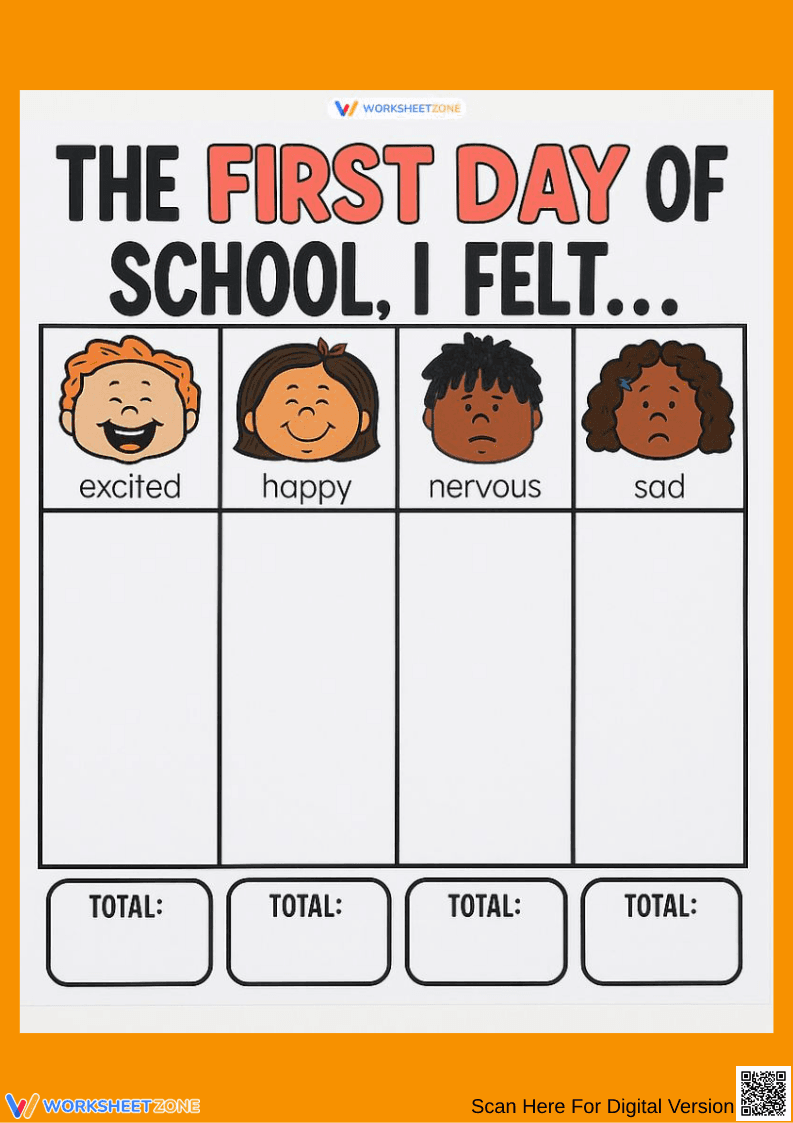
This interactive first day of school feelings chart helps students identify and express their emotions while building foundational data collection skills. By tallying how the class feels—excited, happy, nervous, or sad—students practice self-awareness and graphing in one engaging, community-building activity.
At a Glance
- Grade: 1 · Subject: SEL & Math
- Standard:
CCSS.MATH.CONTENT.1.MD.C.4— Organize and interpret data with up to three categories- Skill Focus: Emotional awareness and graphing
- Format: 1 page · 4 categories · No answer key · PDF
- Best For: Morning meetings and first day
- Time: 15–20 minutes
This single-page printable features four emotion categories: excited, happy, nervous, and sad. Below each face is a blank column for students to record tally marks or draw pictures representing their peers' feelings. A total box at the bottom allows students to count and write the final number, creating a visual representation of the classroom's mood.
This resource offers a zero-prep workflow.
- Print (1 min): Download the PDF and print a class set.
- Distribute (1 min): Hand out charts during morning meeting.
- Review (2 mins): Model how to record a tally mark.
Total teacher preparation takes under two minutes, making this an ideal, stress-free activity for the first week of school or a substitute teacher's plan.
This worksheet aligns to CCSS.MATH.CONTENT.1.MD.C.4: Organize, represent, and interpret data with up to three categories. While the chart includes four categories, it perfectly supports the foundational math skill of collecting categorical data. Both standard codes can be copied directly into lesson plans, IEP goals, or district curriculum mapping tools.
Use this chart as a whole-group morning meeting activity. Ask students to share how they feel, and have the class record a tally mark in the correct column. Alternatively, place it in a morning work center for independent graphing. As a formative assessment tip, observe whether students accurately count tally marks and write the numeral in the total box. Expect this to take 15 to 20 minutes.
Designed for K-2 students developing emotional vocabulary and early graphing skills. To differentiate, younger learners can simply color the face matching their mood. Advanced students can write comparative sentences about the data (e.g., most/fewest responses). This pairs wonderfully with a read-aloud book about first-day jitters.
Integrating social-emotional check-ins with academic tasks significantly boosts student engagement and classroom community. According to a RAND AIRS 2024 report, embedding emotional awareness activities into daily routines helps establish a supportive learning environment, which is especially critical during the transition back to school. This worksheet supports that goal by combining SEL with CCSS.MATH.CONTENT.1.MD.C.4, allowing students to organize and interpret data with up to three categories. By quantifying their feelings, students not only validate their own emotional experiences but also practice essential mathematical concepts like tallying and counting. This dual-purpose approach maximizes instructional time while fostering a safe space for expression. Utilizing structured visual aids for emotional check-ins ensures that all learners, regardless of their verbal proficiency, can actively participate in building a positive classroom culture from day one.


