


























0
Views
0
Downloads

0.0
0
Save
0 Likes
Share
Finish the Silent E Word Worksheet
0 Views
0 Downloads
Paste this activity's link or code into your existing LMS (Google Classroom, Canvas, Teams, Schoology, Moodle, etc.).
Students can open and work on the activity right away, with no student login required.
You'll still be able to track student progress and results from your teacher account.
Information
Description
What It Is:
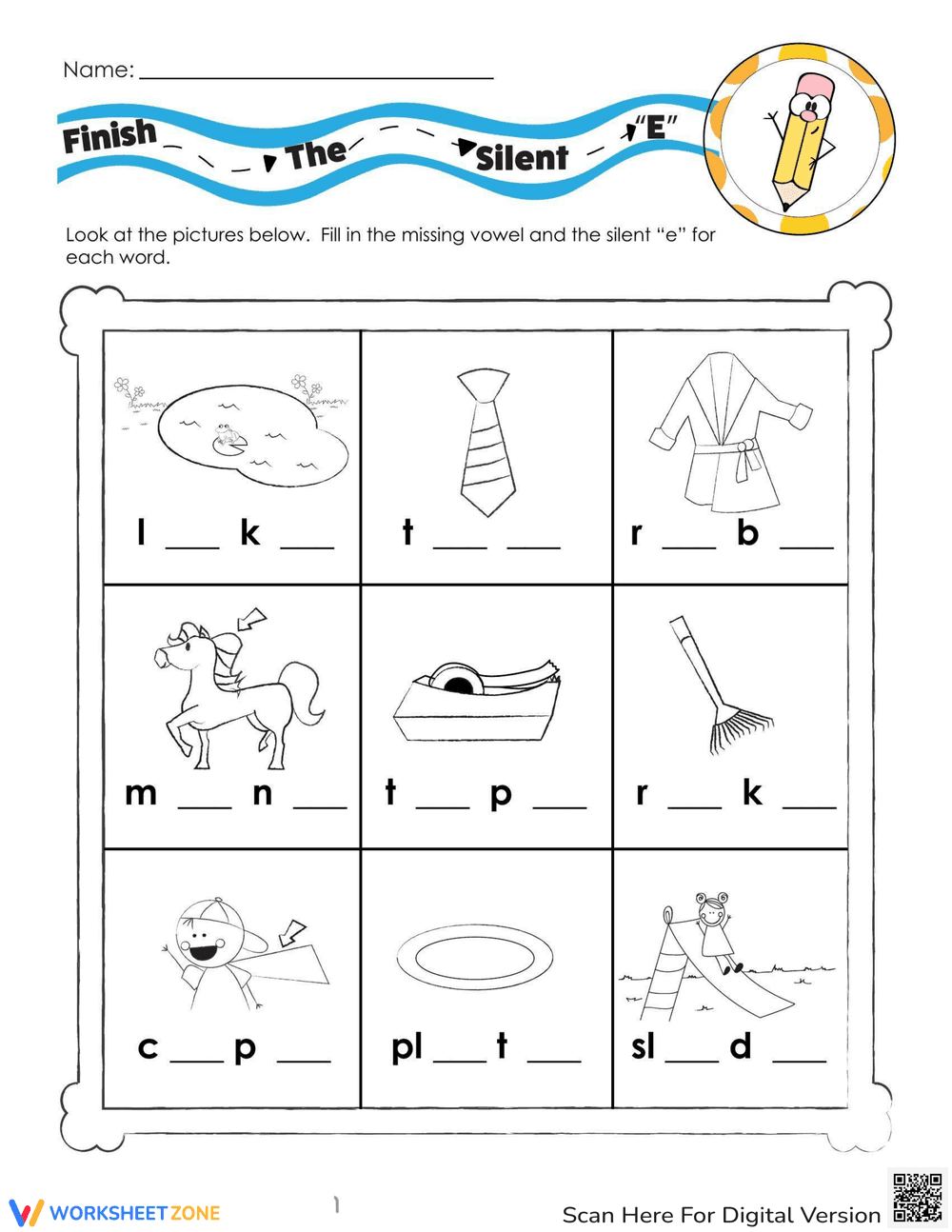
This is a phonics worksheet focusing on the silent 'e' rule. The worksheet presents nine different pictures (lake, tie, robe, mane, tape, rake, cape, plate, slide). Below each picture, there are blanks for students to fill in the missing vowel and the silent 'e' to complete the word.
Grade Level Suitability:
This worksheet is most suitable for 1st and 2nd grade students. It reinforces phonics skills, specifically the silent 'e' rule, which is typically introduced at this level. It also requires basic reading and picture recognition skills.
Why Use It:
This worksheet helps students practice and reinforce their understanding of the silent 'e' rule in phonics. It improves spelling skills, vocabulary, and the ability to decode words with silent 'e'. It also helps connect visual representations (pictures) with their corresponding words.
How to Use It:
Students should look at each picture and determine the corresponding word. They then need to fill in the missing vowel and the silent 'e' at the end of the word. For example, for the picture of the lake, they would fill in 'a' and 'e' to spell 'lake'.
Target Users:
The target users are elementary school students, particularly those in 1st and 2nd grade, who are learning or reinforcing the silent 'e' rule in phonics. It can also be helpful for students who need extra practice with spelling and vocabulary.
This is a phonics worksheet focusing on the silent 'e' rule. The worksheet presents nine different pictures (lake, tie, robe, mane, tape, rake, cape, plate, slide). Below each picture, there are blanks for students to fill in the missing vowel and the silent 'e' to complete the word.
Grade Level Suitability:
This worksheet is most suitable for 1st and 2nd grade students. It reinforces phonics skills, specifically the silent 'e' rule, which is typically introduced at this level. It also requires basic reading and picture recognition skills.
Why Use It:
This worksheet helps students practice and reinforce their understanding of the silent 'e' rule in phonics. It improves spelling skills, vocabulary, and the ability to decode words with silent 'e'. It also helps connect visual representations (pictures) with their corresponding words.
How to Use It:
Students should look at each picture and determine the corresponding word. They then need to fill in the missing vowel and the silent 'e' at the end of the word. For example, for the picture of the lake, they would fill in 'a' and 'e' to spell 'lake'.
Target Users:
The target users are elementary school students, particularly those in 1st and 2nd grade, who are learning or reinforcing the silent 'e' rule in phonics. It can also be helpful for students who need extra practice with spelling and vocabulary.


