


























Views
Downloads

Printable Find the Missing Numbers Worksheet | Grade 2 Math
Paste this activity's link or code into your existing LMS (Google Classroom, Canvas, Teams, Schoology, Moodle, etc.).
Students can open and work on the activity right away, with no student login required.
You'll still be able to track student progress and results from your teacher account.
Master the relationship between addition and subtraction with this targeted missing numbers worksheet. Designed for second-grade students, this resource moves beyond basic computation to build algebraic thinking. Students learn to apply inverse operations to solve for unknown values in equations, ensuring a deeper understanding of mathematical properties and number sense.
At a Glance
- Grade: Grade 2 · Subject: Math
- Standard:
2.NBT.B.5— Fluently add and subtract within 100 using the relationship between addition and subtraction- Skill Focus: Inverse Operations & Missing Numbers
- Format: 3 pages · 12 problems · Answer key included · PDF
- Best For: Small group instruction or independent math centers
- Time: 15–25 minutes
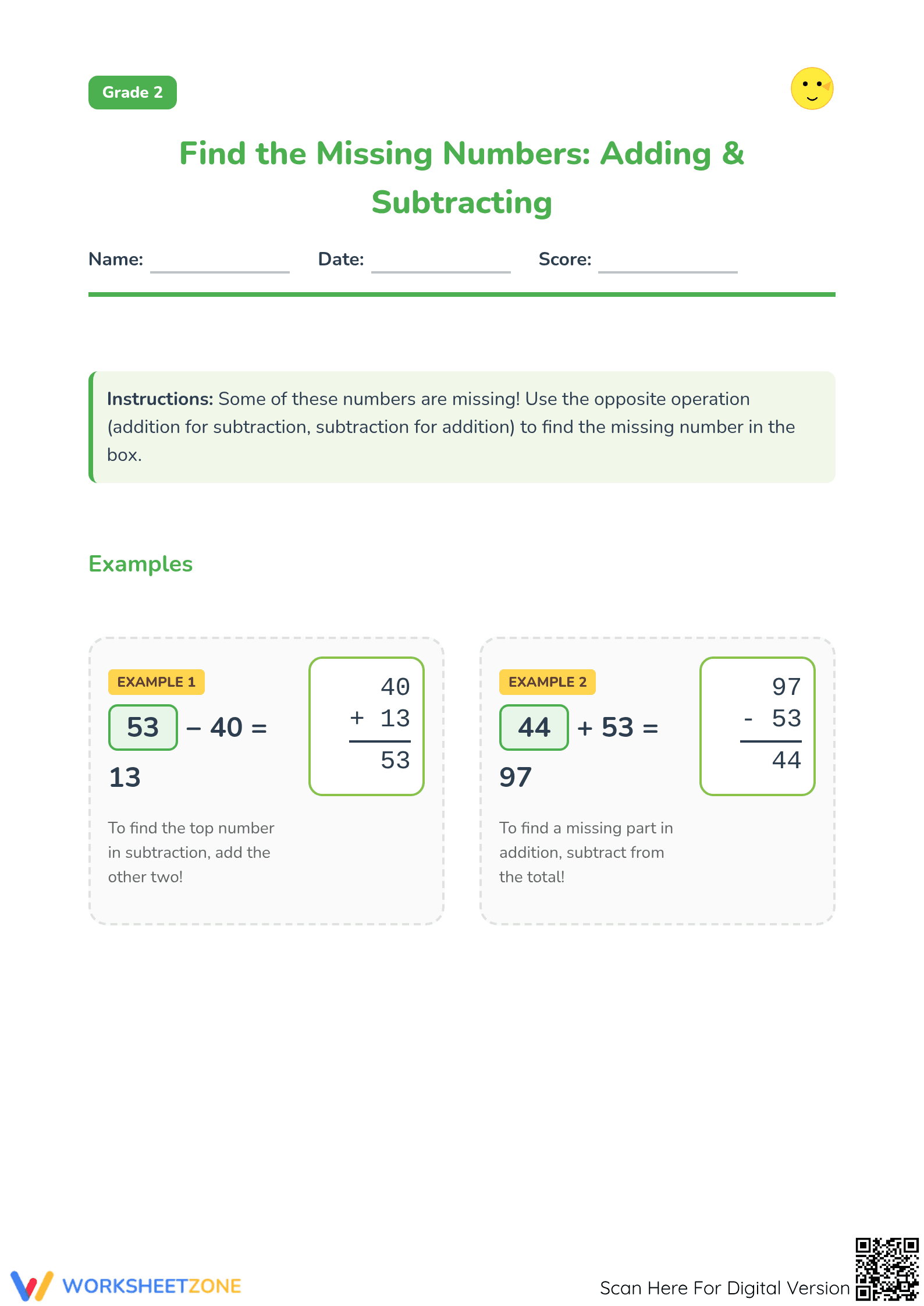
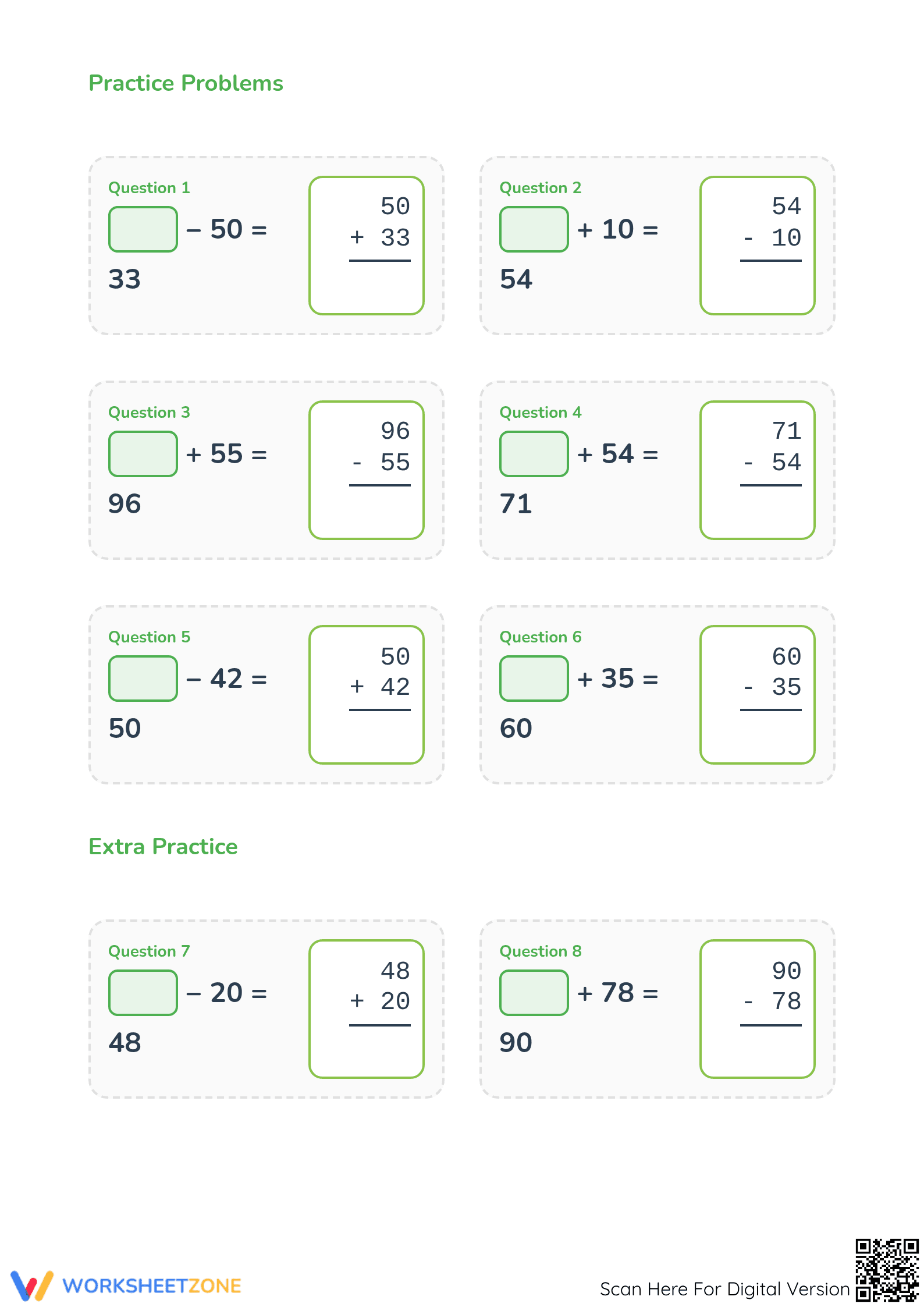
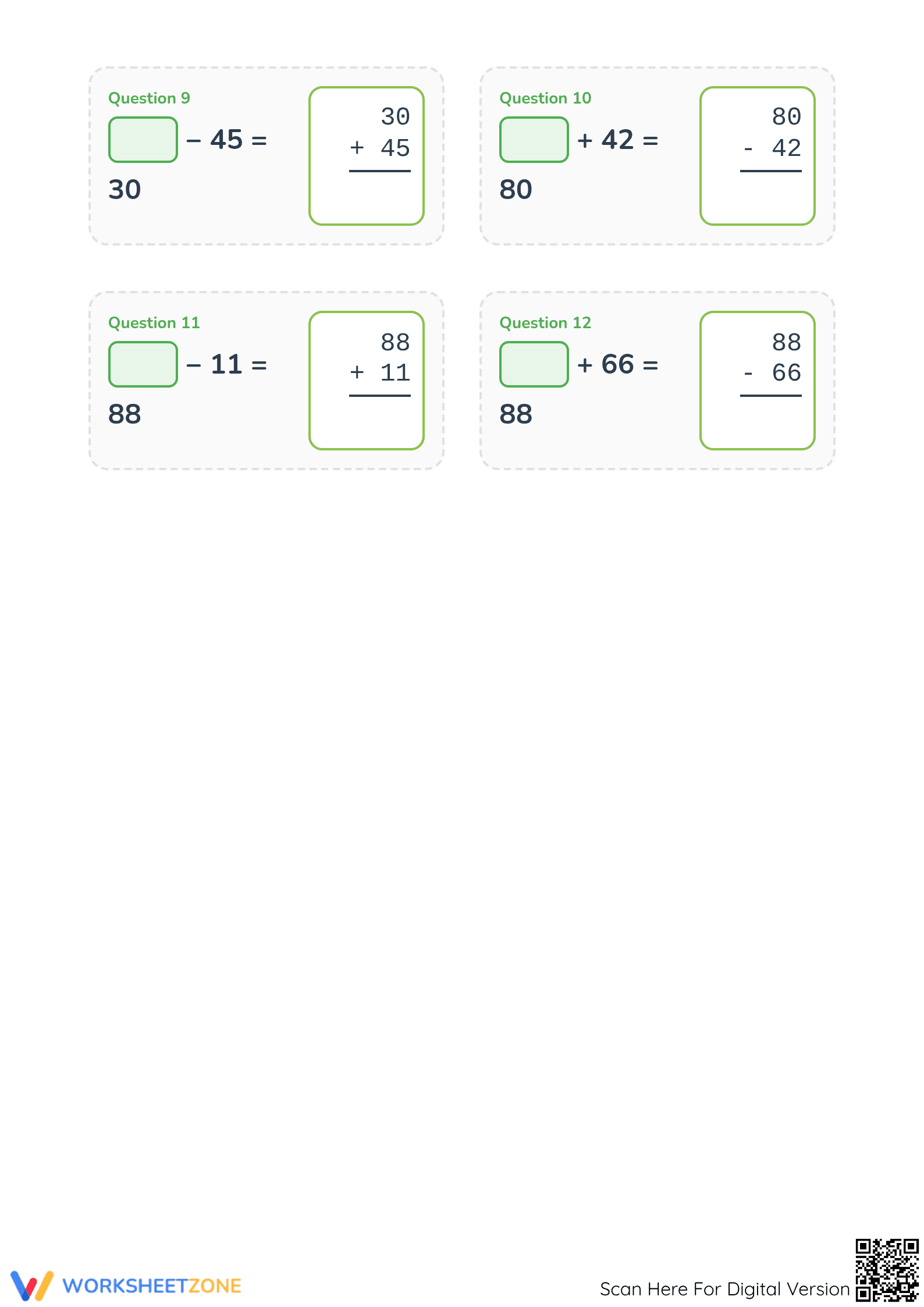
This three-page PDF package includes two worked examples that explicitly demonstrate the "opposite operation" strategy for solving unknowns. It contains 12 practice problems featuring two-digit addition and subtraction. Each problem provides a dedicated workspace for students to set up their inverse calculation, alongside a clear answer key for rapid grading and student self-correction.
The worksheet follows a gradual release model to ensure student success:
- Guided Practice: Two detailed examples model how to transform a subtraction equation into addition and an addition equation into subtraction.
- Supported Practice: Six problems provide a structured framework where students identify the correct inverse operation to solve the equation.
- Independent Practice: Six extra practice items challenge students to solidify their mastery of solving for unknowns in varying mathematical contexts.
This progression mirrors the I Do, We Do, You Do instructional framework to build confidence before independent application.
Standards Alignment
Aligned with 2.NBT.B.5, this worksheet focuses on the relationship between addition and subtraction. By requiring students to "reverse" the operation, it directly supports the standard's goal: "Fluently add and subtract within 100 using strategies based on place value, properties of operations, and/or the relationship between addition and subtraction." This standard code can be copied directly into lesson plans, IEP goals, or district curriculum mapping tools.
How to Use It
Use this as a focused center activity during your Operations and Algebraic Thinking unit. It serves as an excellent formative assessment tool; observe if students correctly flip the operation to identify misconceptions early in the instructional cycle. Expected completion time typically ranges from 15 to 25 minutes depending on student fluency levels.
Who It's For
This resource is ideal for Grade 2 students working on multi-digit fluency. It provides necessary scaffolding for struggling learners through dedicated workspace, while offering rigorous mental math practice for on-level students. Pair this with a number line or base-ten blocks for students who need concrete visual support during the inverse calculation phase.
The 2.NBT.B.5 standard emphasizes the relationship between addition and subtraction as a foundational skill for mathematical fluency. According to research from Fisher & Frey (2014), the gradual release of responsibility—moving from worked examples to independent practice—is critical for students to internalize complex procedural shifts like inverse operations. This worksheet operationalizes that research by providing 12 scaffolded tasks that require students to mentally or physically reverse a two-digit equation to find a missing value. This process builds the cognitive flexibility required for later algebraic thinking, as identified in the NAEP mathematics framework. By focusing on the structural properties of numbers rather than rote memorization, students develop a more robust understanding of Base Ten operations. This resource serves as a high-utility tool for educators looking to bridge the gap between simple arithmetic and the conceptual mastery of operations within 100.


