


























Views
Downloads

CCSS 6.G.A.1 Worksheet: Geometry Area — Grade 6 Aligned
Paste this activity's link or code into your existing LMS (Google Classroom, Canvas, Teams, Schoology, Moodle, etc.).
Students can open and work on the activity right away, with no student login required.
You'll still be able to track student progress and results from your teacher account.
This Grade 6 assessment evaluates mastery of area calculations for triangles, quadrilaterals, and circles. Students move from basic polygon formulas to complex properties and composite shapes, ensuring they can apply geometric principles to diverse mathematical scenarios. It is an essential tool for measuring end-of-unit progress and readiness for advanced measurement concepts.
At a Glance
- Grade: 6 · Subject: Math
- Standard:
6.G.A.1— Find the area of right triangles, triangles, and special quadrilaterals- Skill Focus: Area and Circumference Calculations
- Format: 3 pages · 12 problems · Answer key included · PDF
- Best For: End-of-unit geometry assessment and review
- Time: 45–60 minutes
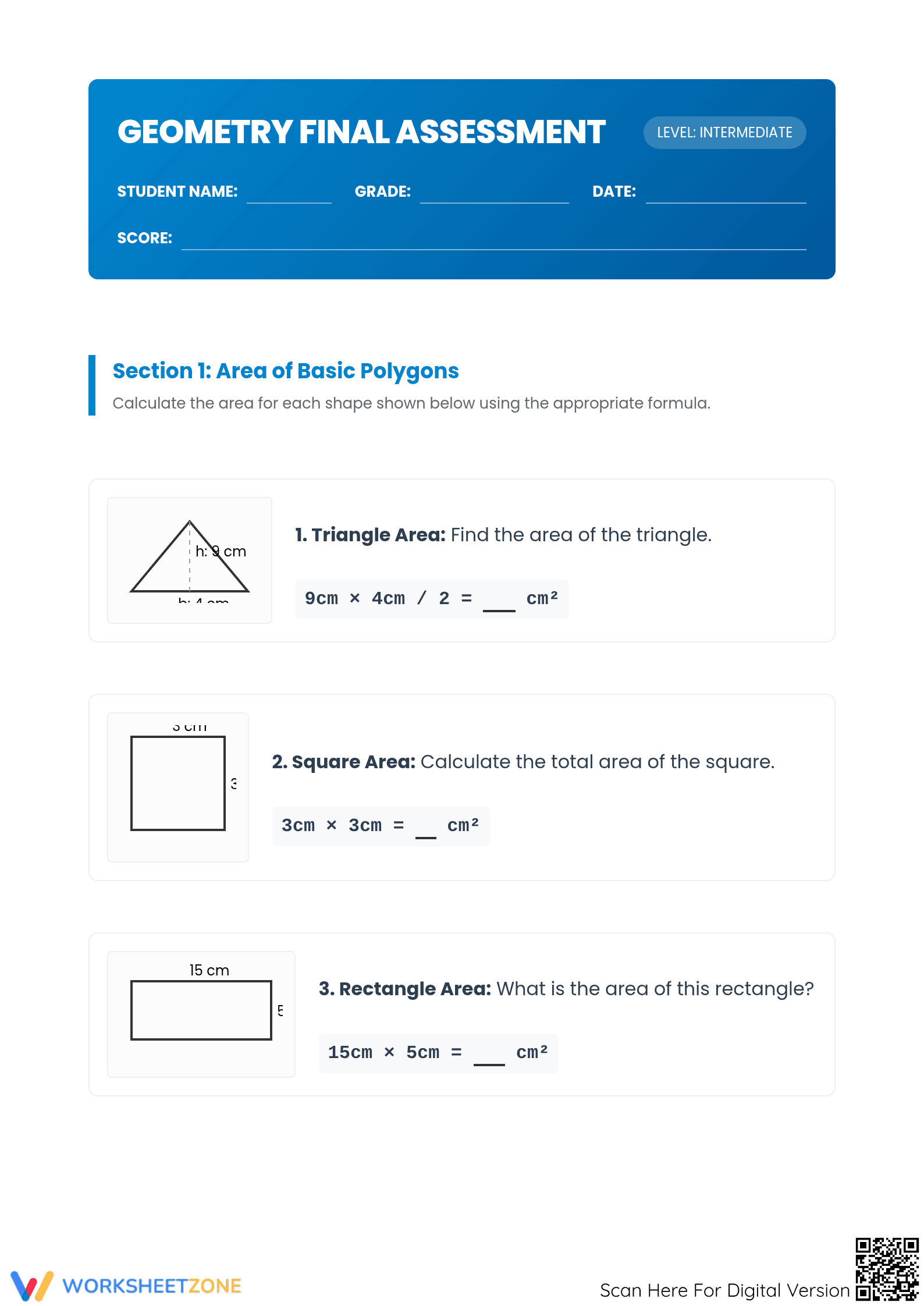
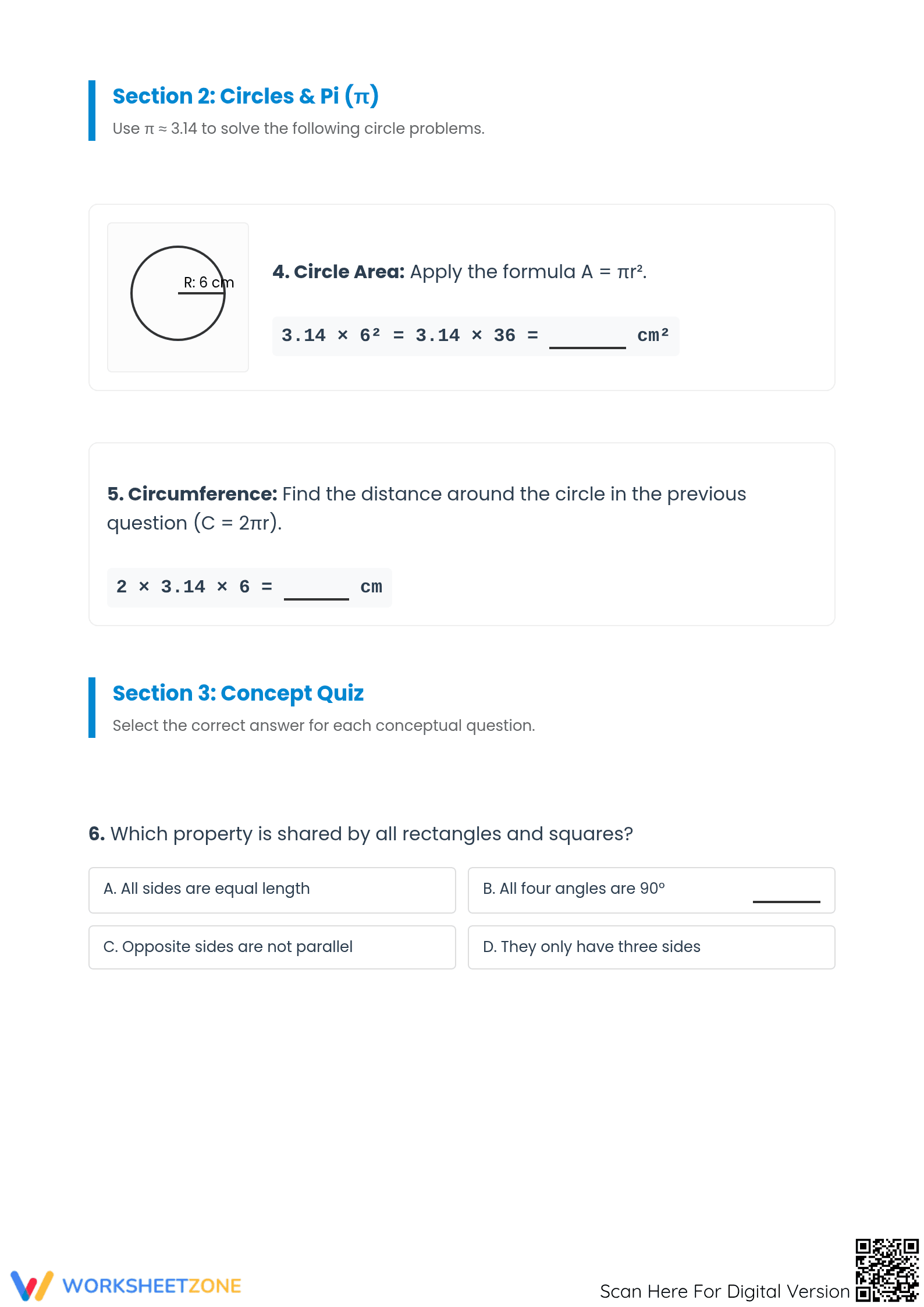
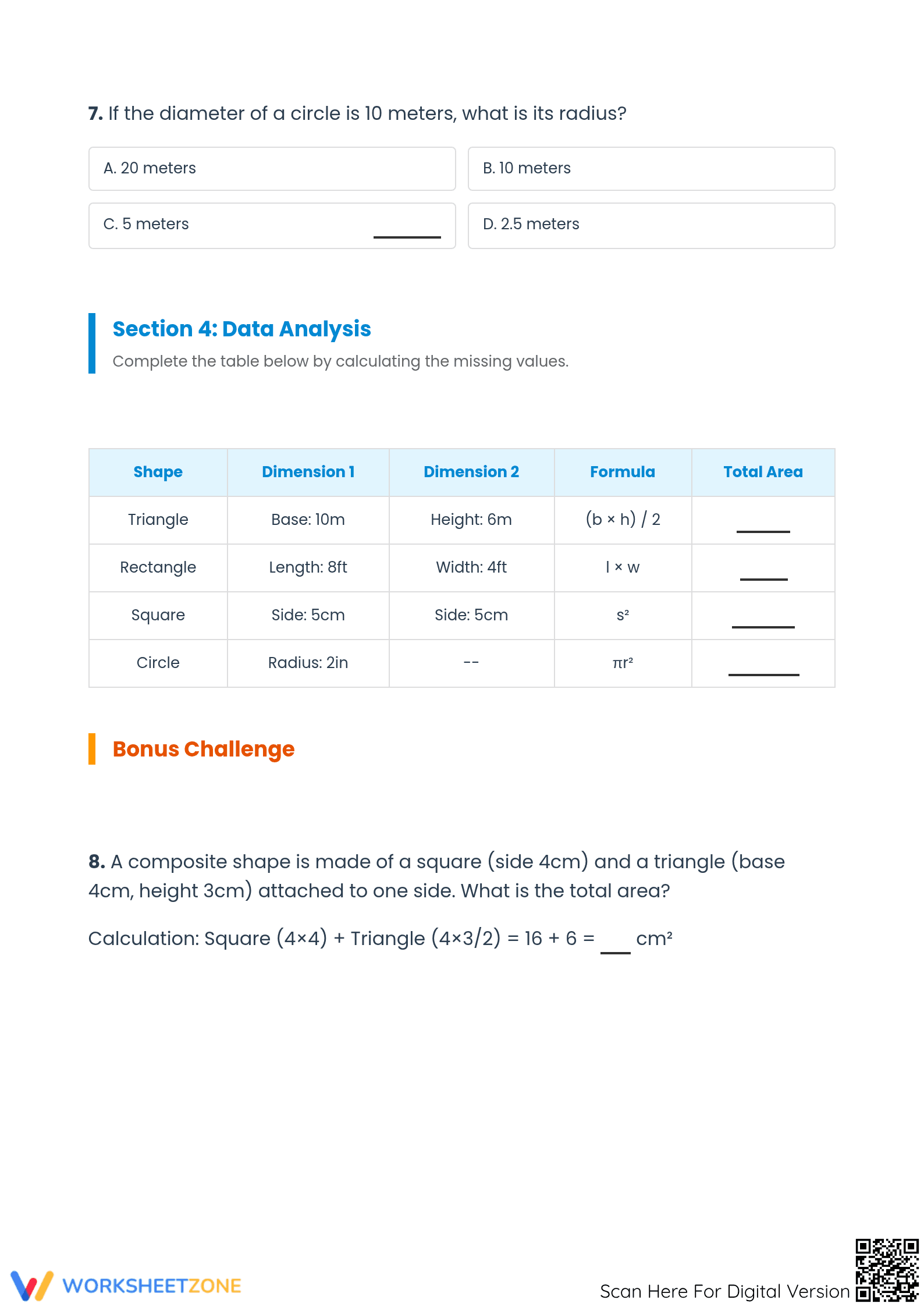
This three-page packet includes 12 tasks across four sections. Section 1 covers area for triangles and rectangles with formula scaffolds. Section 2 focuses on circles, requiring Pi applications for area and circumference. Section 3 tests conceptual properties, while Section 4 uses a data table to challenge formula synthesis. A bonus composite shape problem is included.
The assessment maps tasks to proficiency tiers: Section 1 represents "Meeting" expectations for polygon area. The Concept Quiz and Data Analysis sections evaluate "Exceeding" levels by requiring property identification and variable manipulation. Results facilitate progress monitoring for standards-based reporting and can be used to track specific growth in geometric reasoning.
The primary focus is `6.G.A.1`, which requires students to find the area of triangles and quadrilaterals by decomposing into simpler shapes. The worksheet also provides a bridge to `7.G.B.4` through circle calculations. Both standard codes can be copied directly into lesson plans, IEP goals, or district curriculum mapping tools.
Use this assessment as a summative post-test following a unit on geometry. It is best administered during a focused block to allow students time for the composite shape challenge. For formative observation, watch for transition errors from polygons to circles, which often indicate a need for further modeling of operations.
This resource is ideal for Grade 6 general education or Grade 7 students requiring review. The inclusion of guided formulas makes it highly effective for students with IEPs or those in intervention groups who benefit from gradual release. Pair this with a reference sheet for students still mastering recall.
According to the RAND AIRS 2024 study on mathematics instructional materials, structured assessments that transition from guided calculation to conceptual synthesis significantly improve long-term retention of geometric principles. This Grade 6 geometry worksheet aligns with research suggesting that explicit formula scaffolding, as seen in Section 1, supports cognitive load management during initial mastery phases. By integrating circle properties (6.G.A.1) with real-world data analysis, the tasks reflect the rigor required for NAEP proficiency levels in measurement. Educational analysis from ScienceDirect TpT Analysis (2024) highlights that multi-page assessments featuring conceptual checkpoints allow teachers to identify specific misconceptions regarding shape properties before students move to complex composite area problems. This evidence-based design ensures that the assessment serves not just as a grading tool, but as a diagnostic map for identifying where student understanding of spatial relationships and area calculations might be fractured, allowing for targeted instructional interventions.


