


























Views
Downloads

Printable Fast or Slow Sorting Worksheet | Grade 1
Paste this activity's link or code into your existing LMS (Google Classroom, Canvas, Teams, Schoology, Moodle, etc.).
Students can open and work on the activity right away, with no student login required.
You'll still be able to track student progress and results from your teacher account.
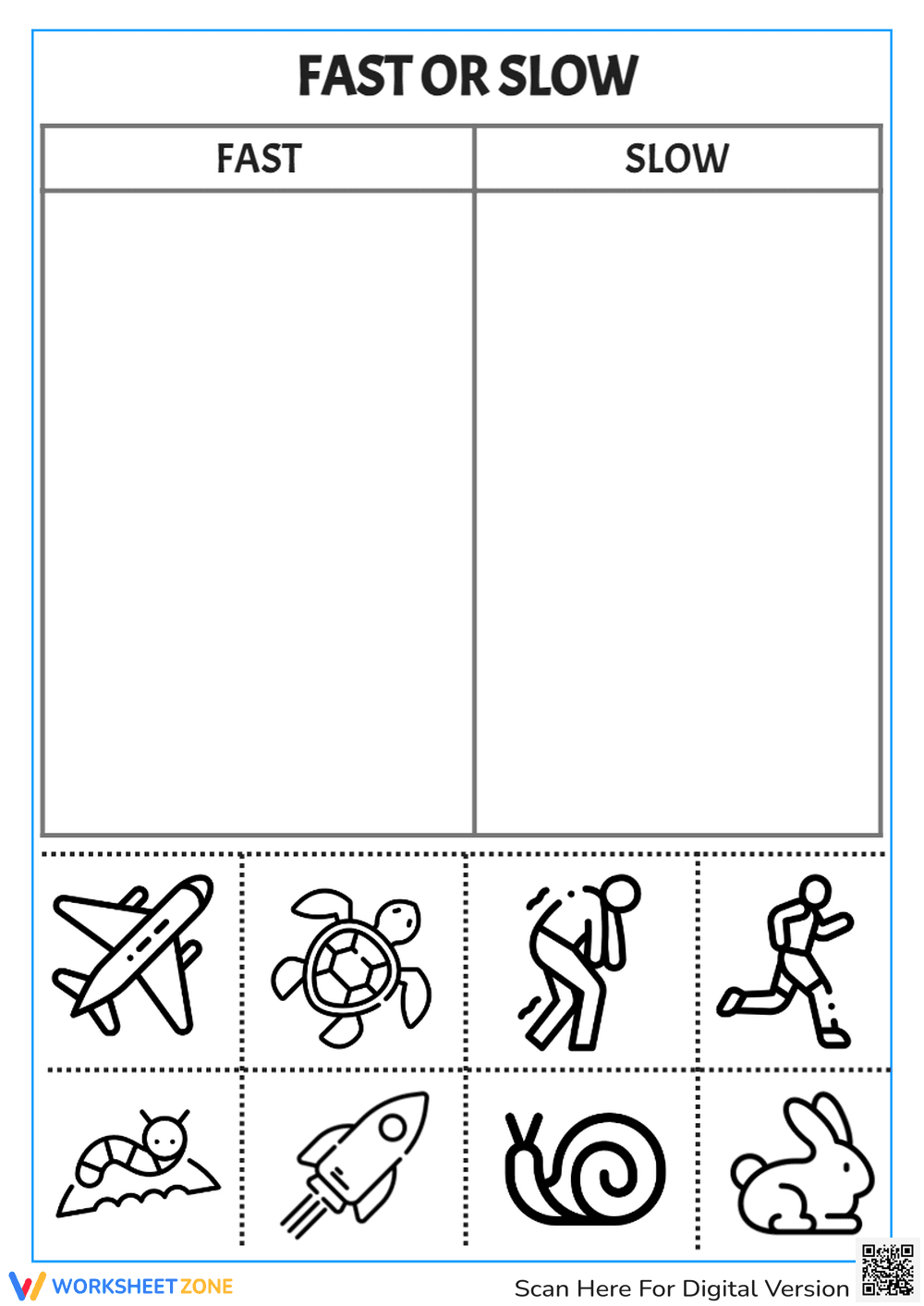
This printable science and ELA worksheet helps first-grade students master basic adjectives and physical properties by sorting objects by speed. Students cut, categorize, and paste eight distinct illustrations into "fast" or "slow" columns. This hands-on activity builds critical vocabulary and classification skills, providing immediate visual reinforcement of opposing concepts.
At a Glance
- Grade: Grade 1 · Subject: Science and English Language Arts
- Standard:
CCSS.ELA-LITERACY.L.1.1.F— Use frequently occurring adjectives to describe speed and motion.- Skill Focus: Sorting fast and slow objects
- Format: 1 page · 8 sorting tasks · Answer key included · PDF
- Best For: Early finisher activities or science centers
- Time: 15–20 minutes
This single-page PDF features a clean, two-column graphic organizer labeled "FAST" and "SLOW" alongside eight dotted-line cut-out boxes. Each box contains a clear, high-contrast line art illustration representing a fast or slow entity, including an airplane, turtle, runner, snail, and rocket. The simple layout minimizes visual distractions, making it highly accessible for young learners developing fine motor skills.
Zero-Prep Workflow
This resource requires less than 2 minutes of total teacher preparation time. First, print the single-page PDF for each student in your class. Second, distribute the sheets along with scissors and glue sticks, allowing students to independently cut and sort the items. Finally, review the completed charts as a whole group or use the provided answer key for rapid grading. This straightforward layout makes the activity an excellent option for emergency substitute plans or morning work.
Standards Alignment
This activity aligns directly with the Common Core State Standard CCSS.ELA-LITERACY.L.1.1.F, which requires students to use frequently occurring adjectives. Additionally, it supports NGSS physical science concepts related to describing the motion of objects. Both standard codes can be copied directly into lesson plans, IEP goals, or district curriculum mapping tools.
How to Use It
Use this worksheet as a quick formative assessment following a direct instruction lesson on descriptive words. Alternatively, place it in a science center to reinforce lessons on speed and motion. During the activity, observe students as they sort the turtle and snail to assess their understanding of slow movement. The entire task takes approximately 15 to 20 minutes to complete.
Who It's For
This worksheet is designed for first-grade students learning basic adjectives, but it also serves as an excellent intervention tool for second graders needing vocabulary reinforcement. English language learners will benefit from the clear visual cues that pair words with concrete images. Pair this activity with a read-aloud book about animal speeds or a physical science anchor chart.
This educational resource targets CCSS.ELA-LITERACY.L.1.1.F by prompting students to classify objects using the frequently occurring adjectives "fast" and "slow." By engaging in this tactile sorting task, first-grade students develop essential categorization skills that bridge science and language arts. According to research by Fisher & Frey (2014) on the gradual release of responsibility, structured sorting activities serve as an effective bridge between guided instruction and independent application. The worksheet uses clear visual representations to scaffold vocabulary acquisition, helping young learners connect abstract descriptive terms to concrete physical properties. This method ensures that students build a robust foundation in both grammar and basic physics concepts. Teachers can confidently integrate this evidence-based activity into their daily curriculum to support diverse learning needs and track student progress toward mastery of foundational language standards.


