





























Paste this activity's link or code into your existing LMS (Google Classroom, Canvas, Teams, Schoology, Moodle, etc.).
Students can open and work on the activity right away, with no student login required.
You'll still be able to track student progress and results from your teacher account.


Farm to Feast: The Complete Food Supply Chain

Paste this activity's link or code into your existing LMS (Google Classroom, Canvas, Teams, Schoology, Moodle, etc.).
Students can open and work on the activity right away, with no student login required.
You'll still be able to track student progress and results from your teacher account.
This Grade 3 economics worksheet guides elementary learners to sequence the agricultural supply chain from initial field planting to household dining. Students examine how raw crops transform into everyday meals while identifying the essential community workers who cultivate, inspect, transport, and distribute food across regional markets.
At a Glance
- Grade: 3 · Subject: Social Studies
- Standard: State Social Studies Standards — Trace food production steps and worker roles from farm to table
- Skill Focus: Food supply chain sequencing and worker roles
- Format: 2 pages · 14 problems · Answer key included · PDF
- Best For: Grade 3 economics and community workers
- Time: 25–35 minutes
What's Inside
The 2-page student activity features 14 sequential questions structured into three distinct instructional formats. Learners begin with a word-bank timeline detailing crop cycles, advance to matching specialized economic roles, and conclude with analytical cause-and-effect questions and constructed responses. A complete 2-page answer key provides clear exemplar explanations for rapid grading.
Skill Progression
- Guided Practice: In Part A, students use a provided word bank to identify 4 missing stages across a 6-step chronological sequence from spring planting to home cooking.
- Supported Practice: In Part B, learners complete 6 matching prompts connecting community labor roles—such as harvesters, food inspectors, and truck drivers—to their specific operational duties.
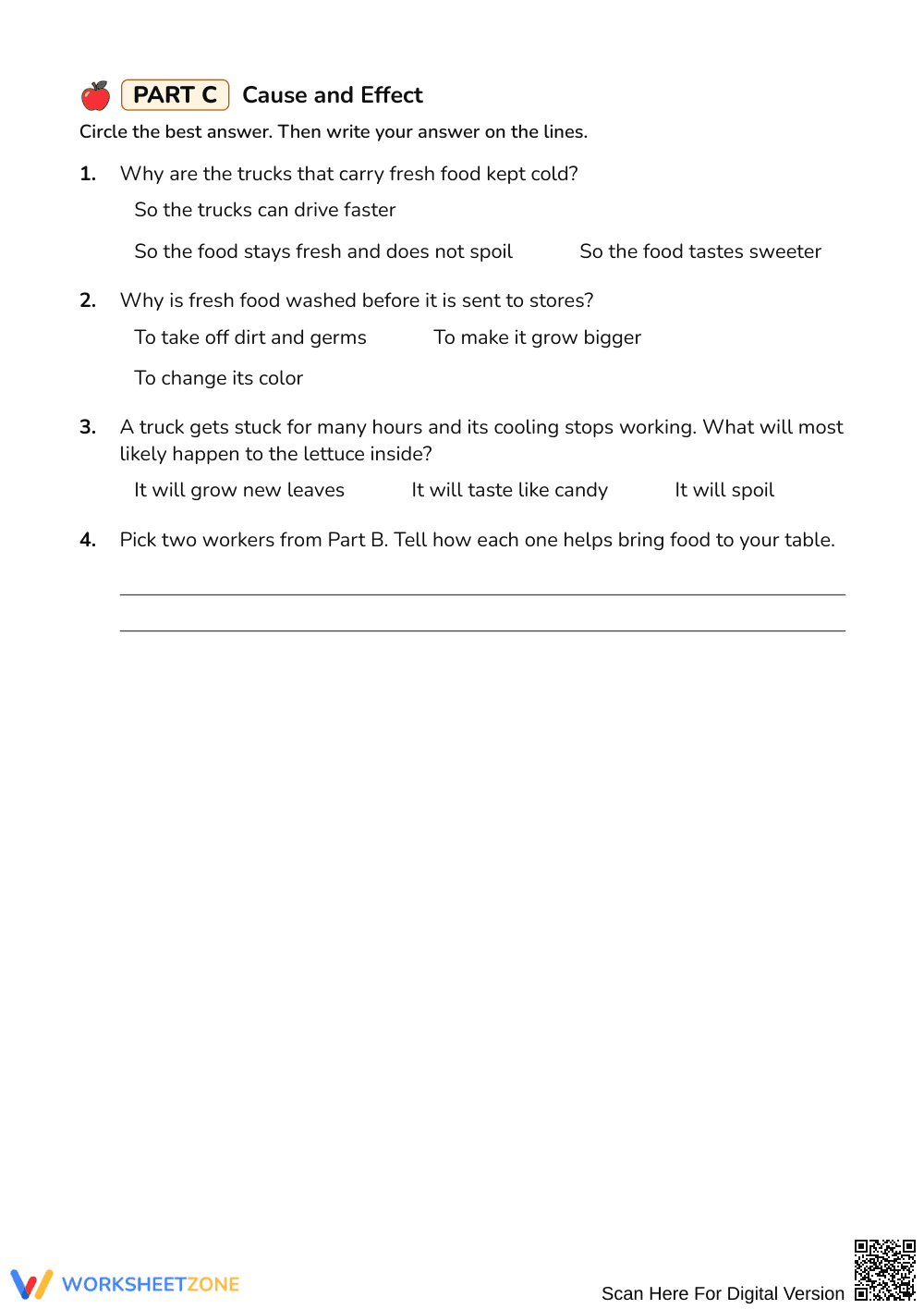
- Independent Practice: In Part C, students solve 4 critical-thinking problems, including 3 multiple-choice questions exploring cold trucking and crop sanitation, followed by an open-ended written synthesis.
This structured progression reflects the gradual release model, guiding third-grade students from basic recall toward independent economic reasoning.
Standards Alignment
This resource aligns with Grade 3 state social studies economics standards requiring students to explain how goods move from producers to consumers and identify the specialized labor involved in local and regional trade. Supporting social studies standards address how transportation and processing maintain food safety across modern supply networks. Both standard codes can be copied directly into lesson plans, IEP goals, or district curriculum mapping tools.
How to Use It
Deploy this worksheet during the active practice phase of an economics unit following direct instruction on producers, consumers, and goods. Alternatively, assign it after an interactive read-aloud as an independent formative check. During individual completion, circulate to observe whether students connect refrigerated transportation to spoilage prevention. Typical completion requires 25 to 35 minutes of instructional time.
Who It's For
This activity supports general education third graders learning foundational economics, English language learners benefiting from embedded word banks, and students needing structured social studies intervention. Pair this worksheet naturally with an informational text on modern agriculture or a classroom anchor chart displaying community helper occupations.
According to Fisher & Frey (2014), structured instructional scaffolds that transition students systematically from guided sequencing to independent analytical writing build durable conceptual knowledge in elementary content areas. This Grade 3 economics worksheet establishes that developmental bridge as students trace the six primary stages of the food supply chain and categorize specialized economic occupations. By ordering agricultural milestones, evaluating distribution logistics like refrigerated freight, and explaining how harvesters, inspectors, and grocers coordinate labor, learners demonstrate a thorough understanding of how producers deliver essential goods to household consumers. Grounding early social studies curriculum in observable community supply chains reinforces practical economic reasoning while expanding expository comprehension. The included two-page format and complete answer key allow educators to document student mastery of production systems effectively, ensuring young learners connect foundational economic principles directly to everyday community functions and real-world dining tables.


