


























Views
Downloads
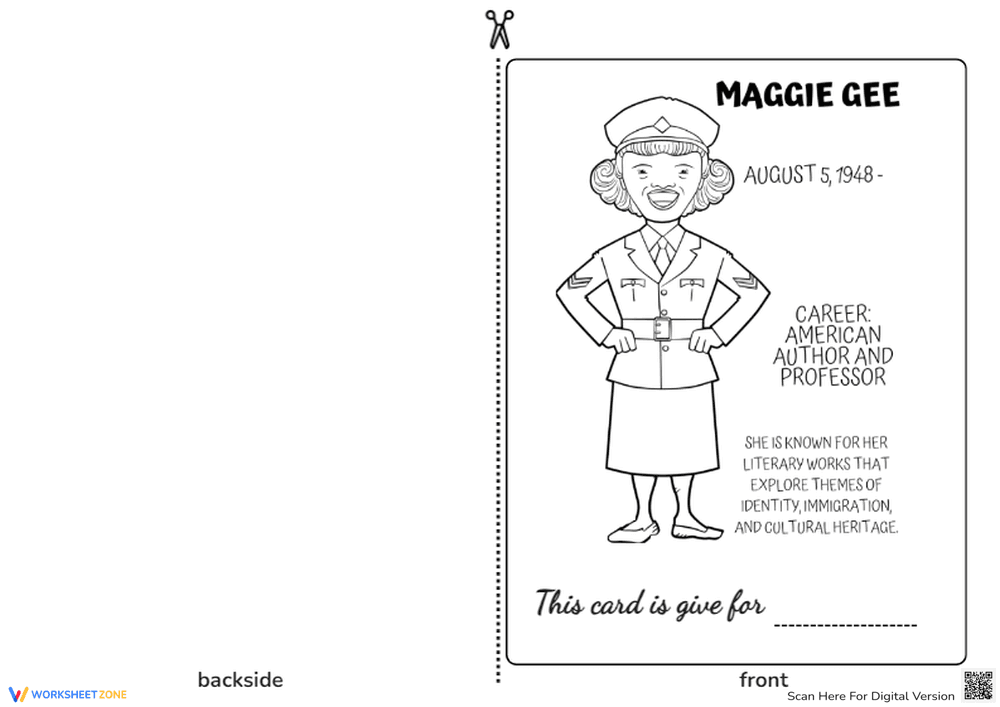

AAPI Heritage Month Maggie Gee Card | Printable Grade 2
Paste this activity's link or code into your existing LMS (Google Classroom, Canvas, Teams, Schoology, Moodle, etc.).
Students can open and work on the activity right away, with no student login required.
You'll still be able to track student progress and results from your teacher account.
Celebrate Asian American and Pacific Islander Heritage Month with this engaging Maggie Gee greeting card. This activity allows students to learn about the influential American author and professor while practicing fine motor skills through coloring and cutting. It provides a meaningful way for young learners to connect with AAPI history and share their knowledge with others through a personalized gift.
At a Glance
- Grade: 2 · Subject: Social Studies
- Standard:
CCSS.ELA-LITERACY.RI.2.1— Identify key details about a historical figure in a biographical text- Skill Focus: AAPI Heritage & Biography
- Format: 1 page · 3 tasks · No answer key required · PDF
- Best For: Seasonal AAPI Heritage Month classroom activities
- Time: 15–20 minutes
This single-page PDF features a foldable greeting card design. The front includes a high-quality line-art illustration of Maggie Gee, her birth date, career title, and a brief summary of her literary contributions regarding identity and cultural heritage. It includes a "This card is give for" line for personalization and clear "front" and "backside" labels to guide assembly. The layout is optimized for standard printer paper, ensuring the fold lines align perfectly for a professional look.
Teachers can implement this activity in under 2 minutes of preparation. First, print the required number of 1-page copies for the class. Second, distribute the sheets along with crayons and scissors. Third, students spend approximately 15 minutes coloring the illustration and reading the biographical facts before folding the card. This makes it an ideal "grab-and-go" resource for busy mornings, transition periods, or emergency sub plans during the month of May.
The primary standard addressed is CCSS.ELA-LITERACY.RI.2.1, which requires students to ask and answer questions about key details in a text. By engaging with the card's text, students identify who Maggie Gee was and why she is significant to American literature. This standard code can be copied directly into lesson plans, IEP goals, or district curriculum mapping tools to document cultural competency and literacy instruction.
Use this card as a concluding activity after a read-aloud about AAPI pioneers. It serves as a formative assessment to see if students can identify the person's career and impact. Expected completion time is 20 minutes. For an added challenge, have students write one additional fact they learned about AAPI heritage on the blank "backside" before folding to deepen the learning experience and practice informative writing.
This resource is designed for students in Grades 1 through 3. It is particularly effective for visual learners and students who benefit from kinesthetic activities like cutting and folding. It pairs naturally with a classroom anchor chart featuring various AAPI leaders or a library display of Maggie Gee's literary works. The simple language makes it accessible for English Language Learners who are building their biographical vocabulary.
This AAPI Heritage Month resource utilizes the CCSS.ELA-LITERACY.RI.2.1 standard to introduce students to Maggie Gee, an influential American author. By combining biographical reading with a creative greeting card format, the worksheet supports the development of historical empathy and reading comprehension. According to Fisher & Frey (2014), integrating visual arts with informational text helps younger students retain key details and improves engagement with complex social studies topics. The 1-page design ensures that the cognitive load remains focused on the biographical content rather than complex assembly. This printable activity provides a structured way for educators to meet diversity requirements in the curriculum while maintaining high standards for literacy. It is a practical tool for fostering inclusive classroom environments during Asian American and Pacific Islander Heritage Month and beyond, providing a tangible artifact for students to take home.


