


























Views
Downloads
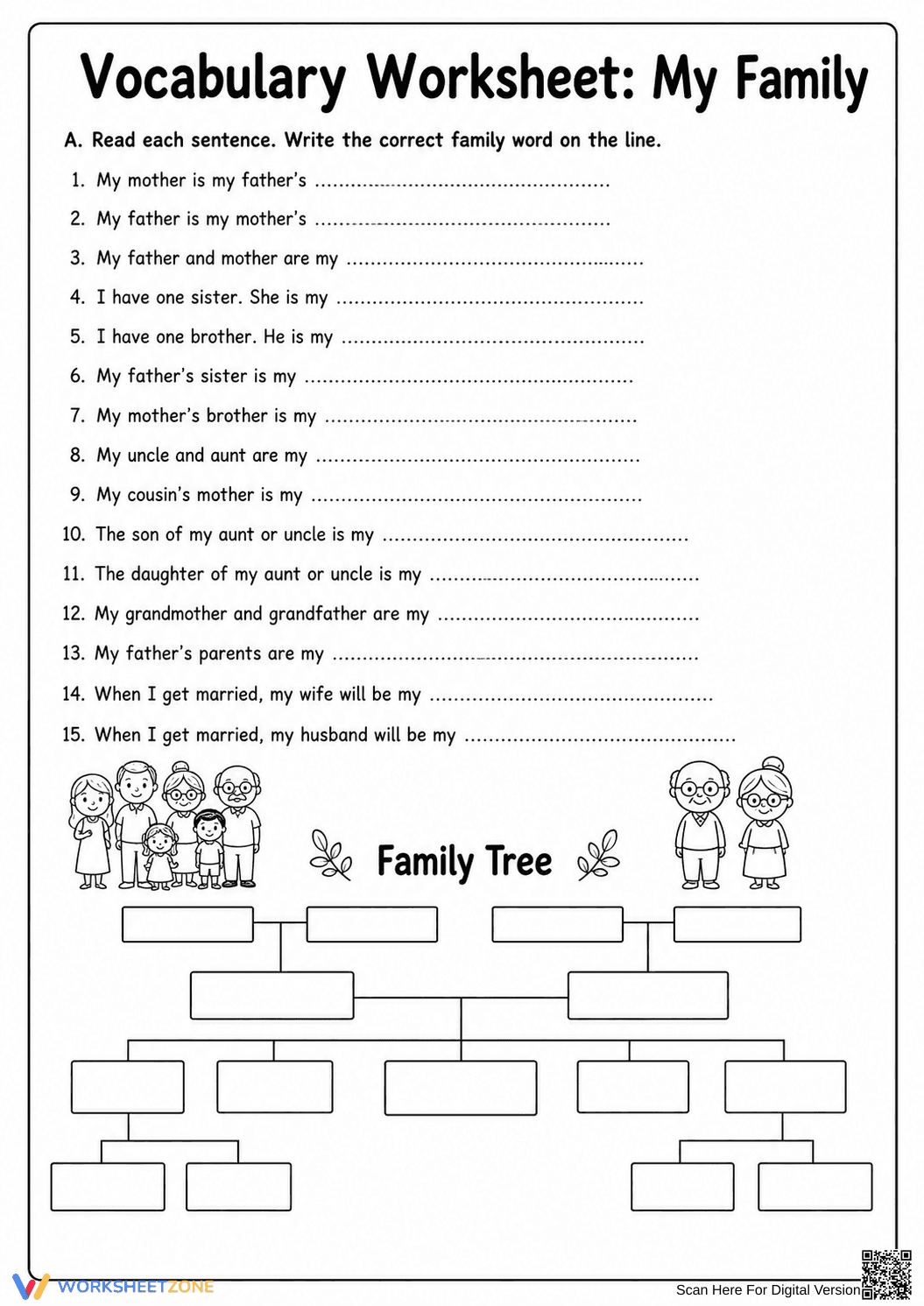

Grade 2 Family Vocabulary — Printable No-Prep Worksheet
Paste this activity's link or code into your existing LMS (Google Classroom, Canvas, Teams, Schoology, Moodle, etc.).
Students can open and work on the activity right away, with no student login required.
You'll still be able to track student progress and results from your teacher account.
This family roles vocabulary worksheet helps early elementary students master relationship terms and build reading comprehension skills. By using sentence-level context clues, learners identify correct family titles like aunt, uncle, and cousin. The activity strengthens foundational language acquisition while providing a visual framework for understanding family structures.
At a Glance
- Grade: 2 · Subject: English
- Standard:
CCSS.ELA-LITERACY.L.2.4.A— Use sentence context to determine word meaning- Skill Focus: Family vocabulary and context clues
- Format: 1 page · 16 problems · Answer key included · PDF
- Best For: Independent practice and vocabulary building
- Time: 15–20 minutes
This single-page resource features two distinct task types to reinforce vocabulary retention. The first section includes fifteen fill-in-the-blank sentences where students must deduce the correct family member based on the described relationship. The second section provides a blank family tree diagram, requiring students to map out generational connections visually. A complete answer key is provided to ensure quick and accurate grading.
Zero-Prep Workflow
- Print (1 minute): Download the PDF and print a class set. The black-and-white design is optimized for standard school copiers.
- Distribute (1 minute): Hand out the worksheet as a morning work activity, literacy center task, or independent assignment.
- Review (3 minutes): Use the included answer key to quickly check student responses or project it on the board for whole-class self-correction.
Total teacher preparation time is under two minutes, making this an excellent option for emergency sub plans or last-minute schedule changes.
Standards Alignment
This worksheet is directly aligned to CCSS.ELA-LITERACY.L.2.4.A: Use sentence-level context as a clue to the meaning of a word or phrase. It also supports foundational reading skills by requiring students to decode and comprehend relationship-based sentences. Both standard codes can be copied directly into lesson plans, IEP goals, or district curriculum mapping tools.
How to Use It
Deploy this worksheet during a social studies unit on communities or an English language arts block focused on vocabulary acquisition. It serves as an effective independent practice activity after direct instruction on family trees. As a formative assessment tip, observe which students struggle with multi-step relationship logic (e.g., "My cousin's mother is my...") to identify those needing additional vocabulary support. Expected completion time ranges from 15 to 20 minutes.
Who It's For
This resource is designed for first through third-grade students, with a primary focus on second-grade language standards. It is highly beneficial for English Language Learners (ELLs) who need explicit practice with English family terminology. Pair this worksheet with a read-aloud book about diverse families or a classroom anchor chart detailing family tree structures to maximize student comprehension.
Mastering foundational vocabulary through context is a critical component of early literacy development. This resource targets CCSS.ELA-LITERACY.L.2.4.A, requiring students to use sentence context to determine word meaning. According to Fisher & Frey (2014), explicit vocabulary instruction combined with structured independent practice significantly improves reading comprehension and expressive language skills. By integrating sentence-level context clues with a visual family tree diagram, this worksheet provides multiple modalities for encoding new terminology. The dual-format approach ensures that learners can connect abstract relationship concepts to concrete visual representations. This method not only builds immediate vocabulary recall but also strengthens the cognitive frameworks necessary for tackling more complex texts in later grades. Educators can rely on this targeted practice to support both native speakers and language learners in achieving essential literacy benchmarks.


