


























Views
Downloads

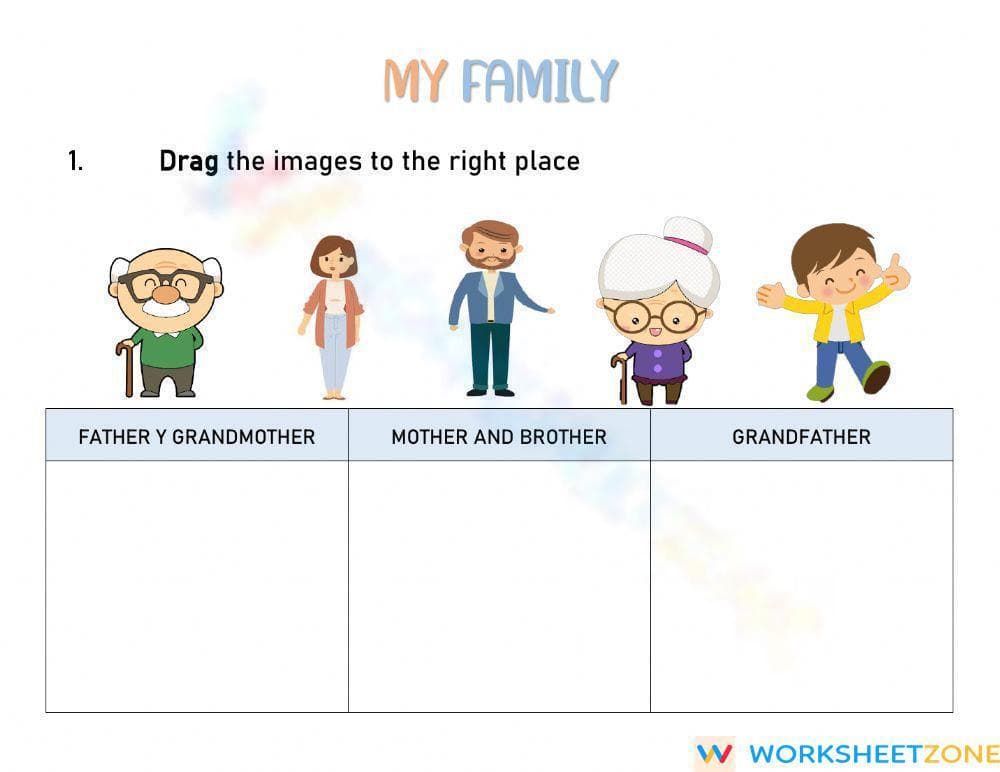



Essential Family and Face Vocabulary Worksheet | Grade 1
Paste this activity's link or code into your existing LMS (Google Classroom, Canvas, Teams, Schoology, Moodle, etc.).
Students can open and work on the activity right away, with no student login required.
You'll still be able to track student progress and results from your teacher account.
This comprehensive Grade 1 vocabulary worksheet helps students master essential terms for family members and facial features through five interactive pages. By combining visual matching, labeling, and verbal practice, students build a robust foundation in descriptive language. This resource ensures learners can accurately identify their surroundings and relationships while developing critical early literacy skills in English.
At a Glance
- Grade: 1 · Subject: ELA
- Standard:
CCSS.ELA-LITERACY.L.1.6— Use words and phrases acquired through conversations, reading, and being read to- Skill Focus: Family and Face Vocabulary
- Format: 5 pages · 24 problems · Answer key included · PDF
- Best For: Early literacy and ESL vocabulary development
- Time: 25–35 minutes
What's Inside
Inside this five-page packet, find diverse activities engaging multiple learning modalities. The first pages focus on family members like "Grandmother" and "Brother" using matching and drag-and-drop tasks. The subsequent pages transition to facial features, incorporating labeling exercises, audio pronunciation guides for listening practice, and a "Speak the missing words" section to reinforce oral fluency and conversational application.
Zero-Prep Workflow
This resource requires no teacher preparation, making it ideal for busy mornings or unexpected sub plans. Total teacher interaction time is minimal, allowing you to focus on direct student support.
- Print: Select all 5 pages and print in less than 30 seconds.
- Distribute: Hand out the packets and briefly explain the visual icons.
- Review: Use the included answer key to grade the entire set in under 2 minutes.
Standards Alignment
This worksheet is primarily aligned to CCSS.ELA-LITERACY.L.1.6, which requires students to use words and phrases acquired through conversations and responses to texts. By practicing high-frequency nouns and adjectives related to the self and family, students meet the foundational requirements for linguistic precision. Both standard codes can be copied directly into lesson plans, IEP goals, or district curriculum mapping tools.
How to Use It
Use this packet during a themed unit on "All About Me" or a lesson on social-emotional relationships. It works best as a guided activity after a read-aloud about family structures. For assessment, observe students during the "Speak the missing words" task; check if they correctly pair family members with specific facial attributes. Expect completion within 35 minutes for most first-grade learners.
Who It's For
This resource is tailored for first-grade students but is highly effective for Kindergarten enrichment or Grade 2 review. It is especially valuable for English Language Learners (ELLs) who need visual scaffolding to acquire basic conversational nouns. Pair this worksheet with a simple anchor chart of the human face or a family tree diagram to provide students with a constant visual reference.
Academic research highlights that early vocabulary acquisition regarding familiar topics like family and the body is critical for long-term reading comprehension. According to Fisher & Frey (2014), the gradual release of responsibility—moving from teacher-led modeling to independent student application—is most effective when the content is personally relevant to the learner. This Grade 1 worksheet follows that evidence-based pedagogy by transitioning from simple image matching to more complex oral production. By targeting CCSS.ELA-LITERACY.L.1.6, the activities ensure that students are not just memorizing words but are learning to use them in descriptive contexts. The multi-modal approach, including listening and speaking, addresses the needs of diverse learners and mirrors the natural way children acquire language through social interaction. Educators can confidently integrate this 24-task packet into their ELA curriculum knowing it supports the linguistic development of both native speakers and English Language Learners.


