




























0
Views
0
Downloads

0.0
0
Save
0 Likes
Share
Fall Idioms Practice Packet Worksheet
0 Views
0 Downloads

Paste this activity's link or code into your existing LMS (Google Classroom, Canvas, Teams, Schoology, Moodle, etc.).
Students can open and work on the activity right away, with no student login required.
You'll still be able to track student progress and results from your teacher account.
Information
Description
What It Is:
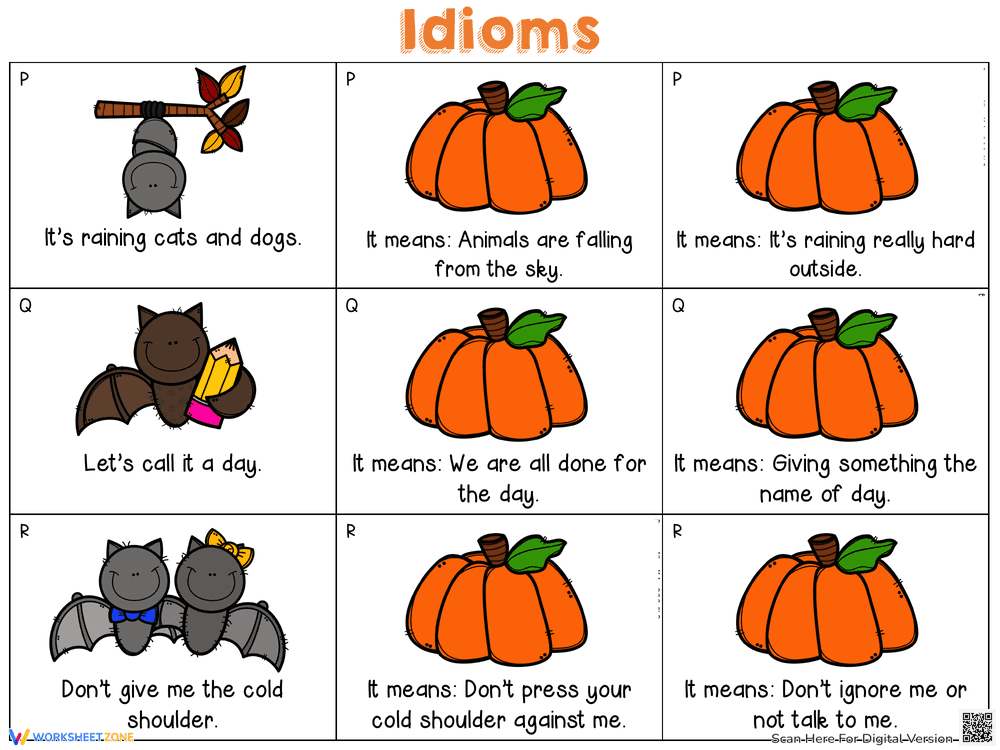
This is an educational worksheet focused on teaching idioms. It presents three idioms: 'It's raining cats and dogs,' 'Let's call it a day,' and 'Don't give me the cold shoulder.' Each idiom is represented by a cartoon image (bat and pumpkin) and is followed by two possible meanings, one correct and one incorrect. The student must identify the correct meaning of the idiom.
Grade Level Suitability:
This worksheet is suitable for grades 2-4. The idioms are common, and the visual aids help with comprehension. The activity requires reading comprehension and critical thinking skills appropriate for this age range.
Why Use It:
This worksheet helps students learn and understand common idioms. It improves vocabulary, reading comprehension, and the ability to interpret figurative language. The visual aids make learning more engaging.
How to Use It:
Students should read the idiom and look at the accompanying picture. Then, they should read both possible meanings and choose the one that accurately describes the idiom's meaning. The worksheet can be used individually or in a group setting.
Target Users:
This worksheet is designed for elementary school students, particularly those in grades 2-4, who are learning about idioms and figurative language. It's also helpful for ESL students who need to improve their understanding of English idioms.
This is an educational worksheet focused on teaching idioms. It presents three idioms: 'It's raining cats and dogs,' 'Let's call it a day,' and 'Don't give me the cold shoulder.' Each idiom is represented by a cartoon image (bat and pumpkin) and is followed by two possible meanings, one correct and one incorrect. The student must identify the correct meaning of the idiom.
Grade Level Suitability:
This worksheet is suitable for grades 2-4. The idioms are common, and the visual aids help with comprehension. The activity requires reading comprehension and critical thinking skills appropriate for this age range.
Why Use It:
This worksheet helps students learn and understand common idioms. It improves vocabulary, reading comprehension, and the ability to interpret figurative language. The visual aids make learning more engaging.
How to Use It:
Students should read the idiom and look at the accompanying picture. Then, they should read both possible meanings and choose the one that accurately describes the idiom's meaning. The worksheet can be used individually or in a group setting.
Target Users:
This worksheet is designed for elementary school students, particularly those in grades 2-4, who are learning about idioms and figurative language. It's also helpful for ESL students who need to improve their understanding of English idioms.


