


























Views
Downloads
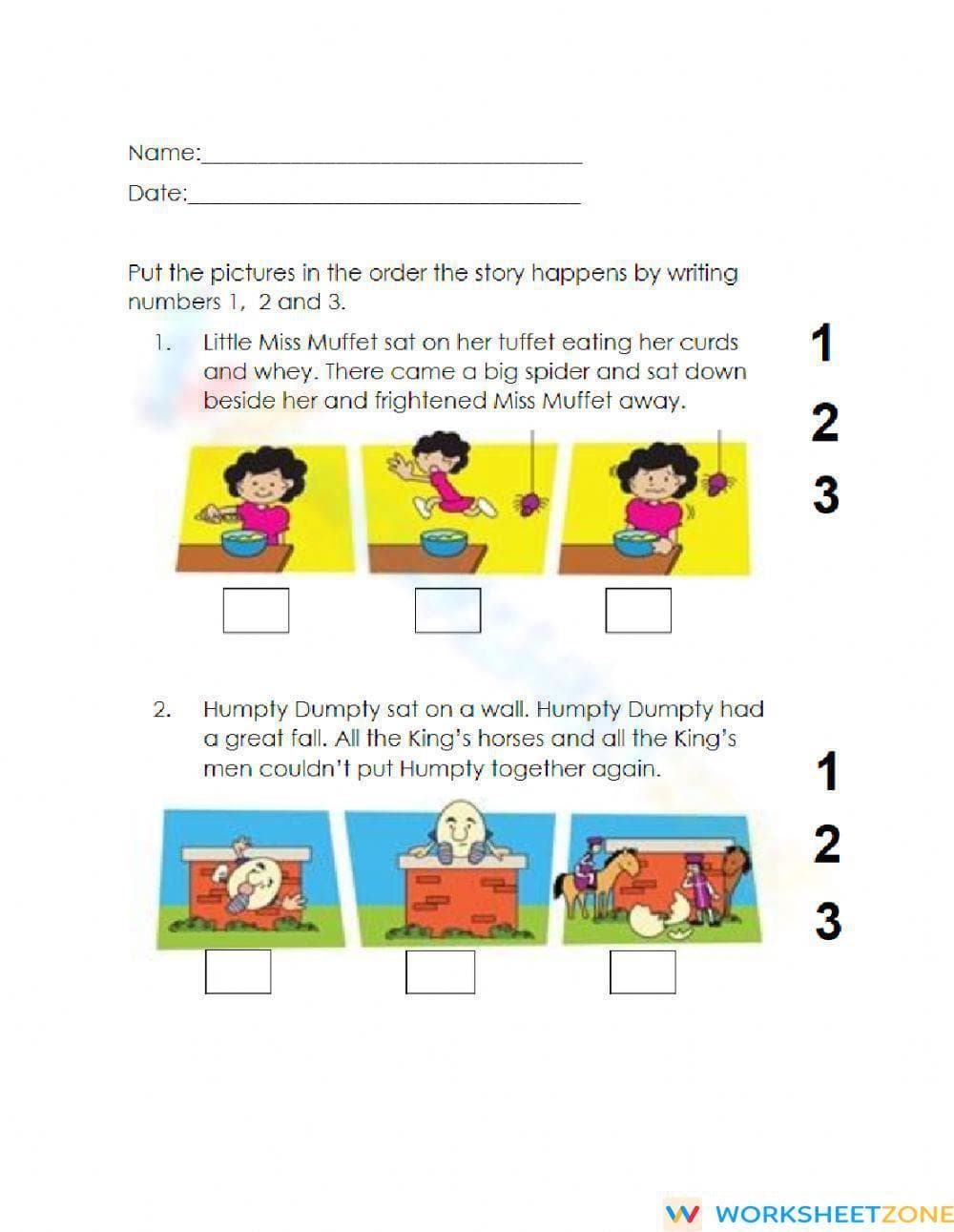

Printable Sequencing Worksheet | Grade K ELA
Paste this activity's link or code into your existing LMS (Google Classroom, Canvas, Teams, Schoology, Moodle, etc.).
Students can open and work on the activity right away, with no student login required.
You'll still be able to track student progress and results from your teacher account.
This essential worksheet helps young learners practice foundational sequencing skills using two classic nursery rhymes. Students will determine the correct order of events for "Little Miss Muffet" and "Humpty Dumpty" by numbering the pictures. It’s a perfect introduction to narrative structure and logical ordering for kindergarten-level English Language Arts.
At a Glance
- Grade: K · Subject: English Language Arts (ELA)
- Standard:
CCSS.ELA-LITERACY.RL.K.2— Retell familiar stories, including key details, with support.- Skill Focus: Sequencing Events
- Format: 1 page · 2 problems · No answer key · PDF
- Best For: Literacy centers or independent practice
- Time: 5–10 minutes
This single-page PDF features two sequencing tasks. Each task presents a well-known nursery rhyme and three accompanying illustrations. Students are prompted to write the numbers 1, 2, and 3 in the boxes below the pictures to place them in the correct story order. The clean layout and familiar content make the activity accessible for early readers.
- Guided practice: A teacher or parent can begin by reading the "Little Miss Muffet" rhyme aloud, helping the student connect the text to the first set of images.
- Supported practice: For the "Humpty Dumpty" task, the student can try to recall the rhyme on their own and match the pictures, with prompts from the teacher as needed.
- Independent practice: The simple format allows a student familiar with the rhymes to complete the worksheet independently, demonstrating their understanding of story sequence.
This progression follows a gradual release model, moving from teacher-led support to student autonomy.
This worksheet is directly aligned with Common Core standard CCSS.ELA-LITERACY.RL.K.2, which requires students, with prompting and support, to retell familiar stories, including key details. By ordering the pictures, students demonstrate a key component of retelling a story accurately. The standard code can be copied directly into lesson plans or curriculum mapping tools.
Use this resource as a small group activity after a nursery rhyme read-aloud session. It's also an effective formative assessment to check for understanding of story structure. For an independent task, place it in a literacy center with colored pencils for students to complete. The activity should take approximately 5 to 10 minutes to complete.
This worksheet is designed for kindergarten students and advanced preschoolers who are developing early literacy skills. It is particularly helpful for visual learners who benefit from picture cues. For differentiation, pair this activity with a nursery rhyme book or video to provide additional context for students who may be unfamiliar with the stories.
This sequencing activity provides focused practice on a key early literacy skill identified in the Common Core State Standards. By having students reconstruct the narrative of familiar stories, the worksheet supports the development of comprehension and logical thinking as outlined in CCSS.ELA-LITERACY.RL.K.2. Research from Fisher & Frey (2014) emphasizes the importance of guided, purposeful tasks in building foundational skills. This single-page resource allows educators to efficiently assess a student's ability to identify and order the major events in a simple story, a critical step toward more complex text analysis in later grades. The use of visuals scaffolds the task for emergent readers, making grade-level standards accessible.


