


























Views
Plays
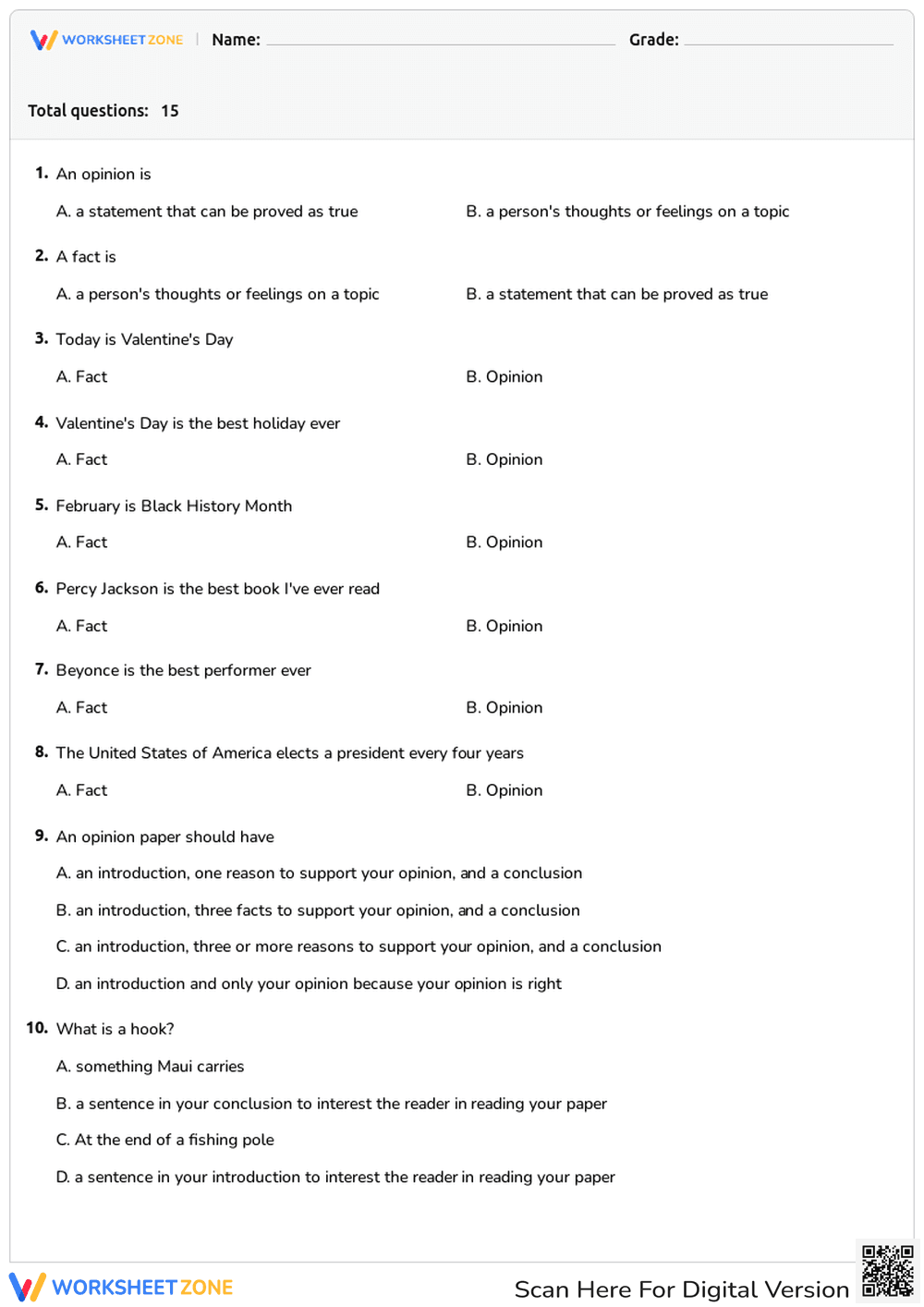


Facts and Opinions Writing Worksheet | Grade 2 Essential
Paste this activity's link or code into your existing LMS (Google Classroom, Canvas, Teams, Schoology, Moodle, etc.).
Students can open and work on the activity right away, with no student login required.
You'll still be able to track student progress and results from your teacher account.
This Grade 2 ELA worksheet helps students master the critical distinction between facts and opinions while reinforcing the structural requirements of opinion writing. By identifying evidence-based statements versus personal feelings, learners build the foundational logic necessary for persuasive composition and effective editing. This resource ensures students understand the 'why' behind their writing choices.
At a Glance
- Grade: 2 · Subject: ELA Writing
- Standard:
CCSS.ELA-LITERACY.W.2.1— Write opinion pieces with reasons, linking words, and a concluding statement- Skill Focus: Fact vs. Opinion & Essay Structure
- Format: 2 pages · 15 problems · Answer key included · PDF
- Best For: Formative assessment or writing process review
- Time: 15–20 minutes
The 2-page PDF contains 15 multiple-choice questions designed to test both conceptual knowledge and practical application. Students define key terms, categorize real-world statements (including seasonal themes like Valentine's Day and Black History Month), and identify the specific components of a successful opinion paper, such as hooks, linking words, and the importance of a plan.
Skill Progression
- Conceptual Foundation: Questions 1-2 establish clear definitions for facts and opinions to ensure vocabulary mastery before application.
- Application & Sorting: Questions 3-8 provide 6 practice scenarios where students must distinguish between provable facts and subjective feelings.
- Structural Synthesis: Questions 9-15 evaluate the student's understanding of the writing process, from initial planning to final editing and punctuation checks.
This progression follows a gradual-release model, moving from simple identification to complex structural analysis of the writing process.
Standards Alignment
This resource aligns with CCSS.ELA-LITERACY.W.2.1, which requires students to write opinion pieces that introduce a topic, state an opinion, and provide supporting reasons. It also supports editing skills found in CCSS.ELA-LITERACY.L.2.2 by emphasizing the final step of the writing process. Both standard codes can be copied directly into lesson plans, IEP goals, or district curriculum mapping tools.
How to Use It
Use this worksheet as a mid-unit check during your opinion writing block to identify students who struggle to differentiate between reasons and feelings. It also serves as an excellent pre-writing activity before students begin their own drafts. Expected completion time is between 15 and 20 minutes depending on reading level.
Who It's For
This is ideal for second-grade students, though it provides valuable review for third graders or scaffolded support for first graders. It pairs naturally with an anchor chart on persuasive writing or a mentor text focused on making arguments. It is particularly useful for students who need a clear roadmap of the writing process.
According to the RAND AIRS 2024 report, explicit instruction in text structure and the logical separation of facts from opinions significantly improves student writing quality in early elementary grades. This worksheet targets CCSS.ELA-LITERACY.W.2.1 by requiring students to recognize the 15 essential elements of a persuasive argument, including the use of linking words and the necessity of a concluding statement. By mastering these components through structured multiple-choice practice, students develop the metacognitive awareness needed to transition from reading opinions to writing them. Research from Fisher & Frey (2014) suggests that checking for understanding of these structural hooks and plans before drafting reduces cognitive load during the actual writing process. This resource provides a measurable way to track student progress toward mastery of the writing process and editing standards.


