


























Views
Downloads

Fact Families Worksheet | Grade 1 Math Printable
Paste this activity's link or code into your existing LMS (Google Classroom, Canvas, Teams, Schoology, Moodle, etc.).
Students can open and work on the activity right away, with no student login required.
You'll still be able to track student progress and results from your teacher account.
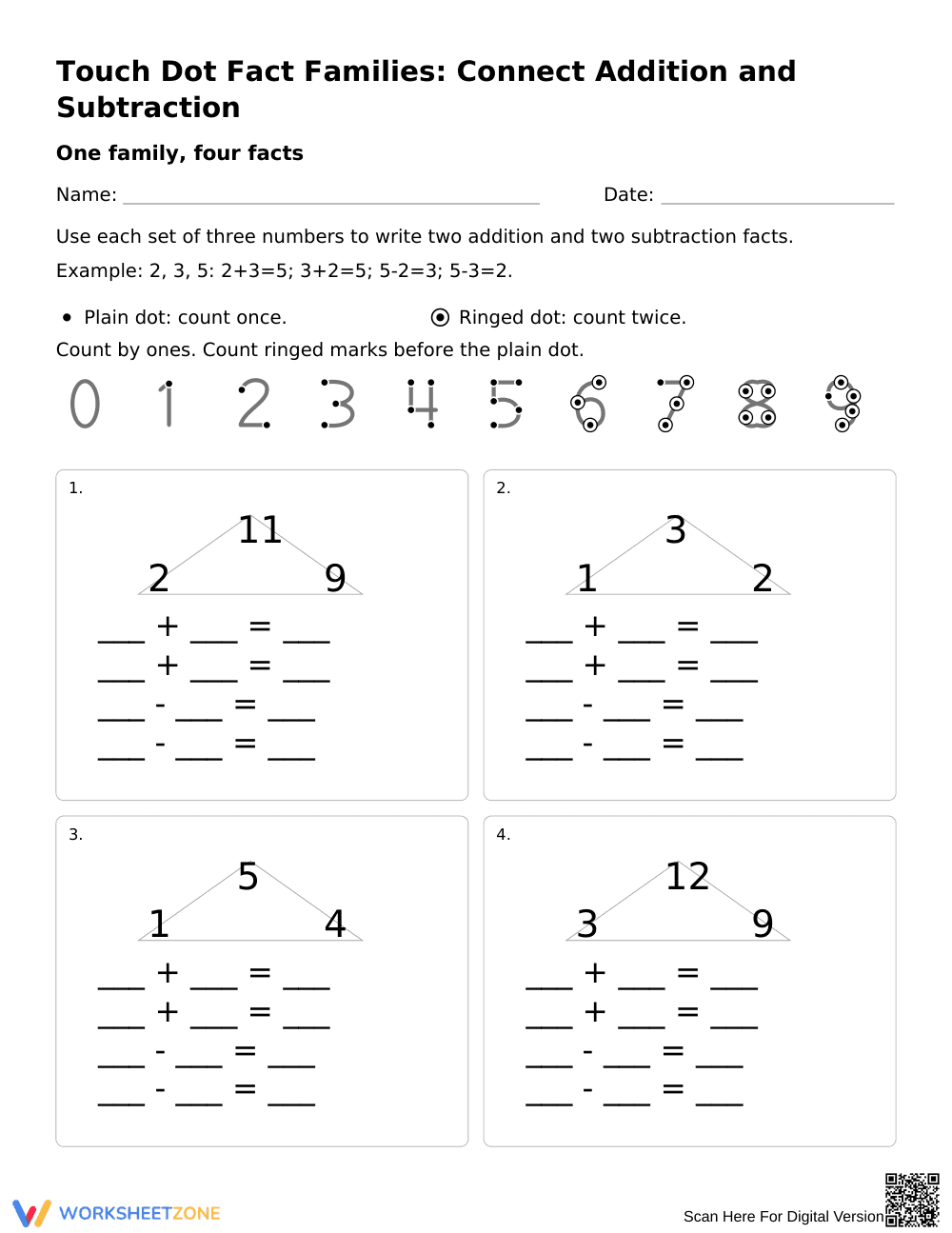
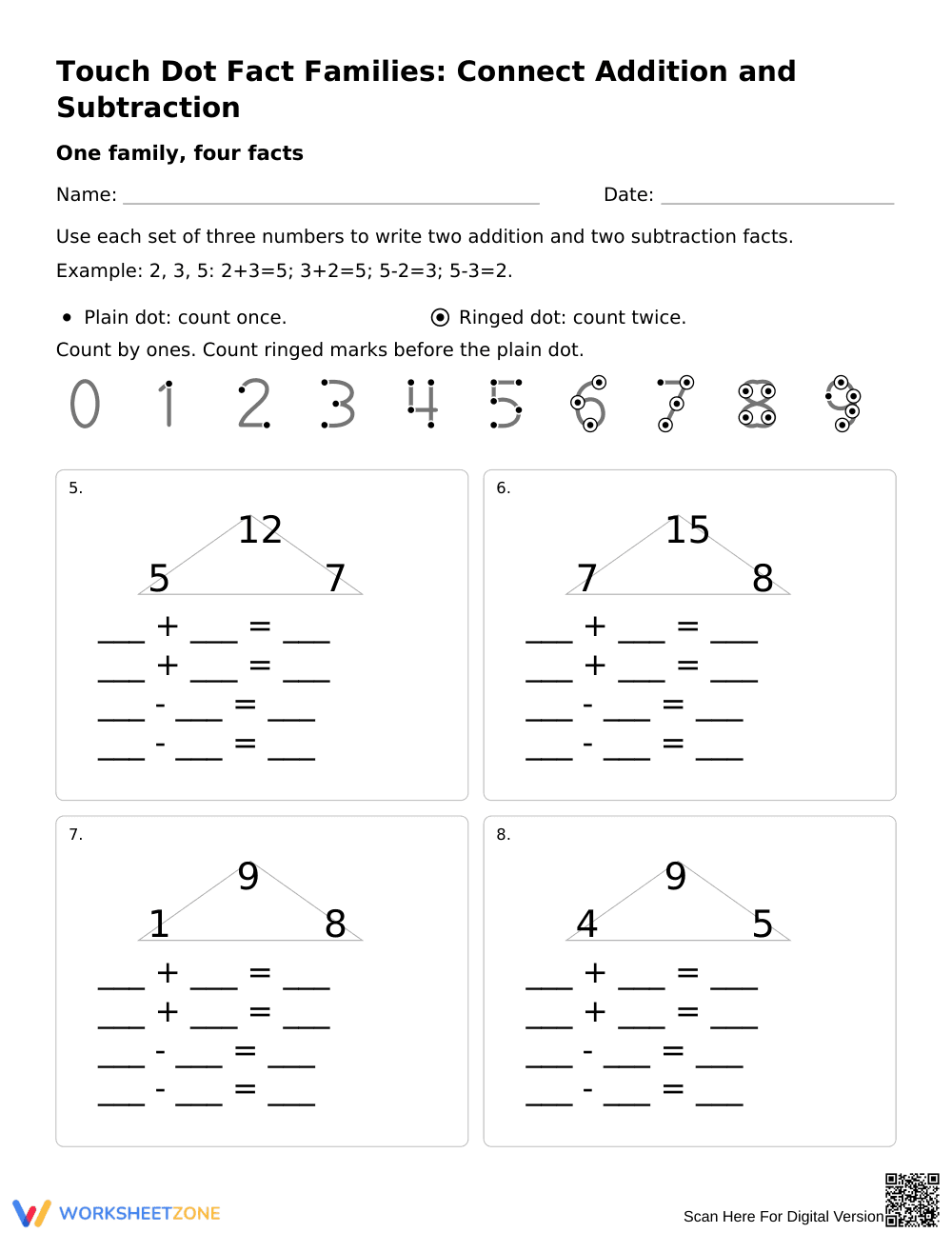
This first-grade math worksheet builds operational fluency by teaching young learners how addition and subtraction relate through fact families. Students use visual number triangles and touch dot counting cues to construct four connected equations per family, transforming abstract inverse operations into concrete, memorable mathematical relationships.
At a Glance
- Grade: 1st Grade · Subject: Early Elementary Mathematics
- Standard:
CCSS.MATH.CONTENT.1.OA.C.6— Add and subtract numbers within 20 by applying the relationship between operations- Skill Focus: Fact families, inverse operations, and touch dot computation
- Format: 2 student pages · 8 triangle problems · Complete answer key included · PDF
- Best For: Small-group guided math and targeted intervention
- Time: 20–30 instructional minutes
What's Inside
This 2-page math resource features 8 fact family triangles supported by a top-page touch dot number banner from 0 to 9. Each problem presents a three-number triangle alongside structured blanks for two addition and two subtraction equations. A 1-page answer key with all 32 equations enables rapid evaluation.
Skill Progression
- Guided practice (Problems 1–2): Students analyze basic combinations within 11, referencing the visual touch counting guide at the top of the page to track addends and totals.
- Supported practice (Problems 3–5): Learners build confidence with intermediate sums up to 12, organizing both addition combinations and corresponding subtraction facts with minimal prompting.
- Independent practice (Problems 6–8): Students independently manipulate challenging sums up to 15, verifying inverse relationships across all four equations without external scaffolding.
This systematic progression embodies the gradual-release model, moving students from guided visual counting to independent conceptual mastery of inverse arithmetic.
Standards Alignment
This activity aligns directly to primary standard `CCSS.MATH.CONTENT.1.OA.C.6`: Add and subtract within 20, demonstrating fluency for addition and subtraction within 10, using strategies such as the relationship between addition and subtraction. It also reinforces foundational standard `CCSS.MATH.CONTENT.1.OA.B.4` by showing students that subtraction can be solved as an unknown-addend problem. Both standard codes can be copied directly into lesson plans, IEP goals, or district curriculum mapping tools.
How to Use It
Implement this resource during small-group guided math after introducing fact triangles during whole-class direct instruction. As a formative-assessment check, observe whether students correctly place the largest triangle number as the minuend in both subtraction equations. Alternatively, assign it for independent practice or math centers. Students typically complete the 8 exercises in 20 to 30 minutes.
Who It's For
This worksheet serves first-grade students developing basic fact fluency and second graders needing arithmetic intervention. Integrated touch dot numerals provide multisensory access for students with dyscalculia. Pair this resource with two-color counters and ten-frame visual charts for hands-on conceptual reinforcement.
Aligned with standard CCSS.MATH.CONTENT.1.OA.C.6, this educational worksheet reinforces fact family fluency and inverse arithmetic by connecting addition and subtraction within 20. When students interact with fact triangles, they recognize that three numbers share four related mathematical statements, preventing the common error of treating addition and subtraction as isolated procedures. According to Fisher & Frey (2014), structured scaffolds that transition from guided modeling to independent application produce significant gains in conceptual retention and operational automaticity. The inclusion of touch point numerals supports diverse learners by bridging tangible counting methods with abstract equation generation. By establishing that the total remains invariant across related facts, this resource solidifies early algebraic thinking and prepares children for multi-digit computation. Educators can deploy this evidence-based tool during small-group instruction, tier-two interventions, or independent practice to ensure foundational numeracy mastery across elementary classrooms.


