


























Views
Downloads
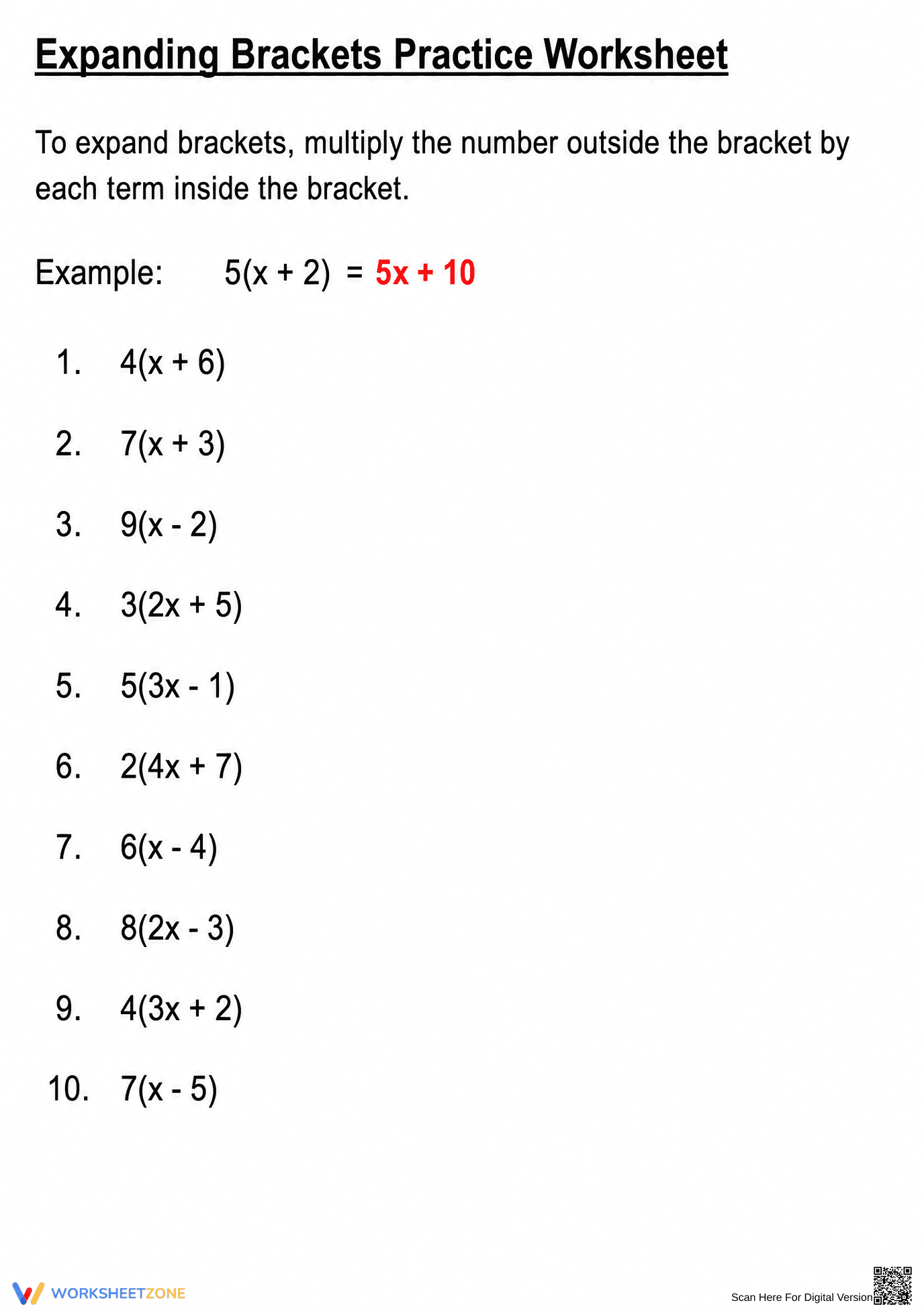

Grade 8 Expanding Brackets — Printable No-Prep Worksheet
Paste this activity's link or code into your existing LMS (Google Classroom, Canvas, Teams, Schoology, Moodle, etc.).
Students can open and work on the activity right away, with no student login required.
You'll still be able to track student progress and results from your teacher account.
This Grade 8 algebra worksheet provides focused practice on expanding brackets using the distributive property. By working through these structured problems, students will learn to multiply an outside term by every term inside the parentheses, building a strong foundation for simplifying complex algebraic expressions.
At a Glance
- Grade: 8 · Subject: Math
- Standard:
CCSS.MATH.CONTENT.7.EE.A.1— Expand linear expressions with rational coefficients- Skill Focus: Expanding brackets and distributive property
- Format: 1 page · 10 problems · Answer key included · PDF
- Best For: Independent practice and review
- Time: 10–15 minutes
What's Inside
This single-page resource features a clear, concise instructional header followed by a fully worked example demonstrating how to distribute a constant to a binomial. The core of the worksheet contains 10 targeted practice problems that gradually introduce different coefficients and operations. A complete answer key is included to facilitate quick grading and immediate student feedback.
Zero-Prep Workflow
- Print (1 minute): Simply print the PDF and you are ready for class. No special materials or advanced setup are required.
- Distribute (1 minute): Hand out the worksheet as a warm-up, homework assignment, or independent practice activity. The built-in example allows students to start working immediately.
- Review (3 minutes): Use the provided answer key to quickly check student work or project the answers on the board for self-correction. Total teacher prep time is under two minutes, making this an excellent option for emergency sub plans.
Standards Alignment
Aligned to primary standard CCSS.MATH.CONTENT.7.EE.A.1: Apply properties of operations as strategies to add, subtract, factor, and expand linear expressions with rational coefficients. It also supports foundational skills needed for Grade 8 equation solving. Both standard codes can be copied directly into lesson plans, IEP goals, or district curriculum mapping tools.
How to Use It
- Direct Instruction Follow-Up: Assign this worksheet immediately after teaching the distributive property. The clear example at the top serves as a helpful reference while students complete the 10 practice problems independently.
- Formative Assessment: Use this as a quick check for understanding. Observe whether students are remembering to multiply the outside term by both terms inside the parentheses, a common point of error. Expected completion time is 10 to 15 minutes.
Who It's For
This resource is designed for middle school math students, specifically those in Grade 8 reviewing core algebra skills or Grade 7 students learning the concept for the first time. It is easily differentiated by allowing struggling learners to use highlighters to mark the terms being multiplied. Pair this with a visual anchor chart demonstrating the distribution method for maximum impact.
Mastering the distributive property is a critical milestone in early algebra and serves as the gateway to advanced mathematical reasoning. Aligned with CCSS.MATH.CONTENT.7.EE.A.1, this resource helps students expand linear expressions with rational coefficients accurately and efficiently. According to EdReports 2024, providing students with clear, step-by-step worked examples alongside targeted, repetitive practice significantly reduces cognitive overload and improves procedural fluency in algebraic manipulation. When students practice expanding brackets through structured problem sets, they develop the necessary muscle memory for solving multi-step equations later in the curriculum. By isolating this specific skill across 10 focused problems, educators can ensure students build the automaticity required for higher-level mathematics. This targeted approach minimizes common errors, such as forgetting to distribute to the second term, and builds robust mathematical confidence.


