


























Views
Downloads
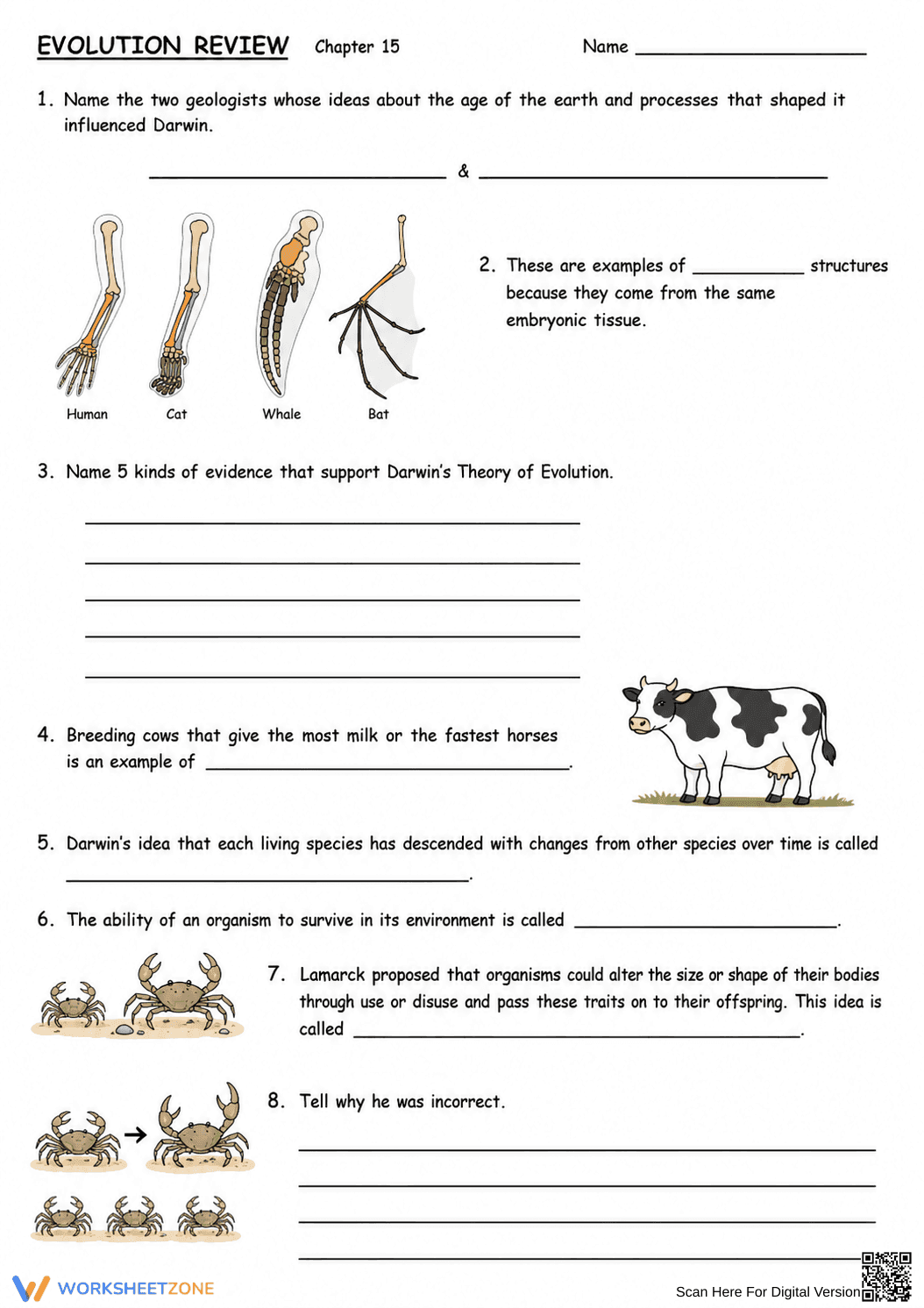

Evolution Review Worksheet | Grade 11-12 Essential Guide
Paste this activity's link or code into your existing LMS (Google Classroom, Canvas, Teams, Schoology, Moodle, etc.).
Students can open and work on the activity right away, with no student login required.
You'll still be able to track student progress and results from your teacher account.
This Grade 11-12 Biology worksheet provides a rigorous review of evolutionary mechanisms and historical scientific influences. Students demonstrate mastery by identifying key geologists, analyzing homologous structures, and contrasting Darwinian natural selection with Lamarckian theories. It ensures learners can articulate the evidence supporting common ancestry and the process of biological change over time.
At a Glance
At a Glance
- Grade: 11-12 · Subject: Biology
- Standard:
HS-LS4-1— Communicate scientific evidence supporting common ancestry and biological evolution- Skill Focus: Evolutionary Evidence & Natural Selection
- Format: 1 page · 8 problems · Answer key included · PDF
- Best For: Unit review or sub plan material
- Time: 25–35 minutes
What's Inside
This single-page PDF features 8 multi-part questions designed to assess conceptual depth. It includes visual identification of homologous structures (human, cat, whale, bat), fill-in-the-blank terminology for fitness and descent with modification, and short-answer prompts regarding artificial selection and the flaws in Lamarckian inheritance. A full answer key is provided for rapid grading.
Zero-Prep Workflow
The zero-prep workflow is optimized for busy classrooms. Print the single-page document (30 seconds). Distribute to students as an independent review or collaborative partner activity (1 minute). Use the included answer key for a whole-class review or rapid formative check (5 minutes). This makes it an ideal emergency sub plan or sub-ready instructional tool.
Standards Alignment
The primary focus is `HS-LS4-1`, which requires students to communicate scientific information that common ancestry and biological evolution are supported by multiple lines of empirical evidence. It also supports `HS-LS4-2` by examining the role of natural selection in adaptation. Both standard codes can be copied directly into lesson plans, IEP goals, or district curriculum mapping tools.
How to Use It
Assign this worksheet as a summative review after completing a unit on Darwinian theory to gauge student readiness for high-stakes assessments. Alternatively, use it as a formative check for understanding during a lecture on the history of evolutionary thought. Teachers should observe whether students can correctly distinguish between acquired traits and inherited variations. Completion typically takes 30 minutes.
Who It's For
This resource is tailored for high school Biology students, including those in Honors or AP tracks requiring a refresher on foundational concepts. It pairs naturally with a visual presentation on comparative anatomy or a primary source reading of On the Origin of Species. The clear layout supports students who benefit from structured writing prompts and visual cues.
The integration of visual evidence, such as homologous structures, alongside conceptual questions on natural selection aligns with the recommendations of Fisher & Frey (2014) regarding the importance of scaffolding complex scientific texts with graphic supports. Research from the RAND AIRS 2024 report emphasizes that high-quality, standards-aligned review materials like this `HS-LS4-1` worksheet significantly improve student retention of abstract biological concepts. By requiring students to articulate the specific evidence for evolution—including fossil records, anatomical similarities, and embryology—this resource addresses the cognitive demands of the NGSS framework. The 8 structured tasks ensure that learners move beyond rote memorization to a functional understanding of how environmental pressures drive population changes. This evidence-based approach to worksheet design facilitates the transition from direct instruction to independent mastery, providing a reliable metric for assessing student progress toward state-level science proficiency standards.


