


























Views
Downloads
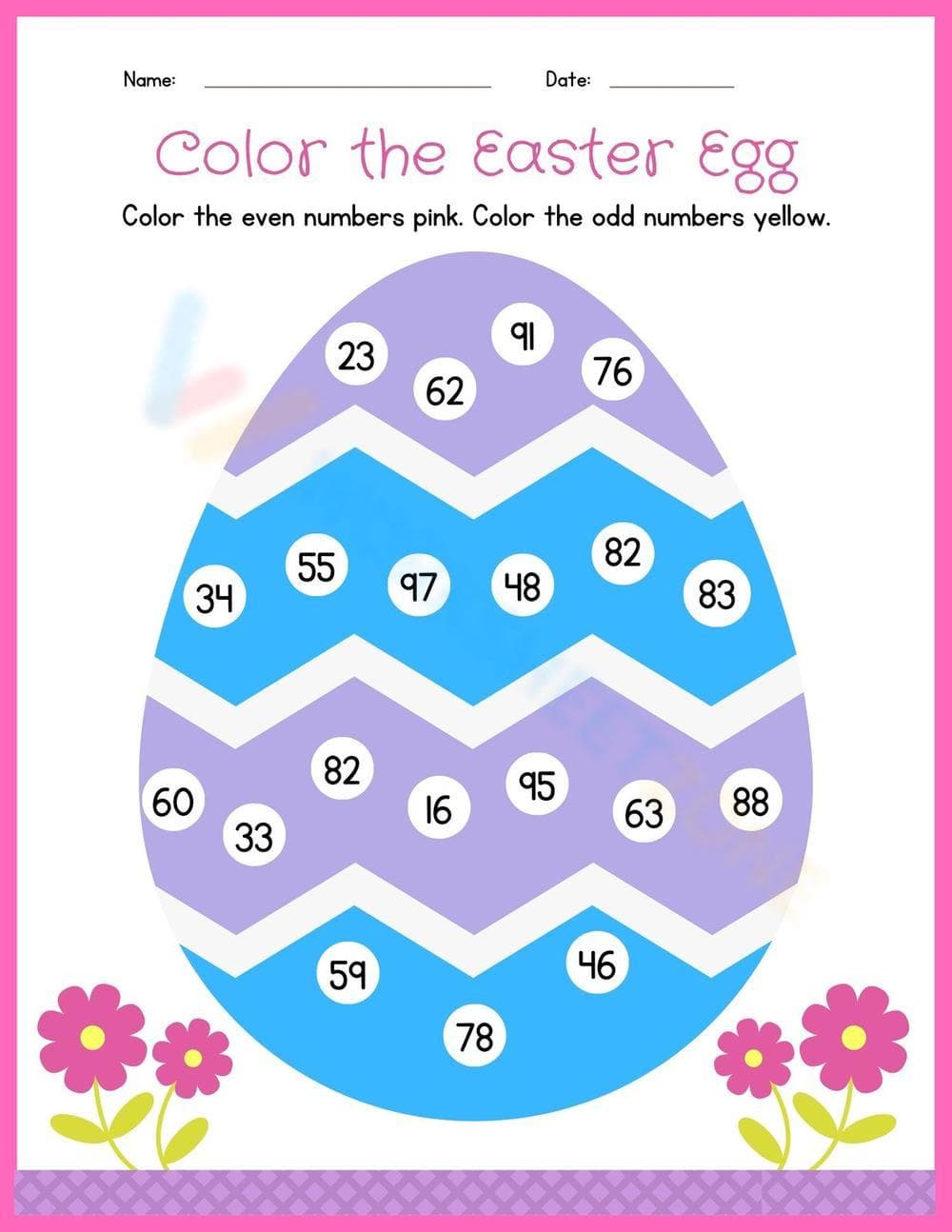

Even and Odd Numbers Printable Worksheet | Grade 2 Math
Paste this activity's link or code into your existing LMS (Google Classroom, Canvas, Teams, Schoology, Moodle, etc.).
Students can open and work on the activity right away, with no student login required.
You'll still be able to track student progress and results from your teacher account.
This Grade 2 math worksheet provides engaging practice for identifying even and odd numbers. Students evaluate two-digit numbers and apply specific colors, revealing a festive Easter egg design. This activity reinforces number sense while keeping young learners focused.
At a Glance
- Grade: 2 · Subject: Math
- Standard:
CCSS.MATH.CONTENT.2.OA.C.3— Identify odd and even numbers- Skill Focus: Even and odd number identification
- Format: 1 page · 20 problems · Answer key included · PDF
- Best For: Independent practice and morning work
- Time: 10–15 minutes
Inside this resource, educators will find a single-page coloring activity featuring a large Easter egg. Each section contains a two-digit number, totaling 20 distinct classification tasks. Students determine if the number is even or odd, then color the space pink or yellow. A complete answer key is included for rapid visual grading.
This worksheet is designed for immediate classroom implementation with a streamlined workflow:
- Print (1 minute): Generate the student copies and the visual answer key directly from the PDF file.
- Distribute (1 minute): Hand out the worksheets along with pink and yellow crayons or markers.
- Review (1 minute): Use the visual answer key to quickly check student work at a glance.
With under two minutes of total teacher preparation required, this activity is highly suitable for emergency sub plans, early finisher packets, or spontaneous skill reinforcement.
This activity is aligned to CCSS.MATH.CONTENT.2.OA.C.3, requiring students to determine whether a group of objects or a specific numeral represents an even or odd quantity. By evaluating the ones digit in two-digit numbers, students build foundational algebraic thinking skills necessary for later division concepts. Both standard codes can be copied directly into lesson plans, IEP goals, or district curriculum mapping tools.
Deploy this worksheet during independent math centers after direct instruction on even and odd numbers. The coloring format provides a calming, focused task that allows the teacher to pull small groups for targeted intervention. Alternatively, use it as a festive morning work assignment during the spring season. As a formative assessment tip, observe whether students are looking at the tens digit or the ones digit to make their determination; redirect those who are confused by the tens place. Expected completion time ranges from 10 to 15 minutes.
This resource is primarily designed for second-grade students mastering basic number properties. It serves as an excellent differentiation tool for first graders needing an advanced challenge or third graders requiring a quick review of foundational concepts. Pair this worksheet with a classroom anchor chart detailing the 0, 2, 4, 6, 8 rule for even numbers to support visual learners and students requiring additional scaffolding.
Mastering the distinction between even and odd numbers is a critical milestone in early elementary mathematics. This worksheet aligns with CCSS.MATH.CONTENT.2.OA.C.3, helping students identify odd and even numbers accurately. According to Fisher & Frey (2014), integrating academic practice with familiar, engaging formats like coloring activities significantly increases student time-on-task and reduces cognitive fatigue during independent work periods. By requiring students to evaluate twenty distinct two-digit numbers, this resource provides the repetition necessary to move this skill from working memory into long-term retention. The visual nature of the final colored product also allows educators to instantly gauge comprehension without tedious numerical grading. This targeted approach ensures that foundational algebraic thinking is solidified, preparing young learners for more complex operations such as multiplication and division in subsequent grade levels.


