


























Views
Downloads




4.NBT.A.2 Worksheet: Essential Grade 4 Math Assessment
Paste this activity's link or code into your existing LMS (Google Classroom, Canvas, Teams, Schoology, Moodle, etc.).
Students can open and work on the activity right away, with no student login required.
You'll still be able to track student progress and results from your teacher account.
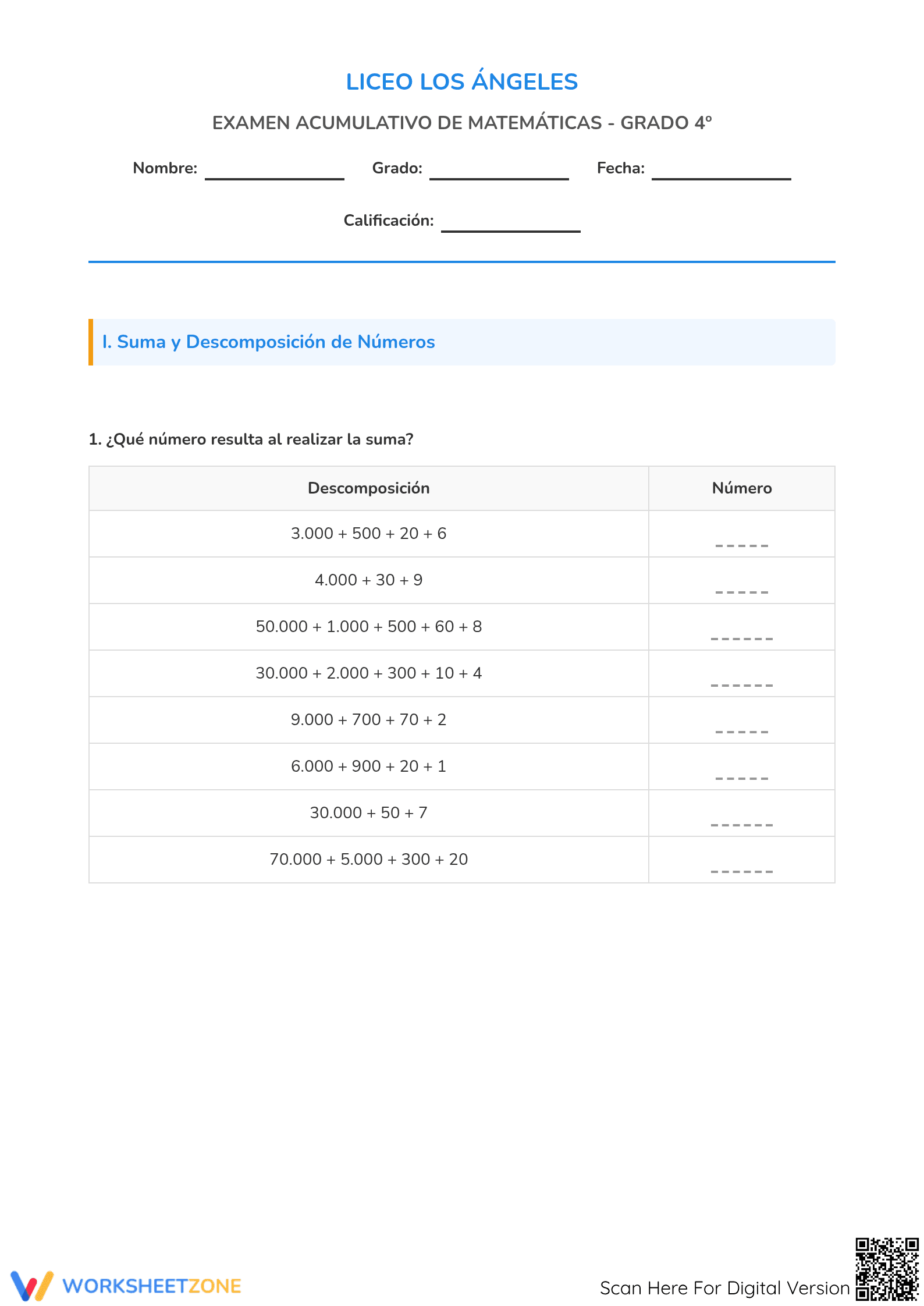
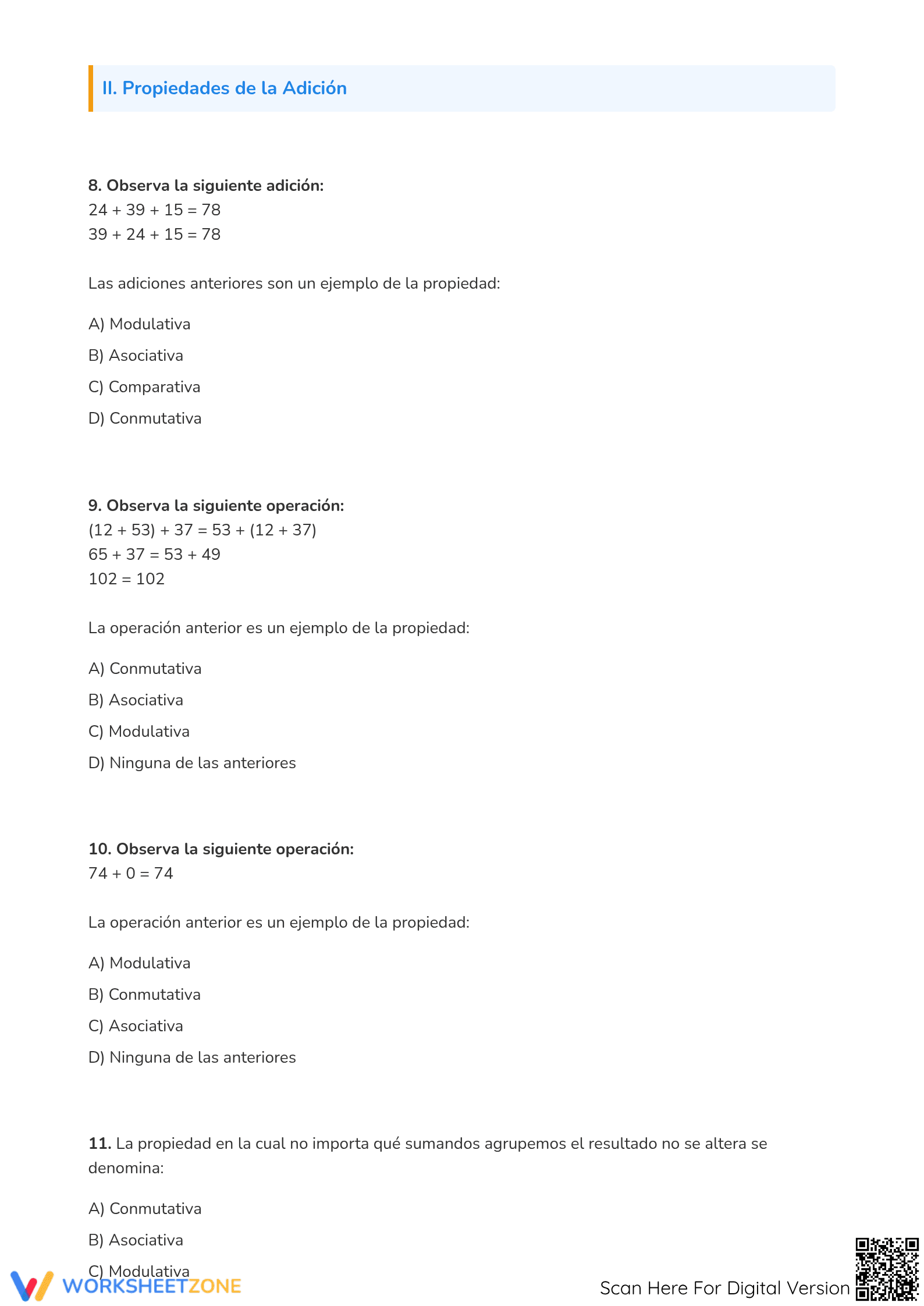
This Grade 4 math assessment provides a comprehensive evaluation of core mathematical competencies. Students demonstrate mastery in number decomposition, properties of addition, and geometric classification. By completing these 13 structured tasks, learners show their ability to manipulate multi-digit numbers and identify plane figures accurately.
At a Glance
- Grade: 4 · Subject: Math
- Standard:
4.NBT.A.2— Read and write multi-digit whole numbers using base-ten numerals and expanded form- Skill Focus: Place Value & Geometry
- Format: 5 pages · 13 problems · Answer key included · PDF
- Best For: Cumulative end-of-unit assessment or review
- Time: 45–60 minutes
The 5-page PDF includes diverse task formats such as expanded form tables, abacus visualization, numerical pattern completion, and multiple-choice questions regarding addition properties. It also features a dedicated geometry section for naming polygons and classifying triangles by sides and angles. A full answer key is provided for efficient grading.
Each task is strategically mapped to specific sub-skills required for fourth-grade proficiency. The initial sections provide evidence of place value mastery, while the middle section evaluates conceptual understanding of the commutative and associative properties. Finally, the geometry portion assesses spatial reasoning and classification skills. Scores can be entered directly into gradebooks to track student progress toward year-end goals.
This resource is primarily aligned with `4.NBT.A.2`, focusing on reading and writing multi-digit whole numbers using base-ten numerals, number names, and expanded form. It also supports `4.G.A.2` through the classification of two-dimensional figures based on the presence or absence of parallel or perpendicular lines. Both standard codes can be copied directly into lesson plans, IEP goals, or district curriculum mapping tools.
Use this as a formal summative assessment after completing units on large numbers and basic geometry. Alternatively, assign specific pages as a diagnostic tool before starting a review cycle. During administration, observe how students handle the abacus representations to identify misconceptions in place value. Expected completion time is 45 to 60 minutes.
This worksheet is designed for general education fourth-grade students, but it also serves as an excellent review for fifth graders needing reinforcement. It is particularly useful for bilingual or Spanish-speaking classrooms given the original language context. Pair this with a place value anchor chart or physical manipulatives for students requiring additional support.
This assessment aligns with the 4.NBT.A.2 standard, requiring students to demonstrate a deep understanding of the base-ten system through decomposition and expanded notation. According to the Fisher & Frey (2014) framework for intentional interest and scaffolding, cumulative assessments like this one are vital for verifying the transition from guided instruction to independent mastery. Research from EdReports 2024 emphasizes that high-quality curriculum materials must provide clear evidence of student learning across multiple domains, including algebraic thinking and geometry. By integrating 13 distinct tasks that range from visual abacus reading to abstract property identification, this worksheet ensures that educators can accurately measure student performance against national benchmarks. The inclusion of a comprehensive answer key facilitates immediate feedback, a critical component in the formative-to-summative assessment loop.


