


























Views
Downloads

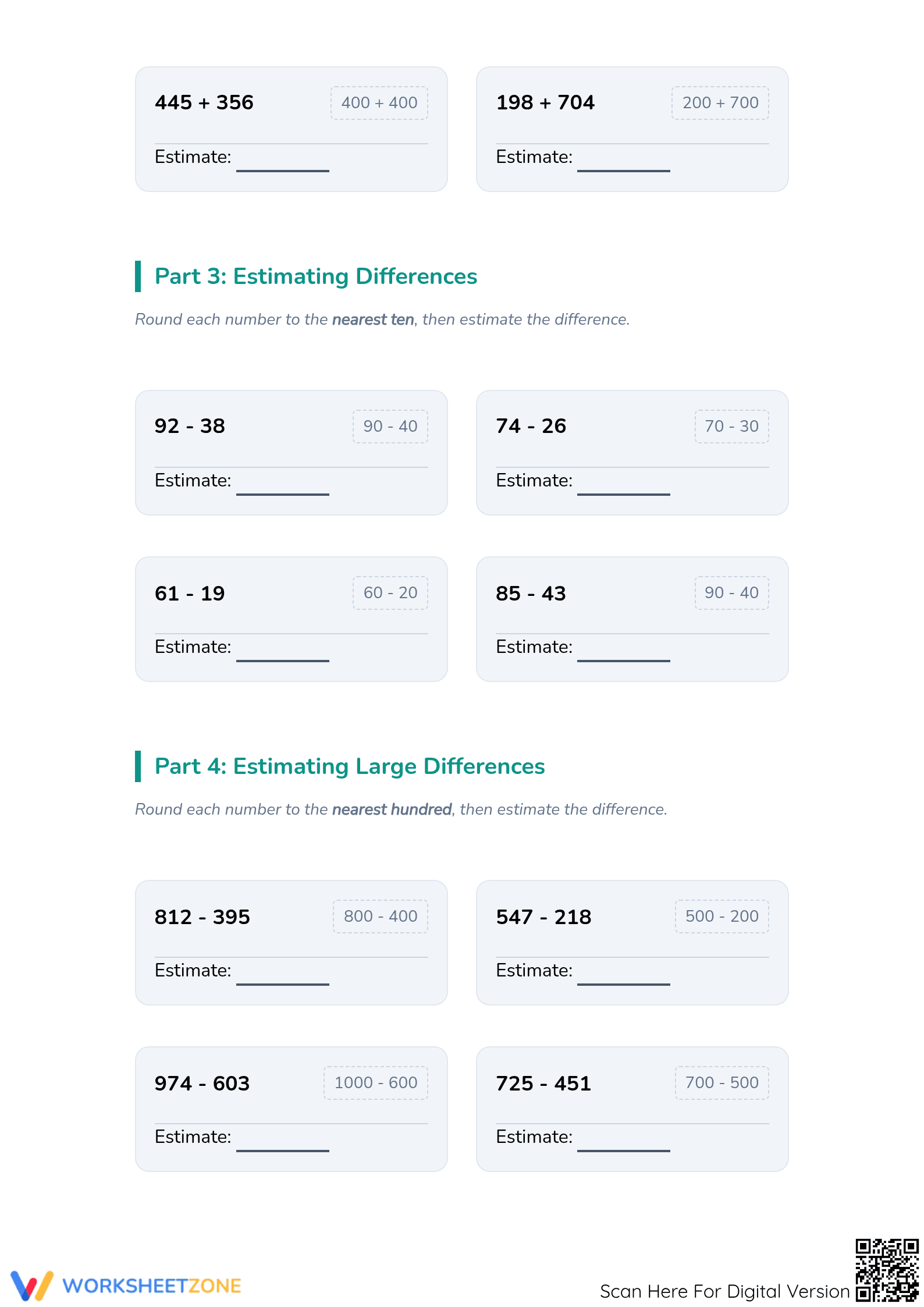



Grade 3 Estimating Sums — Printable No-Prep Worksheet
Paste this activity's link or code into your existing LMS (Google Classroom, Canvas, Teams, Schoology, Moodle, etc.).
Students can open and work on the activity right away, with no student login required.
You'll still be able to track student progress and results from your teacher account.
This essential worksheet helps third-grade students master estimating sums and differences by rounding to the nearest ten and hundred. Through a structured set of problems, learners will develop crucial mental math skills and the ability to assess the reasonableness of their calculations, a key component of mathematical fluency.
At a Glance
- Grade: 3 · Subject: Math
- Standard:
CCSS.MATH.CONTENT.3.OA.D.8— Assess the reasonableness of answers using estimation strategies.- Skill Focus: Estimating sums and differences by rounding
- Format: 4 pages · 20 problems · Answer key included · PDF
- Best For: Independent practice, homework, or formative assessment
- Time: 15–25 minutes
What's Inside
This resource includes three pages of student activities and a complete one-page answer key. The worksheet begins with 16 numerical problems where students round three-digit numbers to the nearest ten or hundred before adding or subtracting. The task complexity increases on the final page, which features four real-world word problems requiring estimation.
A Zero-Prep Workflow
Designed for busy classrooms, this worksheet is ready to use in minutes, making it an ideal resource for a substitute plan or a last-minute review activity. The workflow is simple:
- Print (1 minute): The PDF is formatted for immediate, high-quality printing. Just print the three student pages for each learner.
- Distribute (1 minute): With clear instructions on the first page, students can begin working independently as soon as they receive the worksheet.
- Review (5-10 minutes): Use the provided answer key for quick, efficient grading or to guide a whole-class review session, projecting the key for students to self-assess.
Total teacher time is minimal, allowing you to focus on instruction.
Standards-Aligned for Success
This worksheet directly supports CCSS.MATH.CONTENT.3.OA.D.8, which requires students to "assess the reasonableness of answers using...estimation strategies including rounding." It also reinforces the foundational skill of rounding to the nearest 10 and 100, as outlined in CCSS.MATH.CONTENT.3.NBT.A.1. Both standard codes can be copied directly into lesson plans, IEP goals, or district curriculum mapping tools.
How to Use This Worksheet
This versatile tool can be used as independent practice after a direct instruction lesson on rounding and estimation. It also serves as an excellent homework assignment to reinforce the concept. For formative assessment, circulate as students work on the word problems (problems 17-20), observing how they translate the scenarios into mathematical expressions and apply their estimation skills. Most students will complete the worksheet in 15 to 25 minutes.
Who It's For
This resource is designed for third-grade students who are learning or reviewing estimation strategies. The clear layout and progression from numerical problems to word problems provide a supportive structure for all learners. It pairs well with an anchor chart that visually demonstrates the rules for rounding numbers to the nearest ten and hundred, providing a reference point for students as they work.
Developing estimation skills is critical for building number sense and mathematical reasoning. This worksheet provides targeted practice aligned with CCSS.MATH.CONTENT.3.OA.D.8, where students learn to assess the reasonableness of answers. According to research highlighted by Fisher & Frey (2014), procedural fluency and conceptual understanding are intertwined; activities that connect rounding rules to practical estimation help bridge this gap. By solving 20 problems that progress from simple computation to contextual word problems, students move beyond rote memorization. They engage in strategic thinking, a practice that the RAND AIRS 2024 report confirms is essential for long-term mathematical proficiency. This resource provides a concrete way to build that proficiency, giving students a tool to check their work and make sense of numbers in real-world contexts.


