































Essential Water & Weather Word Search | Grades 6–7 ELA

Paste this activity's link or code into your existing LMS (Google Classroom, Canvas, Teams, Schoology, Moodle, etc.).
Students can open and work on the activity right away, with no student login required.
You'll still be able to track student progress and results from your teacher account.
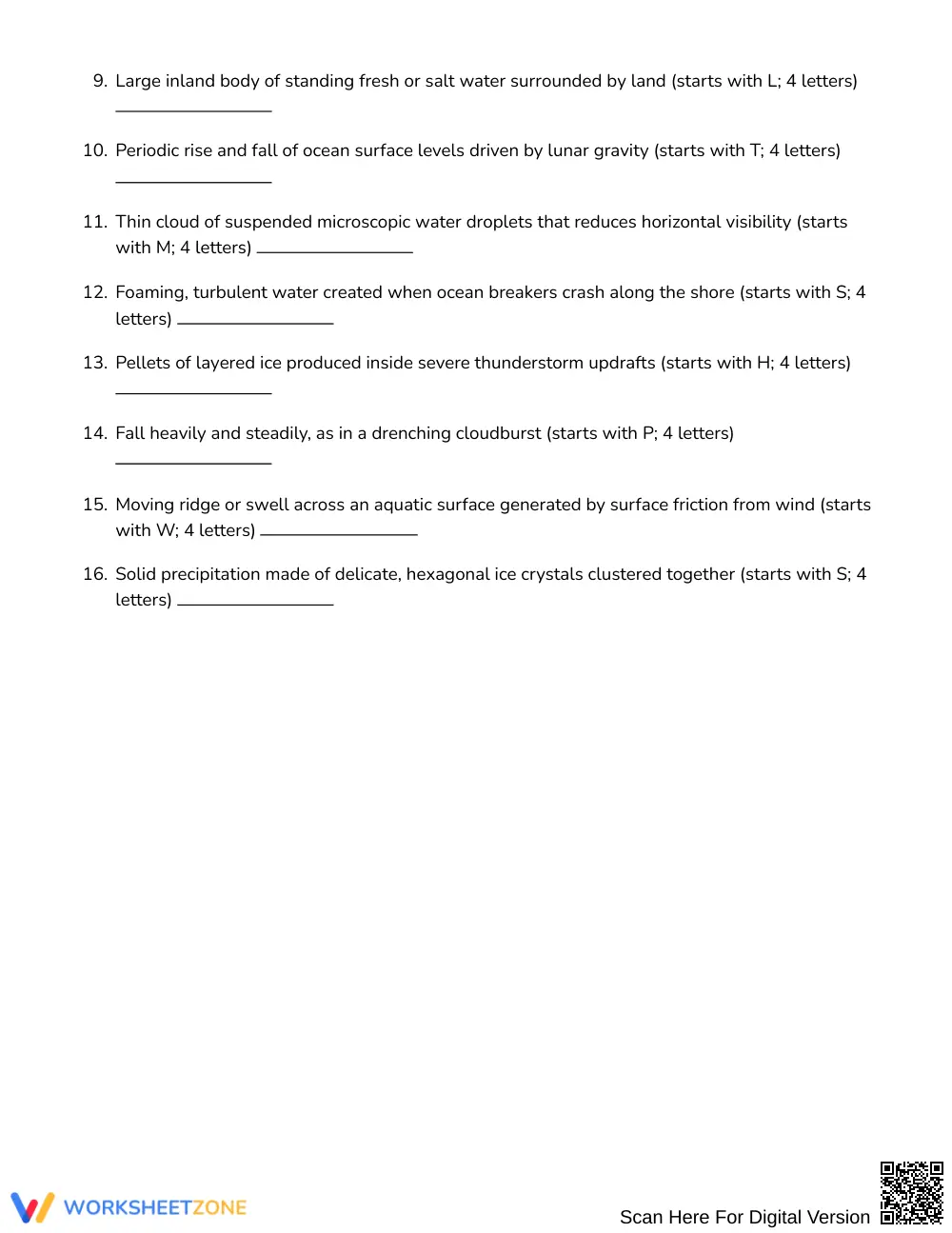
This Grades 6–7 vocabulary word search strengthens earth science and meteorological terminology through definition-based puzzle solving. Students analyze sixteen descriptive clues about water bodies and weather events, deduce each four-letter target word without a word bank, and locate every term across an eighteen-by-eighteen letter grid to reinforce precise content vocabulary.
At a Glance
- Grade: Grades 6–7 · Subject: English Language Arts (ELA) Vocabulary
- Standard: Not standards-assessed — vocabulary enrichment and contextual definition retrieval
- Skill Focus: Four-letter water and weather vocabulary terms
- Format: 3 pages · 16 words · Answer key included · Printable PDF
- Best For: Independent vocabulary enrichment, sponge activities, and early finishers
- Time: 20–30 minutes of focused puzzle solving
What's Inside
The activity spans three printable pages accompanied by a three-page full-solution answer key. Rather than displaying a standard word bank, the sheet provides sixteen concise definitions that challenge students to identify four-letter terms like gale, gust, thaw, and surf. Once students determine each word from its clue, they locate it within the puzzle.
Puzzle Structure and Mechanics
The puzzle features an 18 x 18 grid containing sixteen hidden vocabulary terms. Words are arranged across all eight compass directions: North, Northeast, East, Southeast, South, Southwest, West, and Northwest, including forward, backward, and diagonal orientations. Because no word bank is supplied, learners must rely entirely on clue comprehension and spatial scanning.
Standards Alignment
This resource is designed specifically for vocabulary enrichment and is not aligned to a formal state standard. It offers middle school learners meaningful practice connecting domain-specific definitions to earth science terminology, reinforcing spelling and reading comprehension without requiring standards-based performance reporting.
How to Use It
Deploy this activity after direct instruction on weather systems or water cycles as an engaging reinforcement exercise. Alternatively, assign it as a self-directed station during literacy rotations or for early finishers. During completion, circulate to observe whether students solve the vocabulary clues before scanning the grid or hunt randomly for letter clusters. Students typically complete the clue retrieval and letter search within 20 to 30 minutes.
Who It's For
This word search is built for Grades 6–7 English Language Arts and interdisciplinary science classrooms. Middle school learners who finish core tasks ahead of schedule will appreciate the no-bank puzzle challenge. Pair this printable with a severe weather reading passage or an anchor chart detailing precipitation types to deepen contextual vocabulary retention.
Word search activities that require clue solving prior to word retrieval promote deep semantic processing and active vocabulary acquisition. According to Fisher & Frey (2014), intentional word-learning tasks that require middle school students to generate target terms from academic definitions produce significantly greater lexical retention than passive word-matching exercises. By withholding a pre-printed word bank, this Grades 6–7 puzzle obligates learners to retrieve specialized earth science terms—such as gale, smog, and thaw—directly from semantic memory before initiating spatial letter searches. Combining definition retrieval with spatial visual scanning across an 18 x 18 grid encourages sustained cognitive engagement while preventing passive copying. Teachers utilizing this resource during ELA vocabulary blocks or interdisciplinary science rotations deliver rigorous, independent vocabulary practice that strengthens contextual comprehension and domain-specific terminology without demanding additional instructional scaffolding or teacher preparation.


