































Essential Undersea Objects Word Search | Grades 6–7 ELA

Paste this activity's link or code into your existing LMS (Google Classroom, Canvas, Teams, Schoology, Moodle, etc.).
Students can open and work on the activity right away, with no student login required.
You'll still be able to track student progress and results from your teacher account.
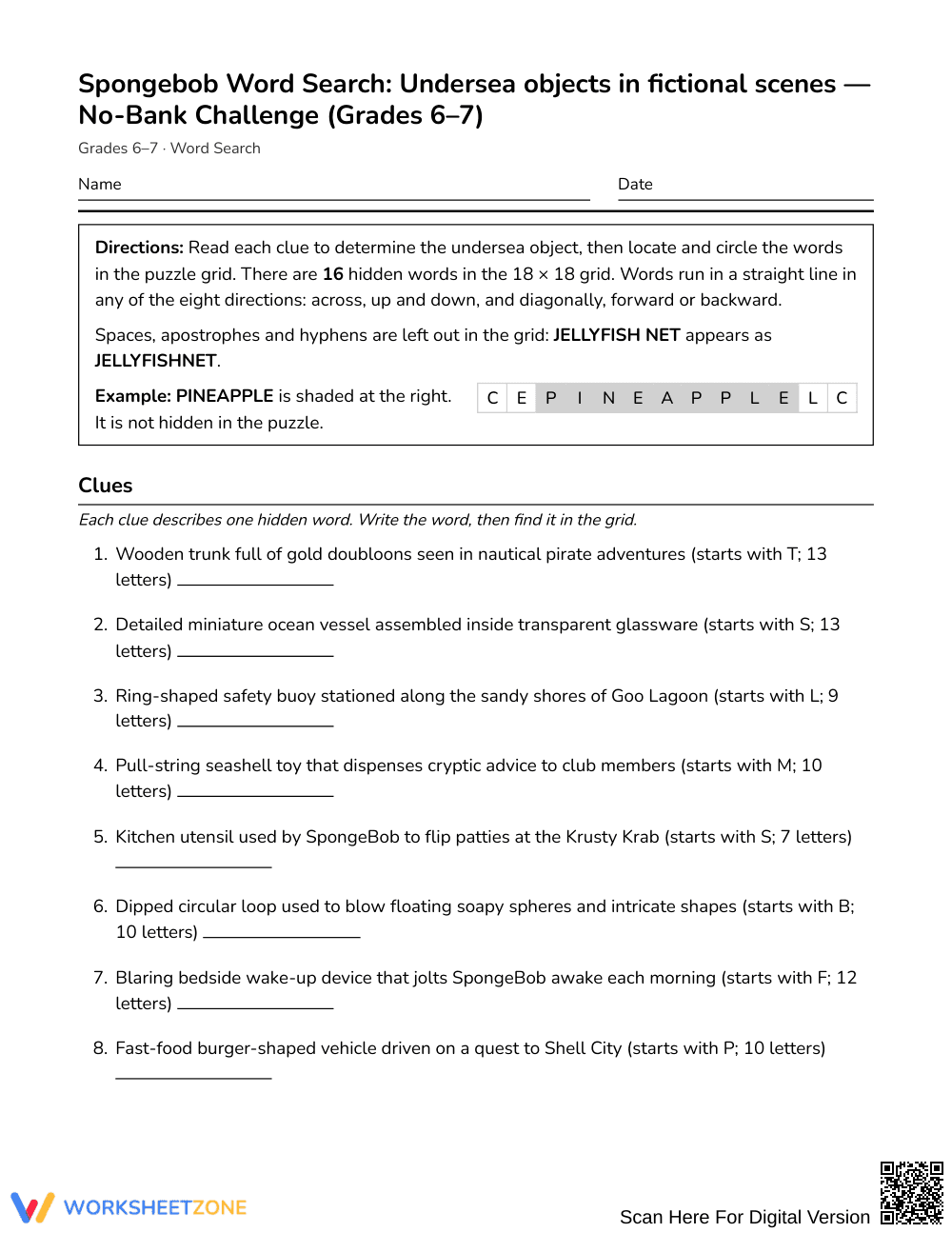
This Grades 6–7 English Language Arts word search builds vocabulary and contextual reasoning through a themed no-bank puzzle challenge. Students read 16 descriptive clues representing undersea objects in fictional scenes, infer the correct terms, and locate each word within an 18 by 18 grid to reinforce descriptive language and active recall.
At a Glance
- Grade: Grades 6–7 · Subject: English Language Arts (ELA) Vocabulary
- Standard: Not standards-assessed — vocabulary enrichment and context clue analysis
- Skill Focus: Identifying undersea objects in fictional scenes
- Format: 3 pages · 16 words · Full answer key included · Printable PDF
- Best For: Independent vocabulary review, early finishers, and engaging context clue practice
- Time: 20–35 minutes
What's Inside
This 3-page activity features an 18 by 18 letter puzzle with 16 hidden words paired with clues instead of an open word bank. Students read descriptions of fictional items—such as a boatmobile, foghorn clock, and bubble wand—to determine each term before locating it. A complete 3-page answer key highlights all letter coordinates across the grid, allowing educators and students to check answers immediately.
Puzzle Mechanics and Structure
This word search operates as an advanced clue-driven challenge designed to foster critical reading without a pre-printed word bank:
- Dense Grid Configuration: Letters populate an 18 by 18 grid, requiring visual scanning and pattern recognition.
- Full Directional Range: The 16 target words run in all eight compass directions: North, Northeast, East, Southeast, South, Southwest, West, and Northwest, including forward and reverse paths.
- Clue-Based Retrieval: Rather than matching spelled terms from a list, learners analyze clue sentences to decipher each target item before searching the grid.
Standards Alignment
This resource serves strictly as vocabulary enrichment and is not formally aligned to a standard. It supports language development by encouraging middle school readers to apply context clue strategies, verify multi-syllable spelling, and connect descriptive adjectives with precise nouns in a recreational format.
How to Use It
Deploy this activity after direct instruction on descriptive writing or context clues as an independent application. Alternatively, schedule the puzzle during station rotations or as a zero-prep sub plan. For formative assessment, observe whether students deduce the vocabulary from clue sentences before searching or rely on random scanning. Most learners complete the full search in 20 to 35 minutes.
Who It's For
This puzzle suits Grades 6–7 students strengthening reading comprehension, vocabulary retention, and spelling. For differentiated support, allow peer collaboration or provide the first letter of each identified object. Pair this word search with a creative writing task where students draft an original undersea narrative incorporating at least five of the discovered items.
According to Fisher & Frey (2014), intentional vocabulary enrichment requires students to retrieve domain-specific words through structured context clues rather than isolated rote memorization. This Grades 6–7 English Language Arts word search supports that cognitive framework by challenging learners to identify 16 undersea objects in fictional scenes without relying on a pre-printed word bank. Although designated as a non-standards assessed enrichment resource, the activity reinforces vital language mechanics including orthographic awareness, directional letter scanning, and semantic association. Students interpret functional clues—ranging from kitchen utensils to diving gear—to establish word meaning before locating targets placed across eight directional orientations in an 18 by 18 grid. By integrating playful fictional themes with analytical reading behaviors, the puzzle promotes sustained attention and active recall. Educators can implement this 3-page resource to support contextual comprehension, reward early finishers, and deepen student engagement during independent English Language Arts practice.


