




























Views
Downloads


Essential Trophic Energy Worksheet | Grade 6 Science

Paste this activity's link or code into your existing LMS (Google Classroom, Canvas, Teams, Schoology, Moodle, etc.).
Students can open and work on the activity right away, with no student login required.
You'll still be able to track student progress and results from your teacher account.
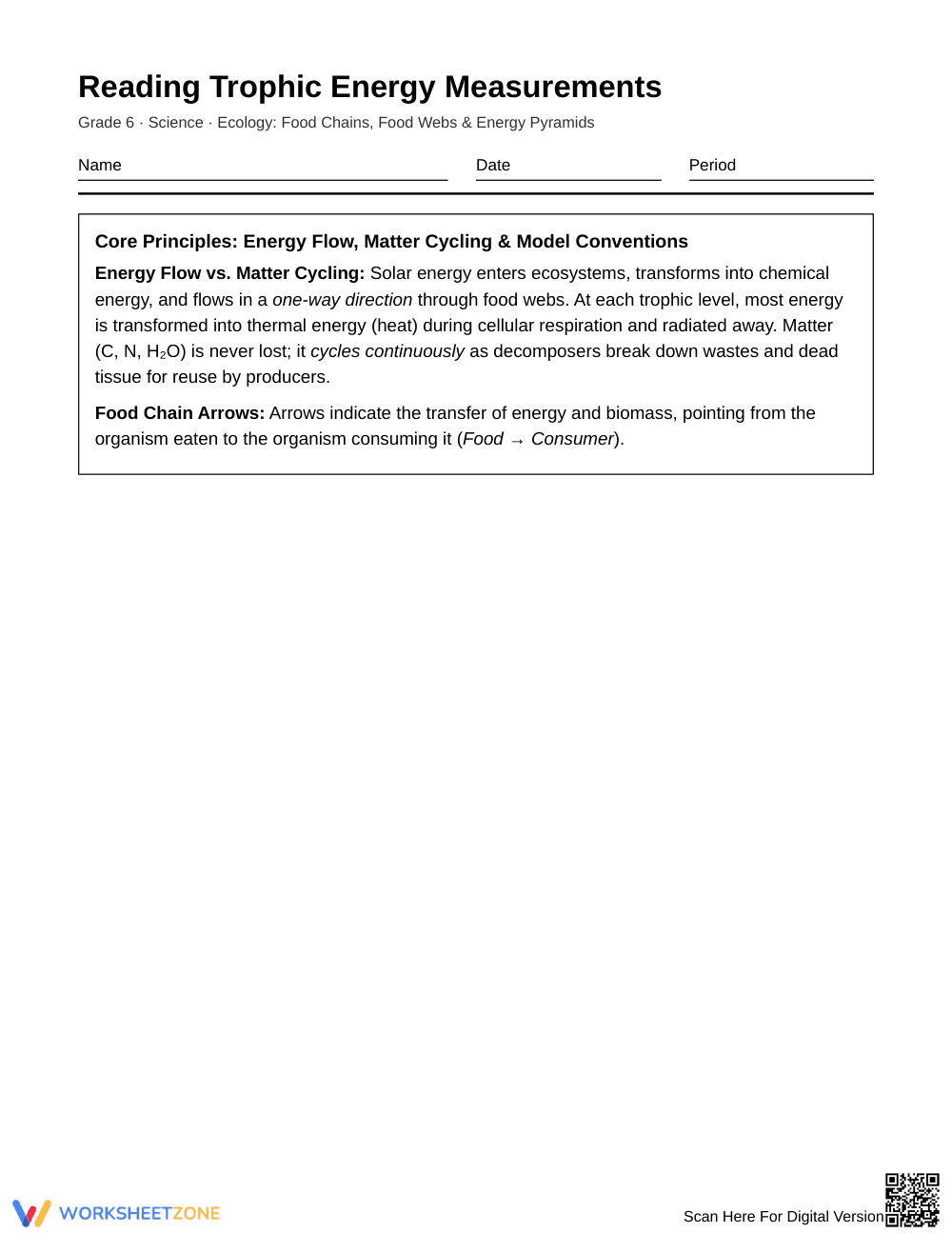
This Grade 6 science worksheet trains students to interpret quantitative field data and calculate trophic energy transfers across ecological food webs. Learners extract standing biomass and available energy from synthetic meadow tables, calculate ecological efficiencies, and contrast unidirectional energy dissipation with cyclical matter conservation to build foundational ecological literacy.
At a Glance
- Grade: 6 · Subject: Science
- Standard: Analyze empirical data to model energy flow and matter cycling across trophic levels
- Skill Focus: Reading Trophic Energy Measurements
- Format: 5 pages · 10 problems · 2-page answer key included · PDF
- Best For: Quantitative ecology review and scientific data analysis practice
- Time: 40–50 minutes
What's Inside
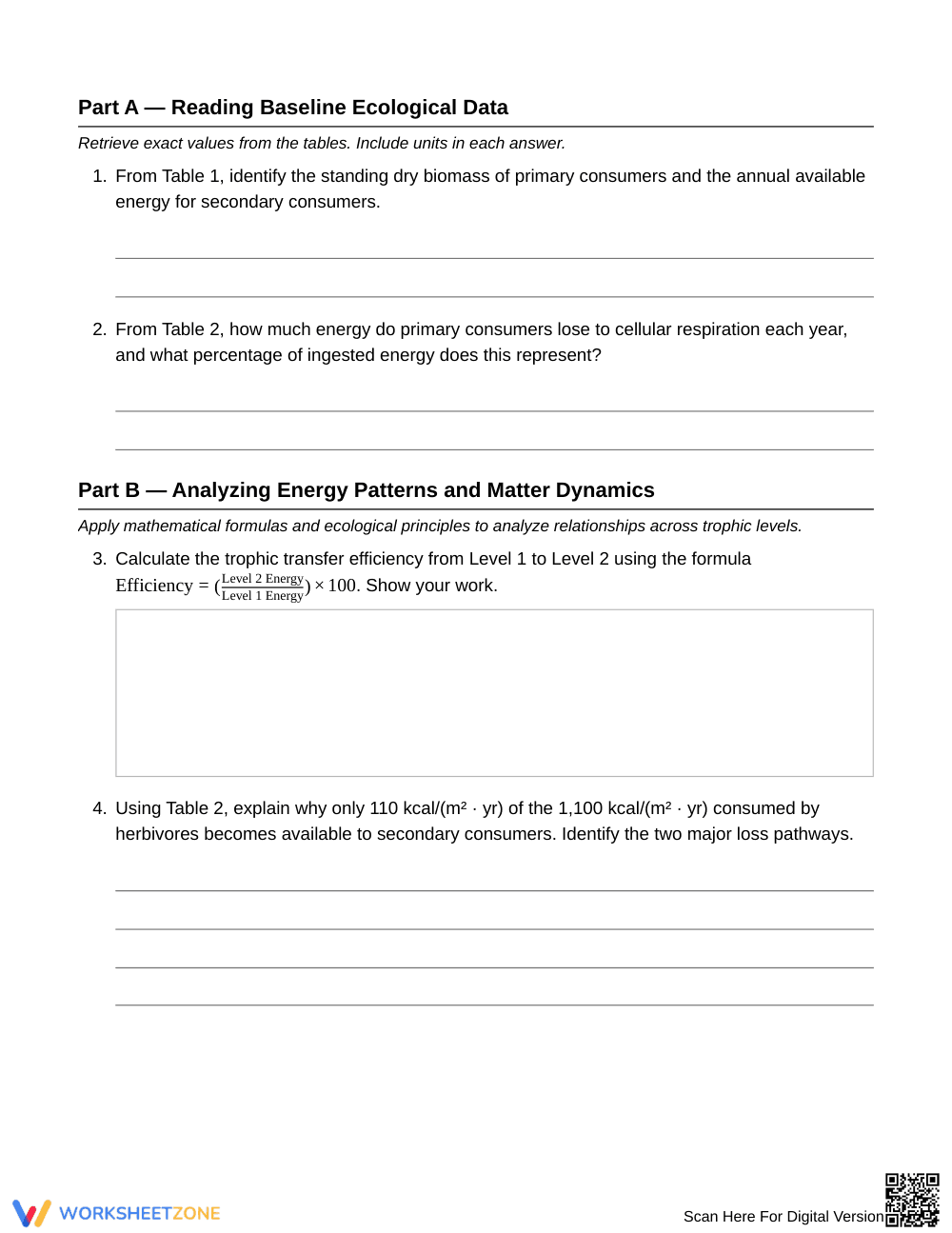
This 5-page printable resource includes background principles, two meadow ecosystem data tables, 10 analytical problems, and a 2-page answer key with step-by-step calculations. Students analyze synthetic field measurements across four trophic levels, using mathematical formulas and biological pathway breakdowns of herbivore energy allocation.
Skill Progression
- Guided practice (Part A, Problems 1–2): Students locate and retrieve baseline ecological values directly from structured data tables, reinforcing unit identification for standing dry biomass and annual available energy.
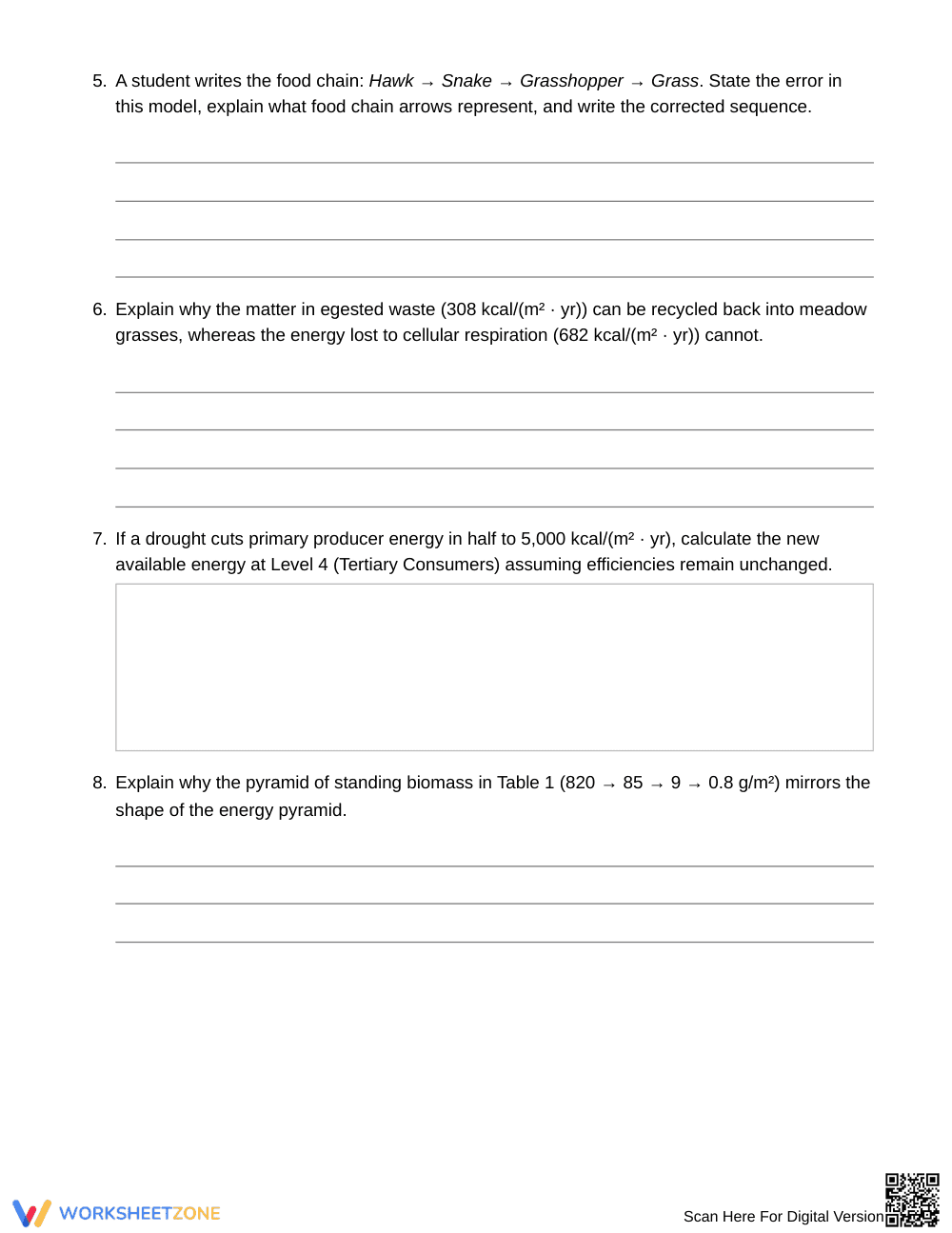
- Supported practice (Part B, Problems 3–8): Learners apply mathematical formulas to calculate trophic transfer efficiency, analyze cellular respiration and waste pathways, correct food chain modeling errors, and compute drought impacts on apex predators.
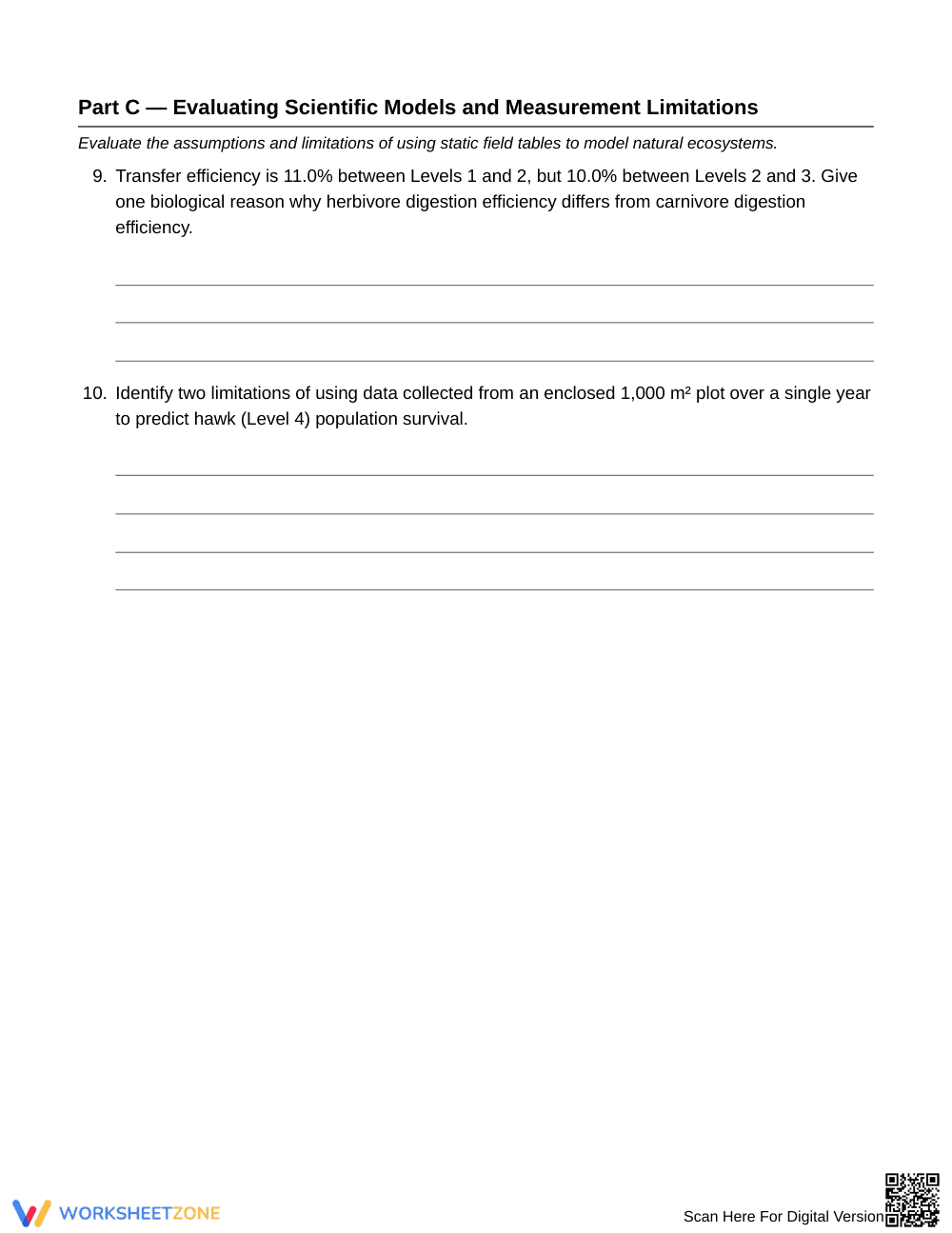
- Independent practice (Part C, Problems 9–10): Students evaluate scientific models by explaining physiological digestion differences across dietary niches and identifying spatial and temporal limitations of field studies.
This structured sequence reflects the gradual-release model, moving learners smoothly from direct data retrieval to independent critical evaluation.
Standards Alignment
This resource aligns with middle school science standards focusing on ecosystem dynamics and models showing matter and energy transfer among organisms. Students demonstrate how energy flows sequentially through producers, consumers, and decomposers while tracking thermal dissipation. Both standard codes can be copied directly into lesson plans, IEP goals, or district curriculum mapping tools.
How to Use It
Implement this worksheet after direct instruction on food webs and trophic pyramids. In class, complete Part A together before students solve Part B in collaborative pairs over a 40- to 50-minute block. For formative assessment, check Problem 5 to determine whether learners understand that food chain arrows represent biomass flow rather than predatory pursuit.
Who It's For
This resource serves Grade 6 science classes, introductory life science courses, and middle school ecology units. Scaffolds like explicit transfer efficiency formulas support developing learners, while extension questions challenge advanced thinkers. Pair this activity with an interactive food web simulation or physical energy pyramid model.
According to Fisher & Frey (2014), purposeful instructional design relies on guided data analysis and explicit modeling to transition middle school students from surface comprehension to robust analytical mastery. This Grade 6 trophic energy worksheet operationalizes that pedagogical framework by guiding learners through empirical meadow ecosystem datasets. Students read quantitative energy values, evaluate biomass pyramids, and contrast one-way thermal energy dissipation with cyclical matter conservation. By requiring students to calculate trophic transfer efficiency and critique static ecological models, the 10 scaffolded tasks develop both mathematical precision and conceptual reasoning in middle school science. The resource provides educators with an actionable, data-driven instrument to verify student understanding of energy pyramids, cellular respiration losses, and ecosystem dynamics without necessitating additional preparatory work.


