































Essential Thematic Matrix Worksheet | Grade 12 English IV

Paste this activity's link or code into your existing LMS (Google Classroom, Canvas, Teams, Schoology, Moodle, etc.).
Students can open and work on the activity right away, with no student login required.
You'll still be able to track student progress and results from your teacher account.
This Grade 12 research worksheet guides students through building a thematic source matrix to synthesize competing archival perspectives. Students analyze two contrasting scholarly texts, map evidentiary tensions, evaluate research limitations, and compose an academic synthesis essay demonstrating college-level textual integration.
At a Glance
- Grade: 12 · Subject: English IV
- Standard:
W.11-12.7— Conduct sustained research projects to synthesize multiple sources and resolve conflicting data- Skill Focus: Build a Thematic Source Matrix
- Format: 6 pages · 8 problems · Answer key included · PDF
- Best For: College-preparatory research synthesis units
- Time: 60–90 minutes
The 6-page printable resource includes a 2-text source dossier pairing institutional and grassroots perspectives on archival preservation, a 3-theme comparative matrix, and an 8-task synthesis sequence. It features an exemplar answer key with sample matrix entries, a model synthesis essay, and a metacognitive rubric audit.
Skill Progression
- Guided practice (Tasks 1–2): Students examine the central tension between institutional digitization and community custody to define, evaluate, and narrow a defensible inquiry question.
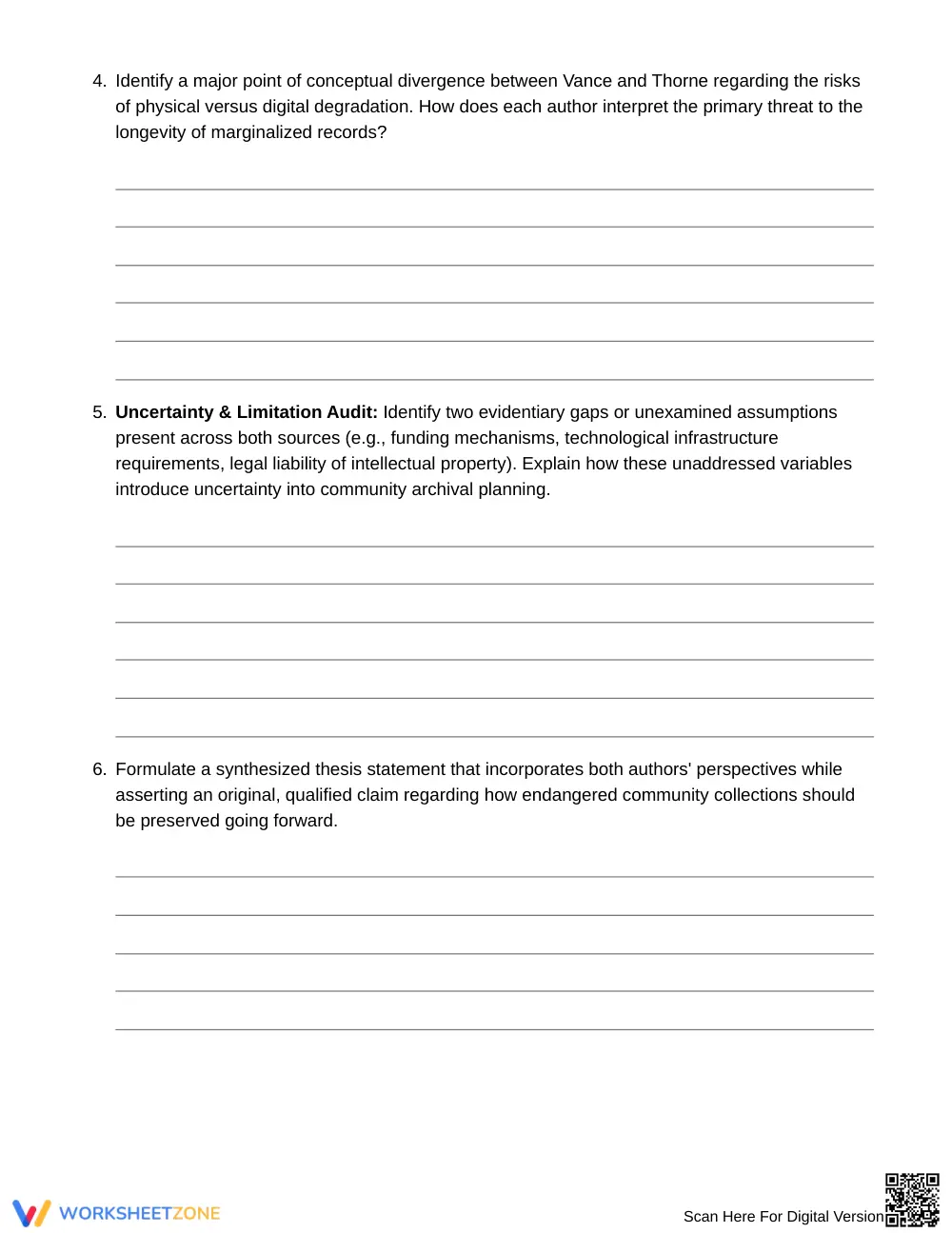
- Supported practice (Tasks 3–6): Learners complete a 3-part thematic matrix, evaluate divergence points, conduct an evidentiary uncertainty audit, and formulate a qualified synthesis thesis statement.
- Independent practice (Tasks 7–8): Students draft a complete 450–650 word synthesis essay resolving archival tensions and perform a structured metacognitive audit using a multi-dimension rubric checklist.
This systematic progression follows the gradual release of responsibility model, moving students smoothly from initial textual deconstruction to independent, collegiate synthesis writing.
Standards Alignment
This worksheet directly aligns with W.11-12.7: Conduct sustained research projects to answer a question, synthesize multiple sources, and resolve conflicting data. It also reinforces standard RI.11-12.7 by requiring students to evaluate multiple sources of information. Both standard codes can be copied directly into lesson plans, IEP goals, or district curriculum mapping tools.
How to Use It
Use this resource during the modeling and drafting phases of a research unit, or assign it after direct instruction on synthesis and argumentation. When circulating during formative matrix work, observe whether students identify underlying methodological premises rather than copying surface details. The 8-task workflow requires approximately 60 to 90 minutes across one or two class periods.
Who It's For
This worksheet is designed for Grade 12 English IV, AP Language and Composition, and dual-enrollment college writing courses. Scaffolded matrix tables and explicit uncertainty prompts provide structured support for developing writers, while high-lexile source texts challenge advanced students. Pair this activity with a mini-lesson on academic counterargumentation or source evaluation anchor charts.
According to foundational instructional research by Fisher & Frey (2014), structured synthesis matrices and metacognitive revision protocols significantly improve high school students' capacity to organize complex cross-textual evidence during sustained academic inquiry. Standardized assessments and collegiate coursework increasingly require Grade 12 learners to demonstrate mastery of standard W.11-12.7 by moving beyond sequential source summaries toward multi-perspective thematic analysis. By engaging with conflicting scholarly viewpoints on archival preservation, students practice identifying evidentiary gaps, evaluating methodological uncertainty, and integrating textual evidence into a unified thematic line of reasoning. This comprehensive 6-page worksheet operationalizes these evidence-based principles through an 8-task progression that scaffolds research question refinement, comparative matrix mapping, and rubric-based self-evaluation. Consequently, secondary educators can effectively bridge high school composition expectations with college-level research standards, ensuring that graduating seniors possess the critical reading, analytical synthesis, and argumentative writing competencies required for postsecondary academic success.


