
































Essential Tea and Dining Word Search | Grades 6–7 ELA

Paste this activity's link or code into your existing LMS (Google Classroom, Canvas, Teams, Schoology, Moodle, etc.).
Students can open and work on the activity right away, with no student login required.
You'll still be able to track student progress and results from your teacher account.
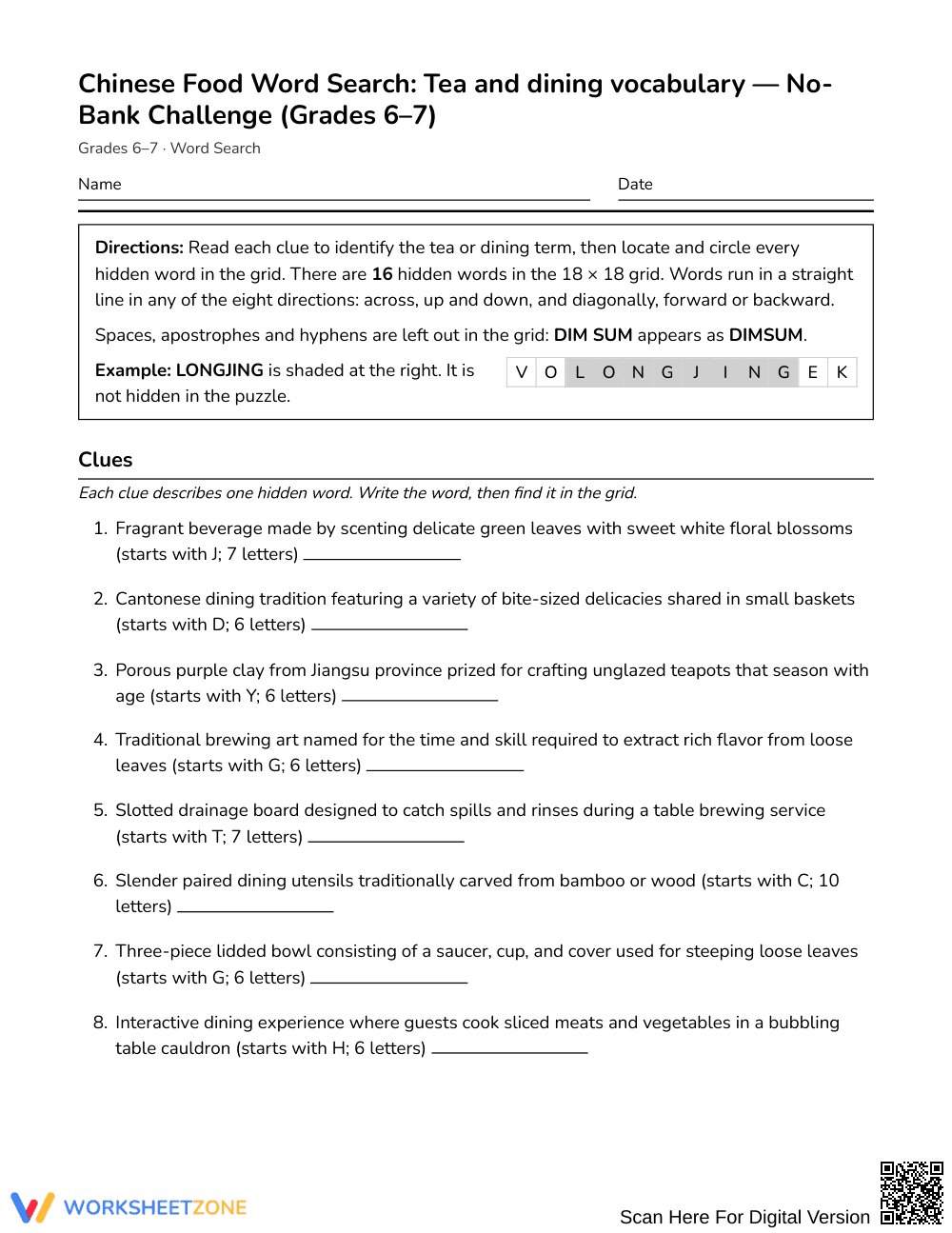
This vocabulary word search builds culinary literacy and domain-specific knowledge for Grades 6–7 students through sixteen cultural terms. Rather than passively scanning a list, learners analyze detailed clues describing traditional Chinese tea and dining traditions, deduce each matching vocabulary term, and then track down the hidden words across an expansive puzzle grid.
At a Glance
- Grade: Grades 6–7 · Subject: ELA
- Standard: Not standards-assessed — vocabulary enrichment
- Skill Focus: Tea and dining vocabulary
- Format: 3 pages · 16 words · Answer key included · PDF
- Best For: Vocabulary enrichment and cultural literacy
- Time: 25–35 minutes
What's Inside
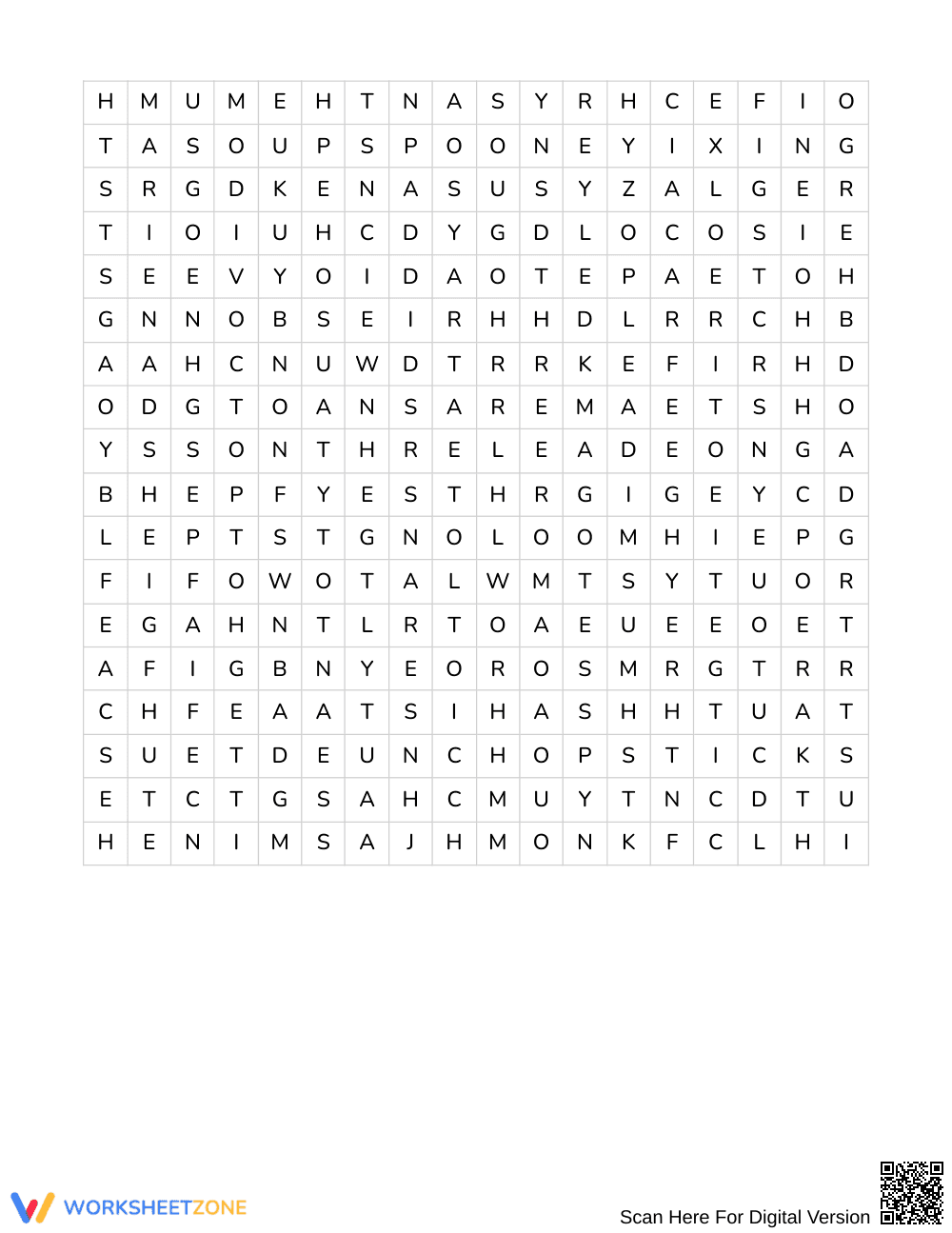
The 3-page resource contains a complete no-bank word challenge featuring 16 words connected to tea service and banquet customs. Students receive a comprehensive clue sheet with descriptive definitions instead of an alphabetized word bank, requiring active recall. A comprehensive 4-page answer key provides full solution grids displaying word placements alongside matched definitions for efficient checking.
Puzzle Structure and Mechanics
The activity centers on a large 18 x 18 letter matrix. Target terms are hidden across all eight compass orientations: north, northeast, east, southeast, south, southwest, west, and northwest. Because no word bank is supplied, learners must carefully read each clue—ranging from ceramic ware like gaiwan and Yixing teapots to dining practices like yum cha—before searching the grid.
Standards Alignment
This activity provides targeted vocabulary enrichment and cultural exploration. It is not aligned to a specific Common Core State Standard, focusing instead on domain-specific terminology, morphological recognition, and cross-cultural reading comprehension in middle school English Language Arts.
How to Use It
Deploy this word search during an informational text unit on global food ways, or assign it as an independent extension after direct instruction on context clues. During classwork, observe whether students identify vocabulary terms from the semantic clues before scanning the grid, or if they require dictionary support for specialized items such as chrysanthemum or pu-erh. Most learners finish within 25 to 35 minutes.
Who It's For
This resource serves general education middle school learners in Grades 6–7, ESL students expanding academic and cultural vocabulary, and fast finishers seeking an engaging mental challenge. For differentiated support, pair this puzzle with an illustrated anchor chart detailing traditional table settings or an informational passage about Chinese tea cultivation.
Contextual vocabulary acquisition relies on active cognitive processing rather than passive rote memorization. According to Fisher & Frey (2014), intentional word study that prompts middle school students to connect precise definitions to domain-specific terminology significantly deepens semantic memory and improves reading comprehension across complex texts. This Grades 6–7 word search reinforces sixteen tea and dining vocabulary words through descriptive clues, requiring learners to retrieve conceptual knowledge regarding historical utensils, culinary techniques, and tea customs before locating terms across an 18 x 18 grid. By removing the traditional word bank and incorporating multi-directional spatial scanning across eight compass headings, the activity encourages persistent focus and orthographic analysis. Teachers can utilize this self-contained puzzle to introduce cultural units or reinforce culinary terminology while monitoring student ability to infer unfamiliar expressions from detailed functional descriptions.


