































Essential System Boundary Worksheet | Grade 12 Physics

Paste this activity's link or code into your existing LMS (Google Classroom, Canvas, Teams, Schoology, Moodle, etc.).
Students can open and work on the activity right away, with no student login required.
You'll still be able to track student progress and results from your teacher account.
This Grade 12 physics worksheet trains students to defend system-boundary choices during momentum and impulse analysis. Through authentic collision data, learners distinguish internal from external forces, apply the impulse-momentum theorem, and justify when external interactions are negligible, establishing conceptual mastery in classical mechanics.
At a Glance
- Grade: 12 · Subject: Physics Mechanics
- Standard: High School Physics — Justify system boundary choices to evaluate momentum conservation and external impulse forces
- Skill Focus: Defend a System-Boundary Choice
- Format: 4 pages · 8 multi-part problems · Full answer key included · Printable PDF
- Best For: Advanced mechanics practice, conceptual review, and collision analysis
- Time: 45–60 minutes
What's Inside
This 4-page resource includes 8 analytical tasks across three scaffolded parts, paired with a complete 2-page answer key. Students interpret synthetic air-track collision records, evaluate impulse ratios, complete a boundary comparison chart, and critique competing claims regarding magnetic gliders and vehicle collision approximations.
Skill Progression
The worksheet applies a gradual-release instructional model:
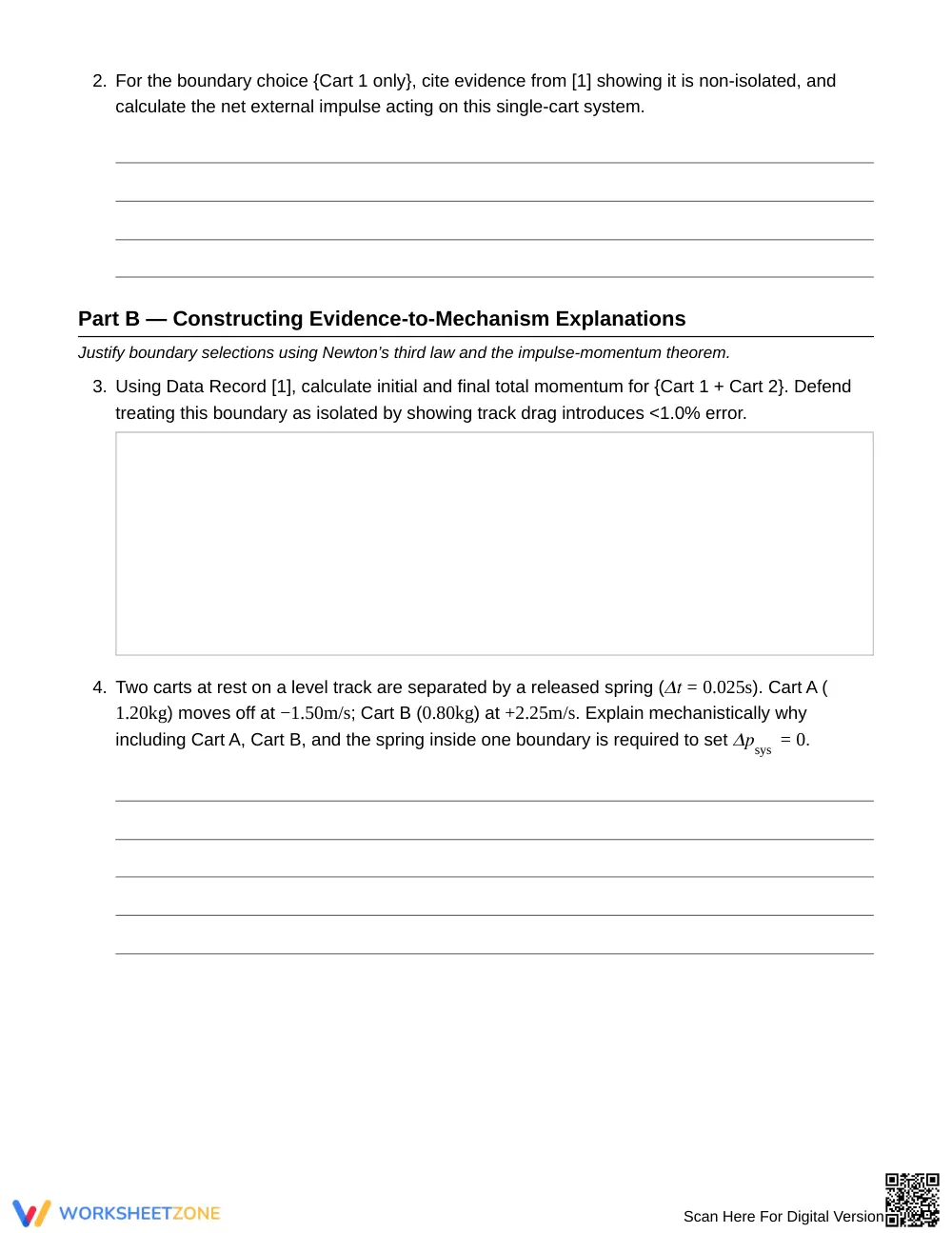
- Guided practice (Part A, 2 tasks): Students examine air-track collision data to calculate external drag versus internal contact impulse, identifying evidence of non-isolated systems.
- Supported practice (Part B, 4 tasks): Learners construct mechanistic arguments using Newton's third law to justify boundary choices in spring separations, inelastic collisions, and Earth-ball impacts.
- Independent practice (Part C, 2 tasks): Students evaluate and refute competing claims concerning magnetic potential energy and road friction collision thresholds.
This sequence supports students as they advance from guided data interpretation to rigorous physical argumentation.
Standards Alignment
This worksheet aligns with high school physics standards on momentum conservation and impulse dynamics. Students use mathematical models to prove momentum is conserved when net external force is negligible. Both standard codes can be copied directly into lesson plans, IEP goals, or district curriculum mapping tools.
How to Use It
Use this worksheet after direct instruction on momentum conservation or before collision lab investigations. During independent or paired practice, observe whether students mistakenly equate kinetic energy loss with momentum loss during inelastic collisions. The 8 tasks take 45 to 60 minutes to complete.
Who It's For
This worksheet is designed for Grade 12 Physics and AP Physics students mastering mechanics. Scaffolds such as data tables and structured comparison charts support varying readiness levels. Pair this resource with a dynamics cart demonstration or a conservation of momentum anchor chart.
Mastering system-boundary identification is essential for developing rigorous physical reasoning in mechanics. When analyzing collision dynamics, students frequently struggle to differentiate between internal interaction forces and external net impulses. According to Fisher & Frey (2014), structured instructional progressions that guide learners from concrete empirical evidence to mechanistic justification significantly deepen scientific conceptual understanding and argumentative competence. This Grade 12 physics worksheet operationalizes that research framework across 8 analytical tasks. By evaluating synthetic collision data, calculating impulse ratios, and refuting theoretical misconceptions regarding energy dissipation, students develop fluency in defending system-boundary choices. The structured comparison tables and competing claim prompts provide targeted scaffolding that transitions students toward autonomous mechanical problem-solving. Educators can utilize these print-ready materials to verify student mastery of momentum conservation principles, ensuring learners accurately distinguish isolated systems from open interactions in complex physical contexts.


