




























Views
Downloads




Essential Symbolism Claims Worksheet | Grade 8 ELA

Paste this activity's link or code into your existing LMS (Google Classroom, Canvas, Teams, Schoology, Moodle, etc.).
Students can open and work on the activity right away, with no student login required.
You'll still be able to track student progress and results from your teacher account.
Strengthen analytical writing with this focused literary analysis worksheet that trains middle school students to replace generic labels with text-grounded arguments. Learners evaluate five common interpretive fallacies, examine an annotated mentor model, and rewrite flawed arguments into defensible symbolic analyses supported by textual evidence, figurative connotation, and competing perspectives.
At a Glance
- Grade: 8 · Subject: ELA
- Standard:
RL.8.4— Determine figurative and connotative word meanings and analyze their literary impact- Skill Focus: Repair Unsupported Symbolism Claims
- Format: 5 pages · 10 problems · Answer key included · PDF
- Best For: Close reading and analytical writing intervention
- Time: 45–60 minutes
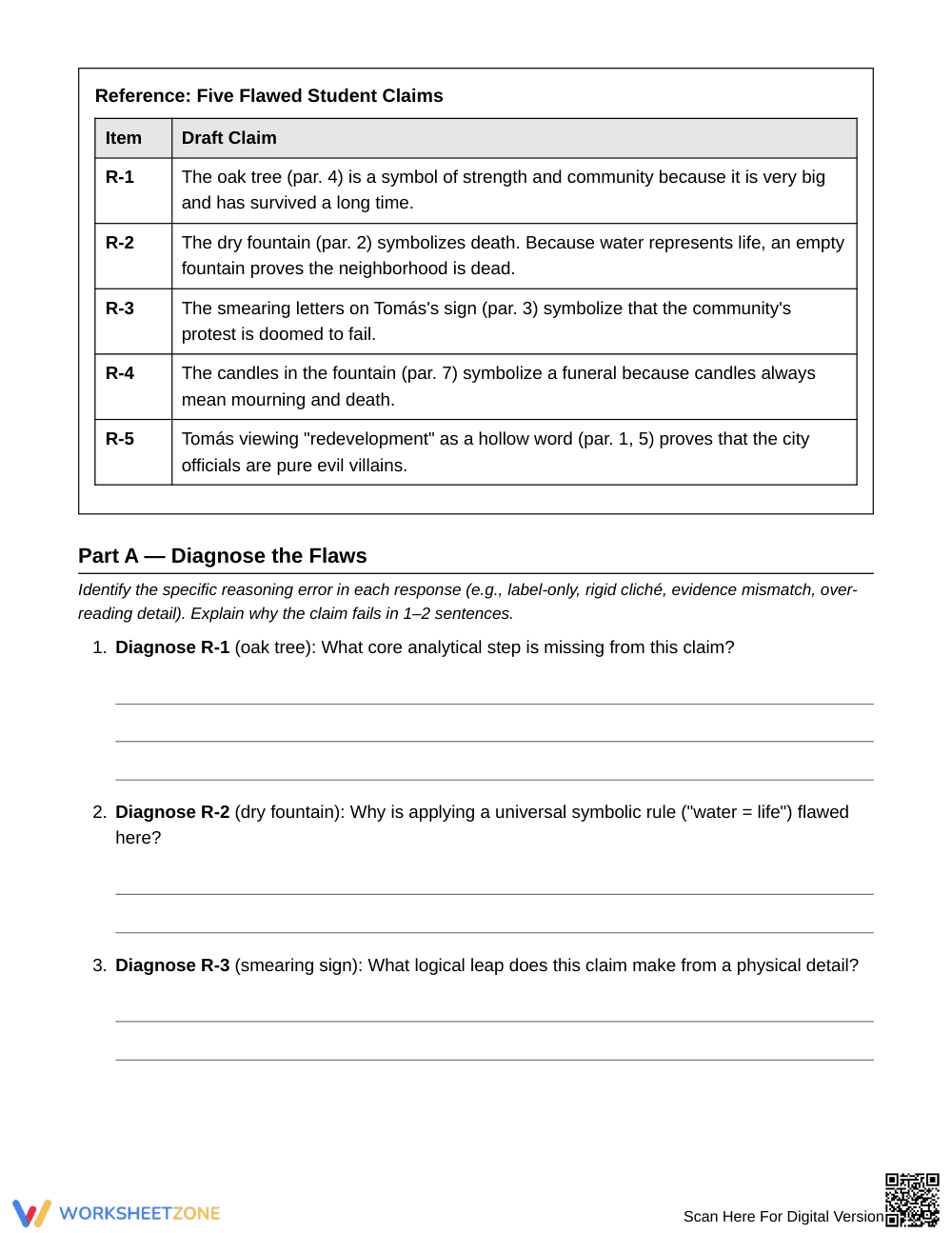
What's Inside: A 5-page printable student resource built around the original anchor narrative "The Last Afternoon at Delgado Square." The activity features an explicit framing guide on the anatomy of defensible claims, a mythological allusion reference, a bank of five flawed student responses, an annotated teacher model analyzing paragraph 2, five diagnostic analysis questions, five text-dependent reconstruction tasks, and an exhaustive 3-page answer key.
Skill Progression
- Guided Practice: Students review an explicit three-part criteria checklist and study an annotated exemplar demonstrating how to move from a superficial label to an evidence-based claim addressing competing viewpoints.
- Supported Practice (Tasks 1–5): Learners diagnose specific analytical flaws across five pre-written claims, identifying rigid dictionary assumptions, over-reading, and unsubstantiated logical leaps.
- Independent Practice (Tasks 6–10): Working directly with the narrative, students reconstruct each flawed claim into a rigorous paragraph-level interpretation analyzing diction, tone, and figurative meaning.
This structured sequence leverages the gradual release of responsibility framework to ensure students master literary argumentation before drafting independent essays.
Standards Alignment
Primary Standard: `RL.8.4` — Determine the meaning of words and phrases as they are used in a text, including figurative and connotative meanings; analyze the impact of specific word choices on meaning and tone, including analogies or allusions to other texts. In addition, this resource reinforces `RL.8.1` by requiring students to cite strong and thorough textual evidence to support inferences drawn from the text. Both standard codes can be copied directly into lesson plans, IEP goals, or district curriculum mapping tools.
How to Use It
Deploy this worksheet after direct instruction on figurative language or during a mid-unit checkpoint on analytical writing. During independent completion, conduct a formative assessment check by reviewing Part A diagnoses; students struggling to spot rigid symbolic clichés will need targeted intervention before attempting Part B. The full packet requires approximately 45 to 60 minutes of focused instructional time.
Who It's For
Designed for eighth-grade English language arts students preparing for high school literary analysis, this resource includes explicit scaffolded framing suitable for general education classrooms, co-taught inclusion settings, and targeted writing interventions. Pair this practice packet directly with your classroom's literary analysis rubric or an anchor chart on authorial craft and connotation.
According to Fisher & Frey (2014), explicit instruction in evaluating and correcting flawed peer work accelerates student writing autonomy by clarifying the cognitive gap between surface-level assertions and reasoned textual analysis. This 10-task worksheet operationalizes standard `RL.8.4` by requiring learners to dissect the mechanics of symbolic interpretation rather than memorizing rigid figurative formulas. Working through the original narrative "The Last Afternoon at Delgado Square," eighth-grade readers evaluate ten structured items that challenge superficial assumptions, parse subtle connotative shifts, and analyze classical allusions like the myth of Sisyphus. Because the five-page packet integrates mentor modeling, diagnostic critique, and paragraph-length reconstruction, it serves as a rigorous bridge between initial reading comprehension and formal text-based composition. The comprehensive three-page answer key details exemplary student responses and counter-interpretations, equipping educators with actionable diagnostic reference points during writing conferences.


