




























Views
Downloads




Essential Symbolic Interpretations Worksheet | Grade 8 ELA

Paste this activity's link or code into your existing LMS (Google Classroom, Canvas, Teams, Schoology, Moodle, etc.).
Students can open and work on the activity right away, with no student login required.
You'll still be able to track student progress and results from your teacher account.
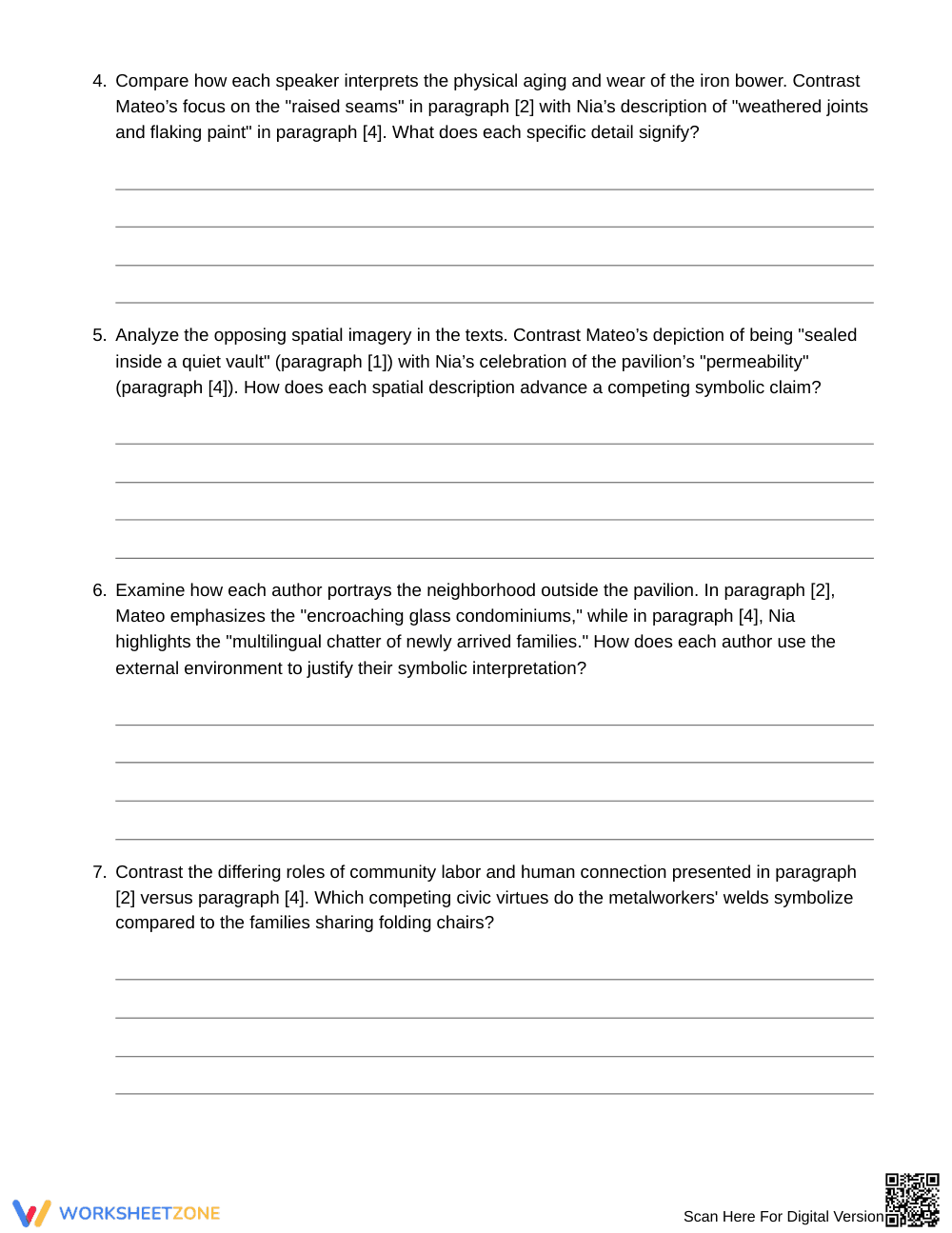
This Grade 8 ELA worksheet guides students through comparing competing symbolic interpretations of a single object in paired literary texts. By contrasting Mateo’s view of an iron pavilion as an immovable fortress with Nia’s view of it as an open trellis, students analyze how tone, diction, and spatial orientation construct conflicting figurative meanings.
At a Glance
- Grade: 8 · Subject: English Language Arts
- Standard:
RL.8.4— Determine figurative and connotative meanings of words and analyze their specific impact on tone- Skill Focus: Comparing Competing Symbolic Interpretations
- Format: 5 printable pages · 10 analytical problems · Complete answer key included · PDF
- Best For: Close reading, paired-text analysis, and thematic synthesis
- Time: 45–60 minutes
What's Inside
This 5-page worksheet includes two paired passages centered on a shared pavilion, accompanied by 10 text-dependent analytical questions. An introductory reference box clarifies the vehicle-tenor relationship and establishes three evaluation criteria. A comprehensive 4-page answer key provides complete model responses and paragraph citations for every question.
Skill Progression
- Guided practice (Part A, 2 tasks): Students identify the shared vehicle and define opposing tenors using connotative diction criteria.
- Supported practice (Part B, 6 tasks): Learners analyze contrasting metaphors, physical wear, spatial imagery, and tonal shifts across paragraph citations.
- Independent practice (Part C, 2 tasks): Students synthesize both perspectives to evaluate diverging civic outcomes and preservation definitions.
This sequence implements the gradual release of responsibility model, guiding students toward independent thematic critique.
Standards Alignment
This worksheet aligns to primary standard `RL.8.4`: Determine the meaning of words and phrases as they are used in a text, including figurative and connotative meanings; analyze the impact of specific word choices on meaning and tone. It also supports `RL.8.1` by requiring explicit paragraph-level evidence for comparative inferences. Both standard codes can be copied directly into lesson plans, IEP goals, or district curriculum mapping tools.
How to Use It
Use this resource after direct instruction on symbolic framing or during a paired-text unit. It functions effectively as a collaborative partner activity or independent assessment. During instruction, check whether students identify specific connotations in Part B rather than summarizing plot. Plan for 45 to 60 minutes of completion time.
Who It's For
This activity is designed for eighth-grade ELA students, advanced seventh graders, and high school reading intervention. Differentiate by providing sentence starters for Part C or highlighting paragraph citations for emerging bilingual learners. Pair this worksheet with an anchor chart defining symbolic vehicle and tenor.
Under CCSS RL.8.4, eighth-grade students must move beyond basic symbol identification to evaluate how distinct authors craft opposing connotations, tones, and thematic claims from identical physical objects. According to Fisher & Frey (2014), structured close reading of complex paired texts substantially accelerates analytical comprehension when students directly contrast figurative frameworks and justify competing interpretations with explicit textual evidence. This 10-prompt instructional resource builds systematic mastery by guiding middle school learners from concrete vocabulary analysis to sophisticated civic synthesis. By comparing Mateo’s portrayal of an unyielding iron fortress with Nia’s portrayal of an adaptable community trellis, students investigate how figurative language shapes cultural values and authorial perspective. The 5-page worksheet provides educators with verified exemplar responses across all questions, making it an exceptionally reliable tool for rigorous literary instruction, classroom differentiation, and standards-based progress monitoring.


