





























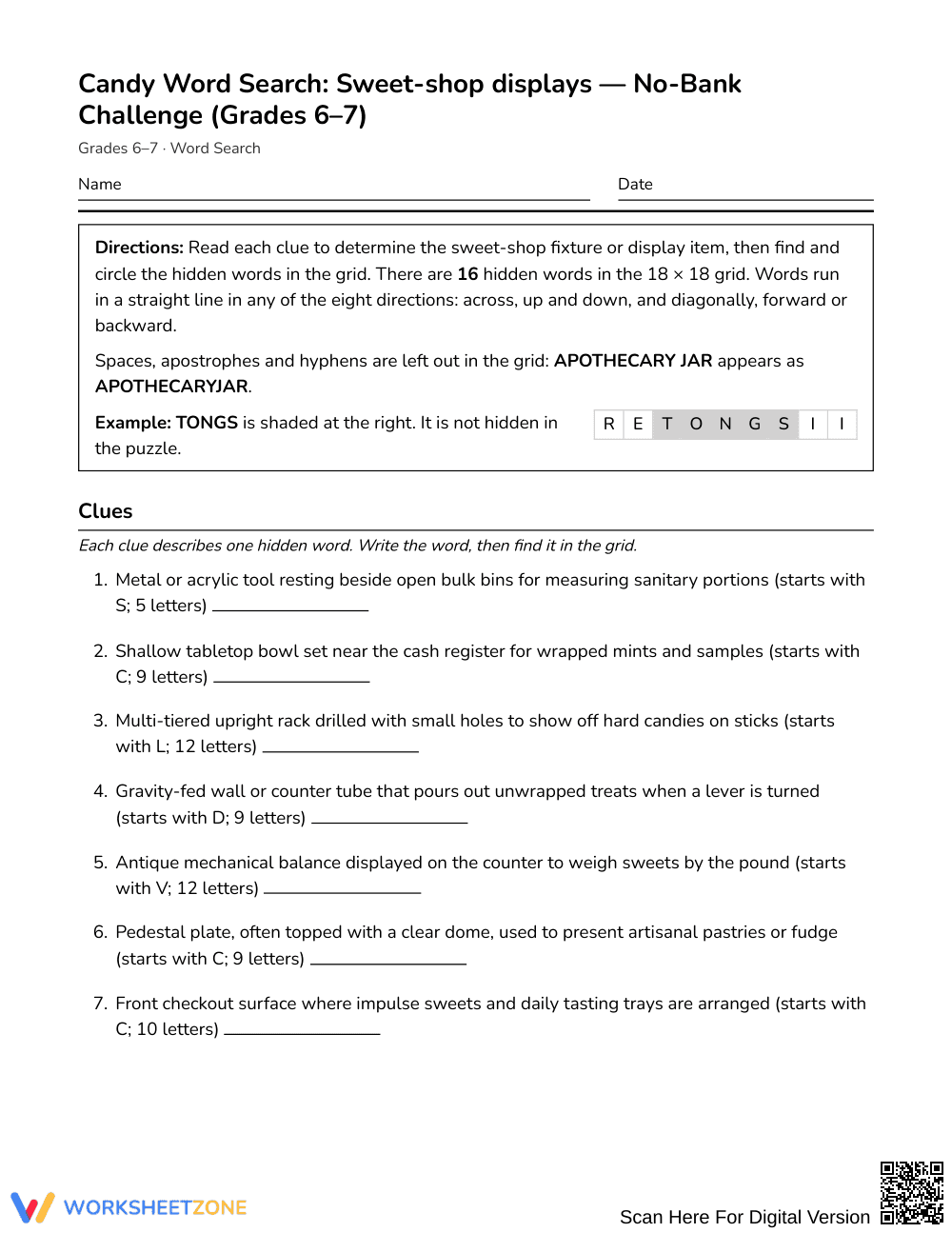


Essential Sweet-Shop Displays Word Search | Grades 6–7 ELA

Paste this activity's link or code into your existing LMS (Google Classroom, Canvas, Teams, Schoology, Moodle, etc.).
Students can open and work on the activity right away, with no student login required.
You'll still be able to track student progress and results from your teacher account.
This vocabulary word search reinforces domain-specific terminology related to retail confectionery merchandising for middle school readers. Students read descriptive definitions to identify 16 targeted vocabulary terms before locating each hidden word within an 18 by 18 puzzle grid. This engaging format strengthens context-clue comprehension, visual scanning, and spelling retention without relying on passive word lists.
At a Glance
- Grade: Grades 6–7 · Subject: English Language Arts (ELA)
- Standard: Not standards-assessed — vocabulary enrichment
- Skill Focus: Sweet-shop displays
- Format: 3 pages · 16 words · Answer key included · PDF
- Best For: Vocabulary enrichment, early finishers, or sub plans
- Time: 20–30 minutes
What's Inside: This 3-page PDF resource presents 16 descriptive clues defining specialized retail fixtures such as cloches, bonbonnieres, and apothecary jars. Instead of providing a pre-printed word bank, the activity requires students to deduce each term from its functional description before searching the grid. A full-size 4-page answer key provides clear, highlighted word paths for rapid verification and grading.
The challenge centers on a dense 18 by 18 letter grid containing 16 hidden vocabulary terms. Words run in all 8 compass directions: north, northeast, east, southeast, south, southwest, west, and northwest, including reverse and diagonal orientations. Because no word bank is provided, learners must actively process the conceptual clues to determine the exact spelling of each target fixture before initiating visual search patterns across the letter matrix.
This instructional activity is designed strictly for vocabulary enrichment and is not aligned to a specific standard. It serves as an interdisciplinary language arts exercise that strengthens semantic knowledge, morphology, and descriptive inference through domain-specific retail terminology.
Deploy this word search during independent practice following a descriptive writing lesson, or post it as a high-engagement station during literacy rotations. Teachers can also assign it as an effortless, meaningful sub plan. Formatively observe whether students deduce terms directly from clues or require scaffolding dictionaries to confirm unfamiliar items like pedestals and compotes. Most students complete the activity within 20 to 30 minutes.
This activity targets students in Grades 6–7 seeking rigorous vocabulary extension and semantic challenge. It offers natural differentiation for advanced readers who benefit from clue-based retrieval rather than standard rote matching. Pair this puzzle with an informational passage describing historical confectionery shops or an architectural anchor chart illustrating vintage retail display fixtures.
Vocabulary acquisition research highlighted in Fisher & Frey (2014) demonstrates that intentional word exposure coupled with contextual retrieval dramatically improves long-term semantic retention in adolescent learners. When middle school students identify domain-specific words through functional descriptions rather than rote memorization, they build robust neural pathways linking orthographic patterns to contextual meaning. This clue-driven word search engages Grades 6–7 students in active problem-solving by eliminating passive word banks and demanding inferential reasoning across 16 precise descriptive prompts. Searching an 18 by 18 matrix across all 8 cardinal and intercardinal directions further reinforces visual word-form recognition and spelling accuracy. By embedding specialized retail terms such as bonbonniere, cloche, and apothecary jar into an interactive puzzle format, educators provide meaningful lexical enrichment that supports broader informational reading comprehension and precise descriptive communication without requiring repetitive drill-and-practice routines.


