

































Essential Style Edit Worksheet | Grade 12 English IV

Paste this activity's link or code into your existing LMS (Google Classroom, Canvas, Teams, Schoology, Moodle, etc.).
Students can open and work on the activity right away, with no student login required.
You'll still be able to track student progress and results from your teacher account.
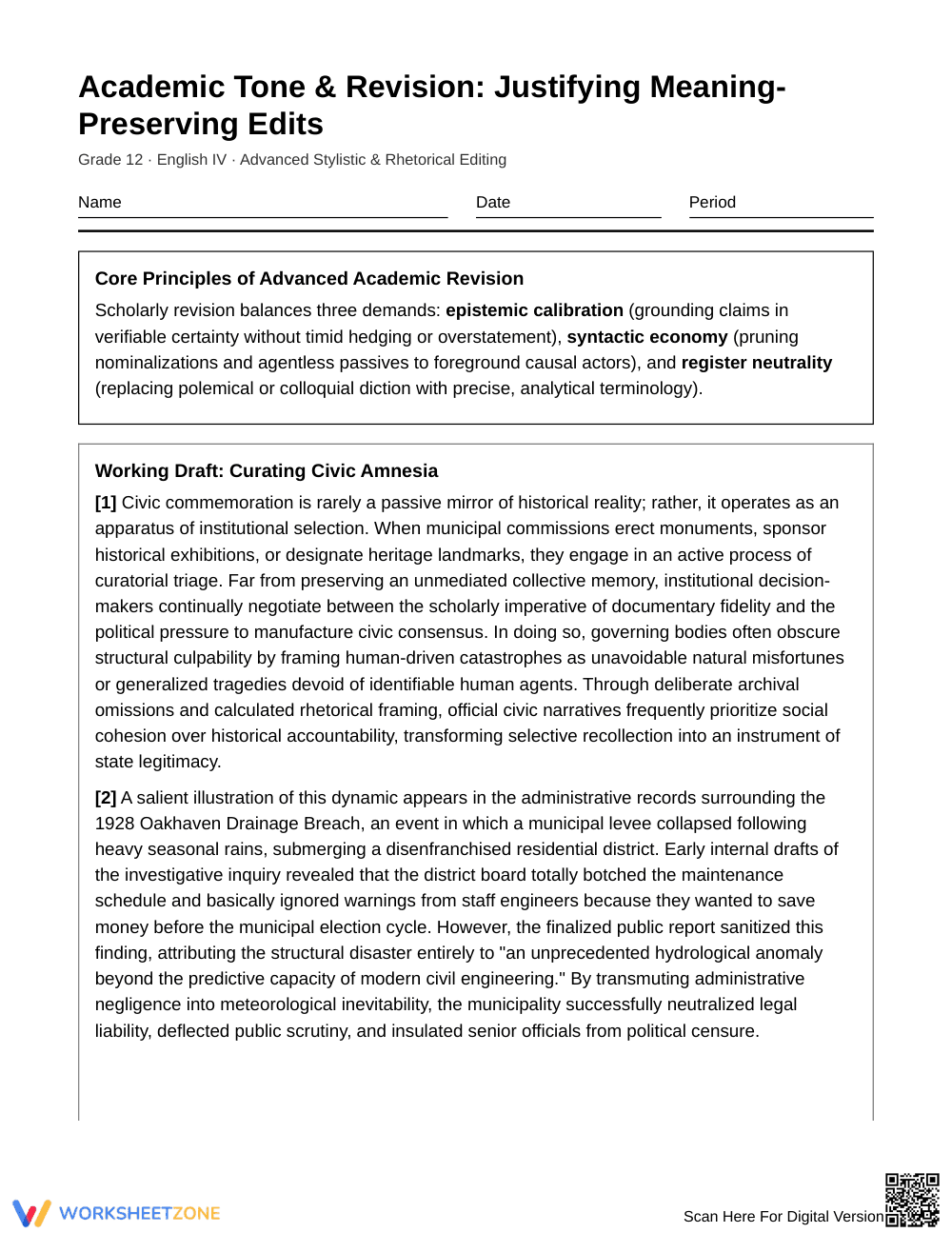
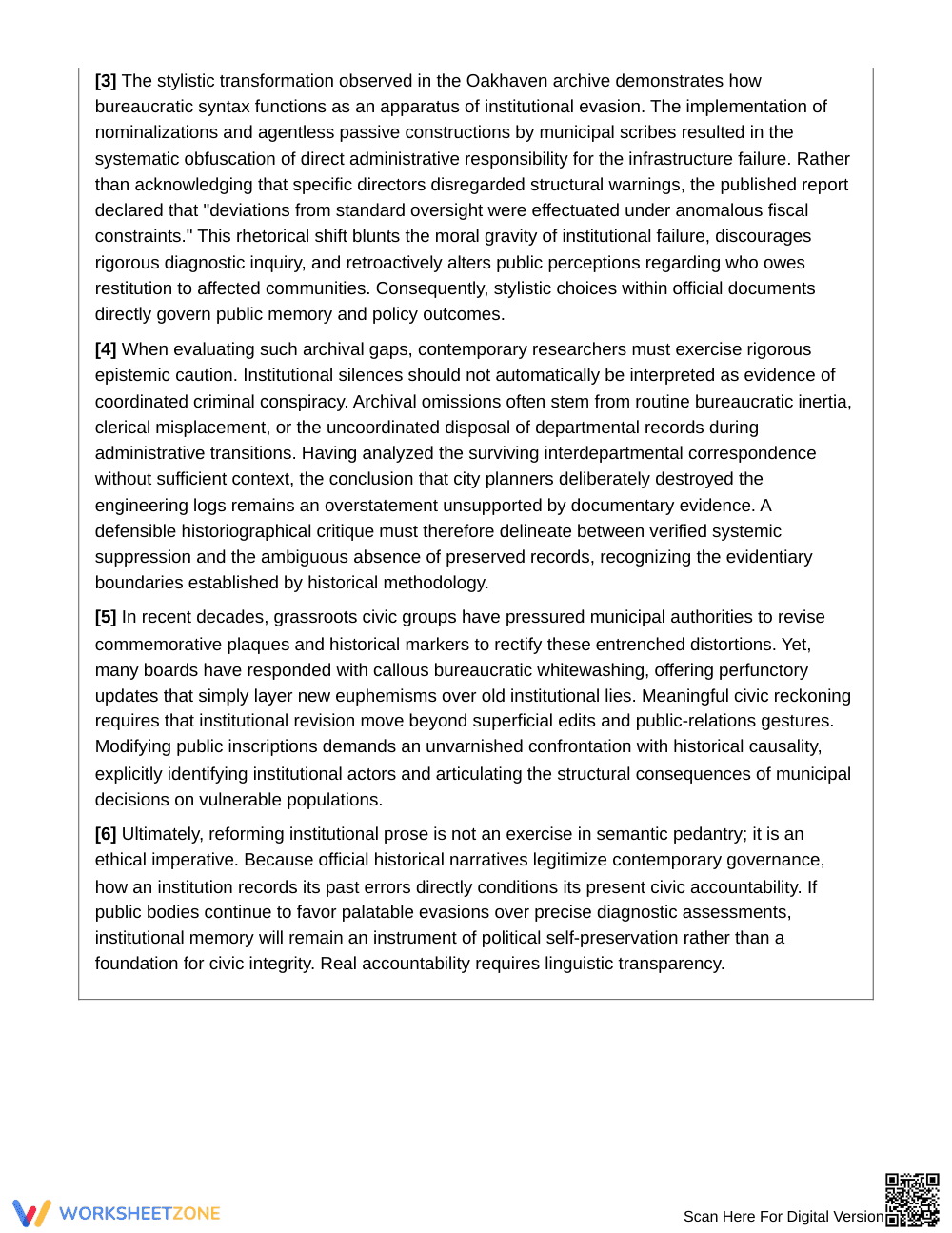
This advanced revision resource trains Grade 12 students to analyze syntactic structures, eliminate nominalizations, and justify stylistic choices in academic prose. Students examine a 6-paragraph working draft on institutional rhetoric, evaluate competing editorial revisions against external style guidelines, and compose evidence-based arguments defending precise rhetorical decisions without altering core semantic meaning.
At a Glance
- Grade: 12 · Subject: English IV
- Standard: Advanced Stylistic & Rhetorical Editing — Justify meaning-preserving revisions to enhance academic register and syntactic clarity
- Skill Focus: Justify a Meaning-Preserving Style Edit
- Format: 6 pages · 8 problems · Answer key included · PDF
- Best For: Advanced rhetorical revision and argumentative analysis
- Time: 45–60 minutes
What's Inside
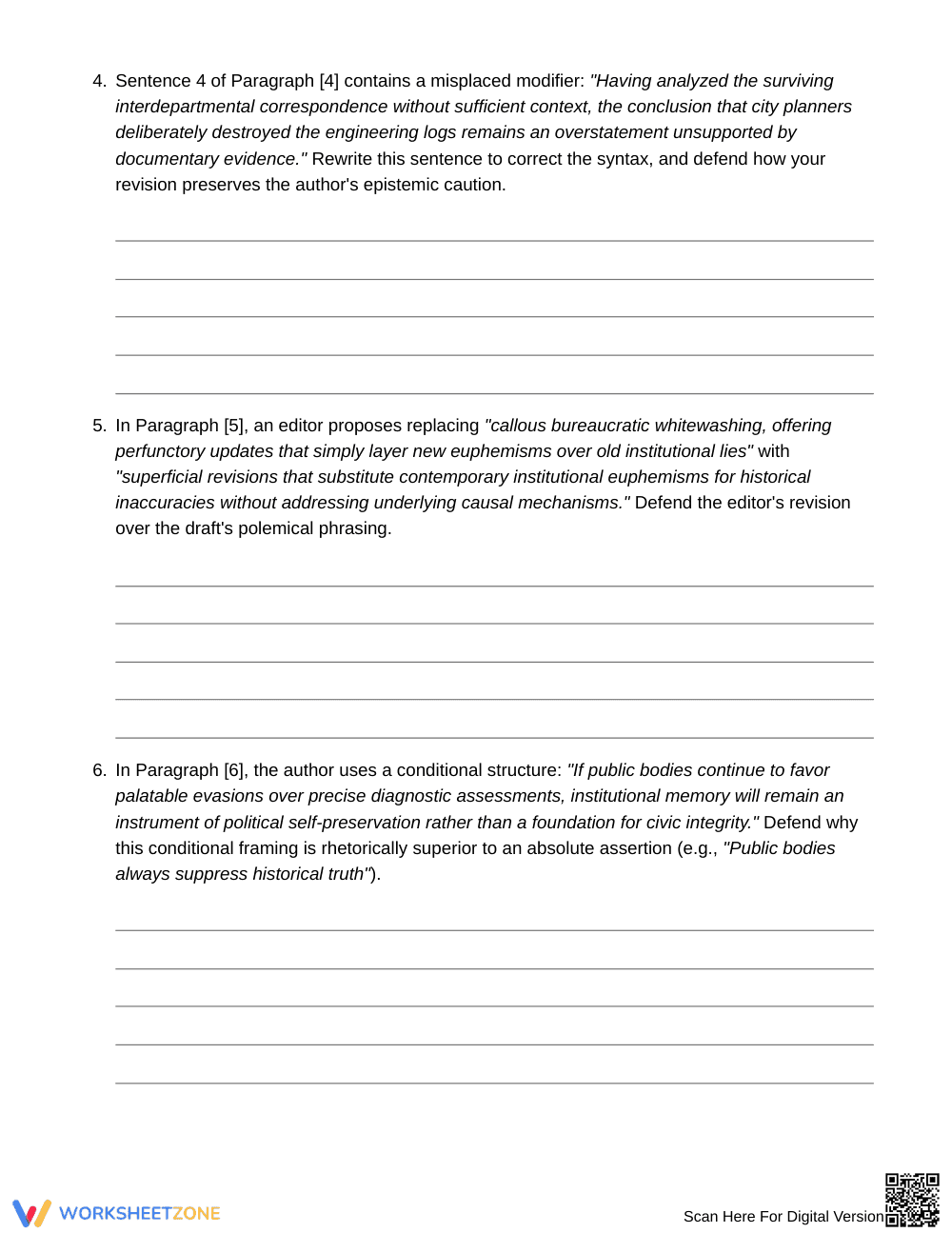
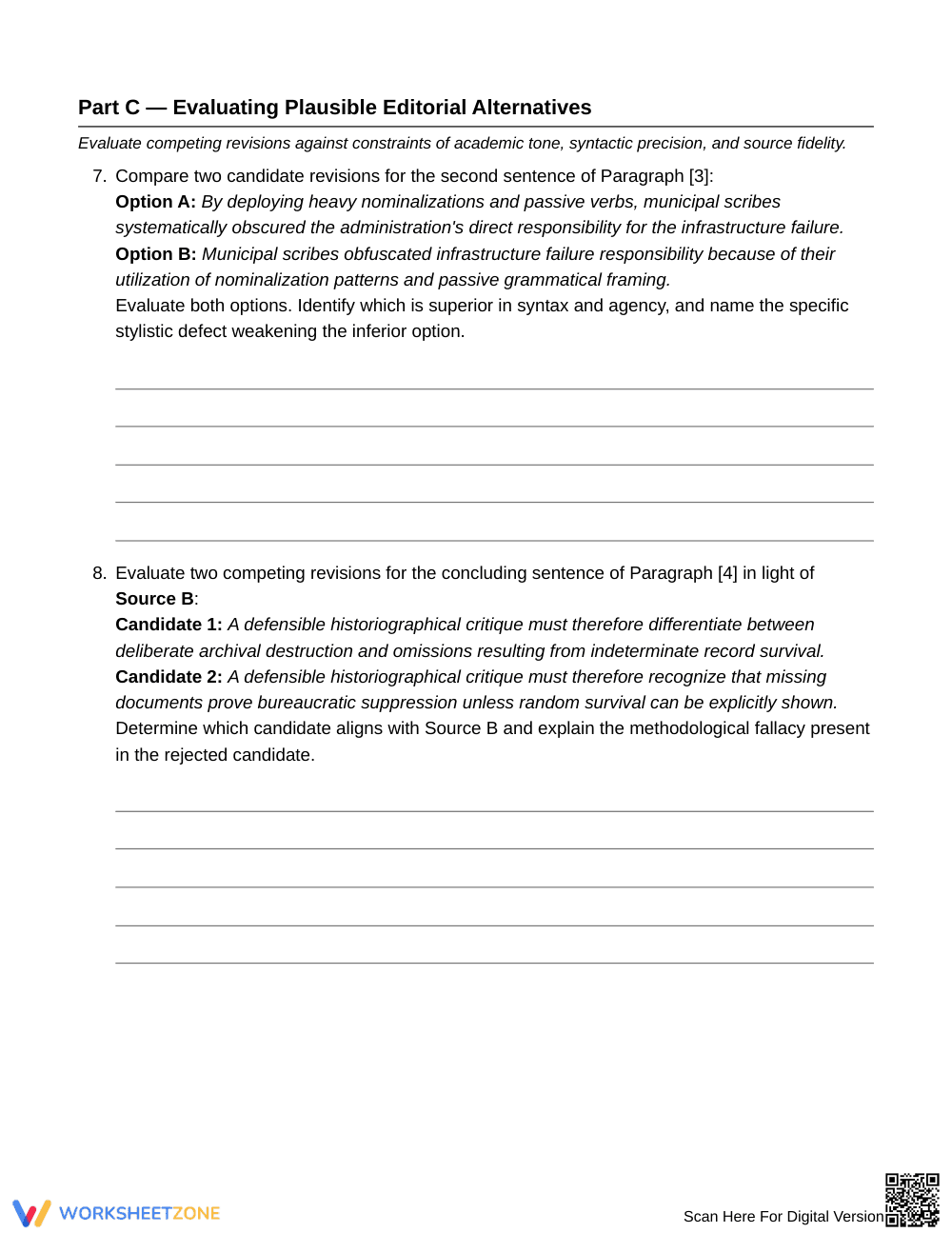
The 6-page printable worksheet includes a comprehensive rule box detailing the core principles of academic revision, a six-paragraph working text, two reference excerpts, and 8 rigorous analytical tasks across three distinct parts. The layout provides diagnostic multiple-choice items, sustained short-answer justification prompts, and comparative evaluation tasks, concluded by a detailed 2-page answer key with model rationales.
Skill Progression
- Guided Practice (Part A, 2 tasks): Students diagnose stylistic flaws, identify weak passive phrasing, and select revisions that maintain causal force while adhering to academic constraints.
- Supported Practice (Part B, 4 tasks): Students write sustained justifications defending specific phrasing choices, correcting misplaced modifiers, and explaining the rhetorical value of conditional framing.
- Independent Practice (Part C, 2 tasks): Students critically evaluate pairs of competing editorial alternatives, identifying underlying methodological and syntactic defects in light of archival reference sources.
This sequence follows a gradual-release model that builds from targeted error detection to independent rhetorical defense.
Standards Alignment
This worksheet directly targets upper-level high school writing conventions and language standards, emphasizing command of formal academic register, precise syntactic manipulation, and rhetorical effectiveness in revision. Students integrate domain-specific vocabulary and resolve subtle grammatical inconsistencies. These benchmarks can be copied directly into lesson plans, IEP goals, or district curriculum mapping tools.
How to Use It
Deploy this resource during the revision phase of an argumentative or research writing unit to model mature stylistic editing. Teachers can use Part A as an entry ticket to identify whether students recognize passive obfuscation before assigning Parts B and C for collaborative partner analysis or individual practice. For formative assessment, examine student responses in Part B to verify whether learners explain grammatical function rather than relying on subjective personal preferences. Typical completion time spans 45 to 60 minutes.
Who It's For
This activity is designed for Grade 12 English IV students, Advanced Placement language learners, and college-prep writers refining expository style. Pair this worksheet with an anchor chart on active voice and nominalization or an introductory lesson on academic hedging and epistemic stance.
According to research in writing pedagogy by Fisher and Frey (2014), structured scaffolds that require students to explicitly defend revisions significantly improve metacognitive control over complex syntax. When Grade 12 English IV students analyze how nominalizations and agentless passives obscure accountability across 8 focused tasks, they develop transferable rhetorical decision-making skills. Practicing evidence-based justifications enables learners to evaluate competing phrasing options, balance epistemic certainty, and sustain an analytical register across 6 comprehensive pages without altering underlying textual meaning. Furthermore, empirical findings show that engaging in explicit comparative analysis of sentence-level choices sharpens critical reading ability and helps mature writers recognize the subtle semantic boundaries between synonymous grammatical structures. By articulating clear rationales for stylistic changes rather than relying on intuitive impressions, students internalize standard editorial conventions, refine voice, and strengthen academic communication across varied high school and collegiate disciplines.


