





























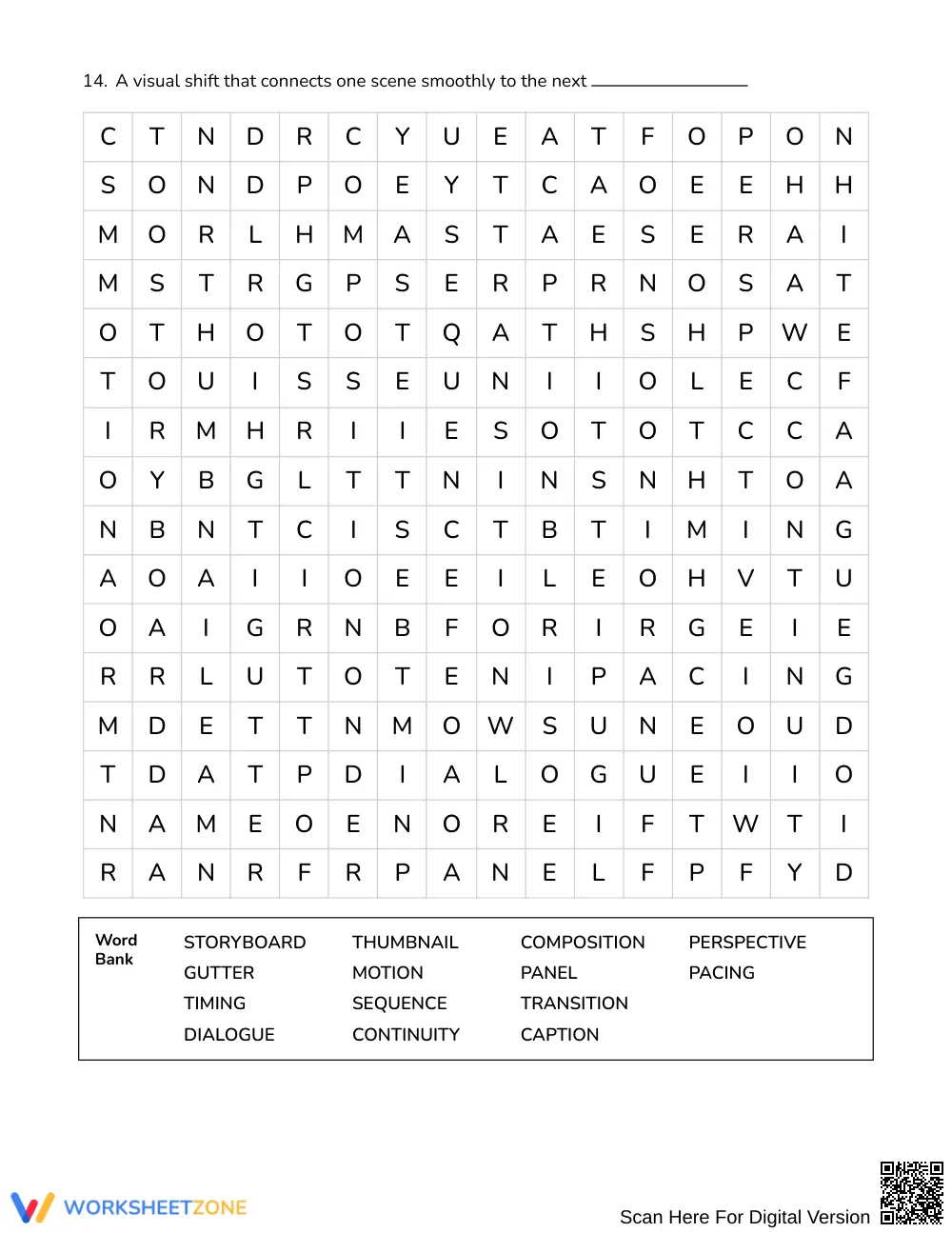


Essential Storyboard Word Search | Grades 4–5 ELA

Paste this activity's link or code into your existing LMS (Google Classroom, Canvas, Teams, Schoology, Moodle, etc.).
Students can open and work on the activity right away, with no student login required.
You'll still be able to track student progress and results from your teacher account.
This Grades 4–5 vocabulary word search reinforces visual storytelling concepts by challenging students to identify and locate 14 essential cartooning and storyboard sequence terms. Learners read definitional clues to determine each target word before searching the letter grid, strengthening domain-specific vocabulary retention, reading comprehension, and visual scanning skills across media arts and English language arts units.
At a Glance
- Grade: Grades 4–5 · Subject: English Language Arts (ELA)
- Standard: Not standards-assessed — vocabulary enrichment
- Skill Focus: Storyboards and panel sequence
- Format: 2 pages · 14 words · Answer key included · PDF
- Best For: Media arts and narrative writing enrichment
- Time: 20–30 minutes
What's Inside: The two-page printable activity features 14 domain-specific vocabulary terms centered on animation planning and sequential art. Rather than simply providing an alphabetical list, the resource functions as a Clue Detective activity where students read complete definitions for technical terms such as gutter, panel, sequence, and thumbnail. A comprehensive answer key highlights every hidden term across the puzzle grid for rapid, accurate grading.
How the Puzzle Works: Students navigate a 16 × 16 letter grid containing 14 hidden storyboard terms. Target words run in four distinct directional paths: northeast, east, southeast, and south. A shuffled word bank pairs each entry with an explanatory clue describing key visual storytelling techniques, ensuring students connect terminology to concrete media concepts before locating each word in the puzzle.
Standards Alignment: This resource is designed specifically as vocabulary enrichment and is not aligned to a formal standard. The focus remains on building descriptive visual storytelling vocabulary that complements graphic novel studies, narrative sequencing lessons, and creative writing projects.
How to Use It: Deploy this puzzle as an engaging introductory activity before students begin drafting their own narrative graphic novels, or assign it as an independent vocabulary station during literacy centers. While students work, circulate to observe whether they use the definitional clues to infer terms before scanning the grid. Expect completion to take between 20 and 30 minutes.
Who It's For: This activity supports upper elementary learners in general education, visual arts electives, or gifted enrichment programs who are studying sequential art, story structure, or media literacy. For students needing support, encourage highlighting keywords within the clues before searching. Pair this puzzle with an authentic graphic novel excerpt or storyboard planning template.
Integrating domain-specific vocabulary into structured learning activities builds background knowledge essential for reading comprehension and creative expression. Fisher & Frey (2014) emphasize that intentional exposure to technical terminology across diverse formats strengthens student retention, academic discourse, and conceptual mastery in upper elementary language arts. This Grades 4–5 word search provides focused vocabulary enrichment centered on storyboards and panel sequence, prompting learners to engage with 14 precise media arts terms. By combining definitional clues with structured visual search patterns across a 16 × 16 grid, the activity supports contextual word recognition and active recall. Educators can implement this print-ready puzzle during narrative writing units, media literacy lessons, or independent center rotations to deepen student familiarity with the structural building blocks of sequential storytelling.


