































Essential Story Vocabulary Word Search | Grades 7–8 ELA

Paste this activity's link or code into your existing LMS (Google Classroom, Canvas, Teams, Schoology, Moodle, etc.).
Students can open and work on the activity right away, with no student login required.
You'll still be able to track student progress and results from your teacher account.
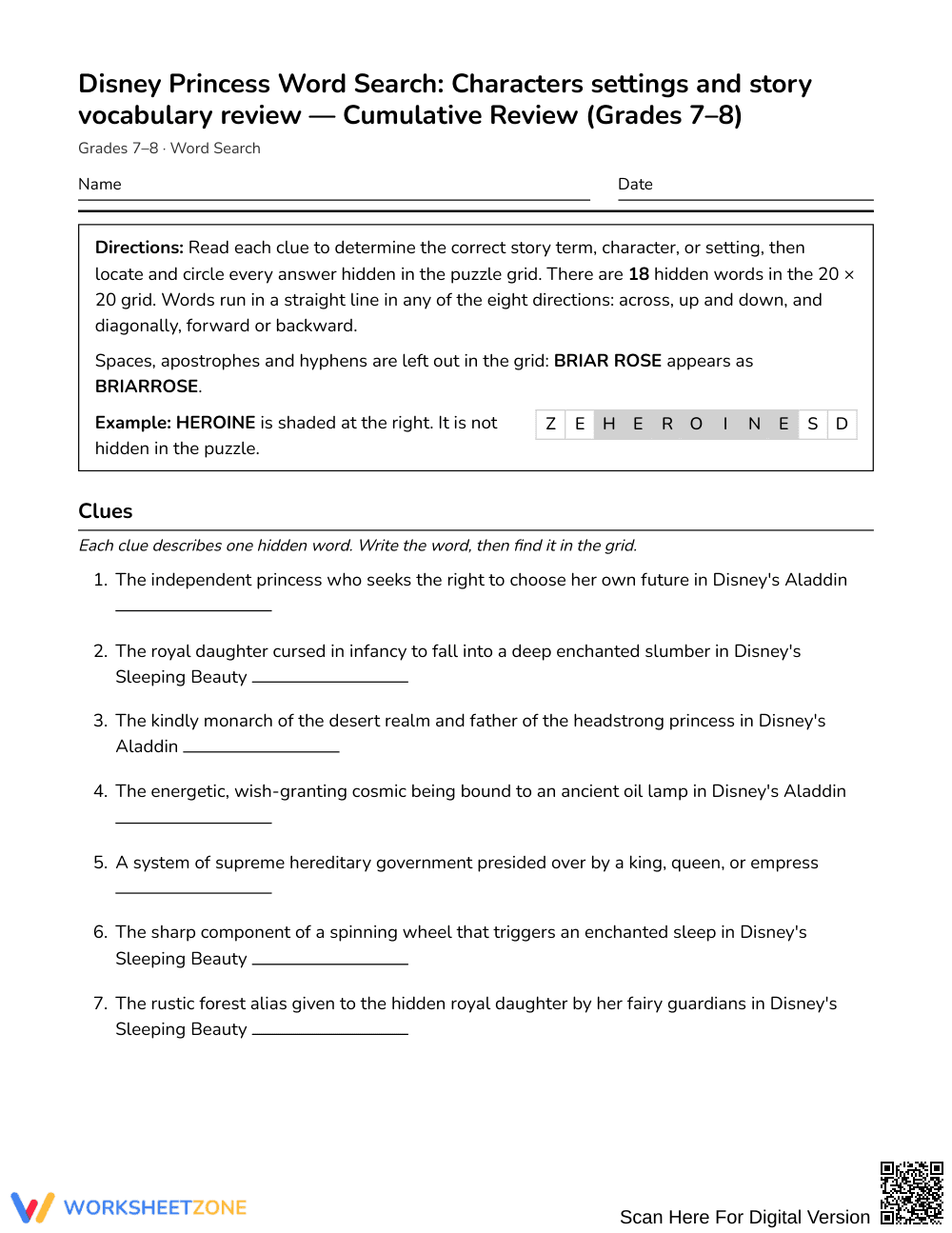
This literary vocabulary word search reinforces narrative terminology, character roles, and story settings for middle school readers. Students solve clues defining narrative concepts and specific story elements before locating each term in the puzzle grid, strengthening academic recall and literary analysis vocabulary through active context-clue decoding.
At a Glance
- Grade: Grades 7–8 · Subject: English Language Arts
- Standard: Not standards-assessed — vocabulary enrichment
- Skill Focus: Narrative terminology, characters, and settings
- Format: 3 pages · 18 words · Answer key included · PDF
- Best For: Vocabulary review and sub plans
- Time: 20–30 minutes
What's Inside
This 3-page printable activity features 18 vocabulary words paired with rigorous text-based clues. Students analyze clues defining narrative terms such as archetype, protagonist, and metamorphosis alongside specific character and setting references before finding them. The resource includes a full 4-page answer key showing exact letter coordinates for swift grading.
Puzzle Mechanics
The activity is built around a dense 20 x 20 letter grid containing 18 hidden vocabulary words. Words run in all 8 directions: north, northeast, east, southeast, south, southwest, west, and northwest. Students work from a shuffled word list and comprehensive definition clues, requiring them to read definitions critically to confirm target terms before searching.
Standards Alignment
This activity is designed for vocabulary enrichment and is not aligned to a specific grade-level content standard. It provides supplementary reinforcement of foundational literary elements, including character archetypes, narrative structure, and thematic vocabulary encountered in middle school literature units.
How to Use It
Deploy this puzzle as an independent review station during a narrative writing unit or as an emergency, zero-prep substitute lesson plan. For formative assessment, circulate as students match clues to determine whether they can distinguish between opposing character functions like protagonist and antagonist prior to circling them. Most middle school learners complete the search within 20 to 30 minutes.
Who It's For
This resource serves general education students in Grades 7–8 reviewing narrative devices, as well as English language learners needing contextual reinforcement of academic terms. Pair this activity with a short story analysis lesson, an anchor chart on narrative archetypes, or an introductory unit on folklore and mythology.
Academic vocabulary acquisition requires meaningful exposure across varied instructional contexts to build lasting reading comprehension. Fisher & Frey (2014) emphasize that intentional word study routines, including retrieval practice, morphological examination, and definition matching, consolidate domain-specific vocabulary into long-term memory. When students read analytical definitions of foundational narrative elements such as archetypes, conflicts, tone, and settings prior to searching letter grids, they engage in dual-stage cognitive processing. This sequence ensures that learners process conceptual meaning rather than simply scanning letters in isolation. Furthermore, repeated exposure to formal literary terminology equips middle school readers with the academic lexicon necessary for discussing texts analytically and constructing evidence-based written responses. Integrating low-stakes retrieval exercises into regular classroom instruction fosters lexical automaticity, supporting broader reading fluency and narrative comprehension as students encounter complex literature across secondary English language arts curricula.


