
































Essential Solving Inequalities Worksheet | Grade 7 Math

Paste this activity's link or code into your existing LMS (Google Classroom, Canvas, Teams, Schoology, Moodle, etc.).
Students can open and work on the activity right away, with no student login required.
You'll still be able to track student progress and results from your teacher account.
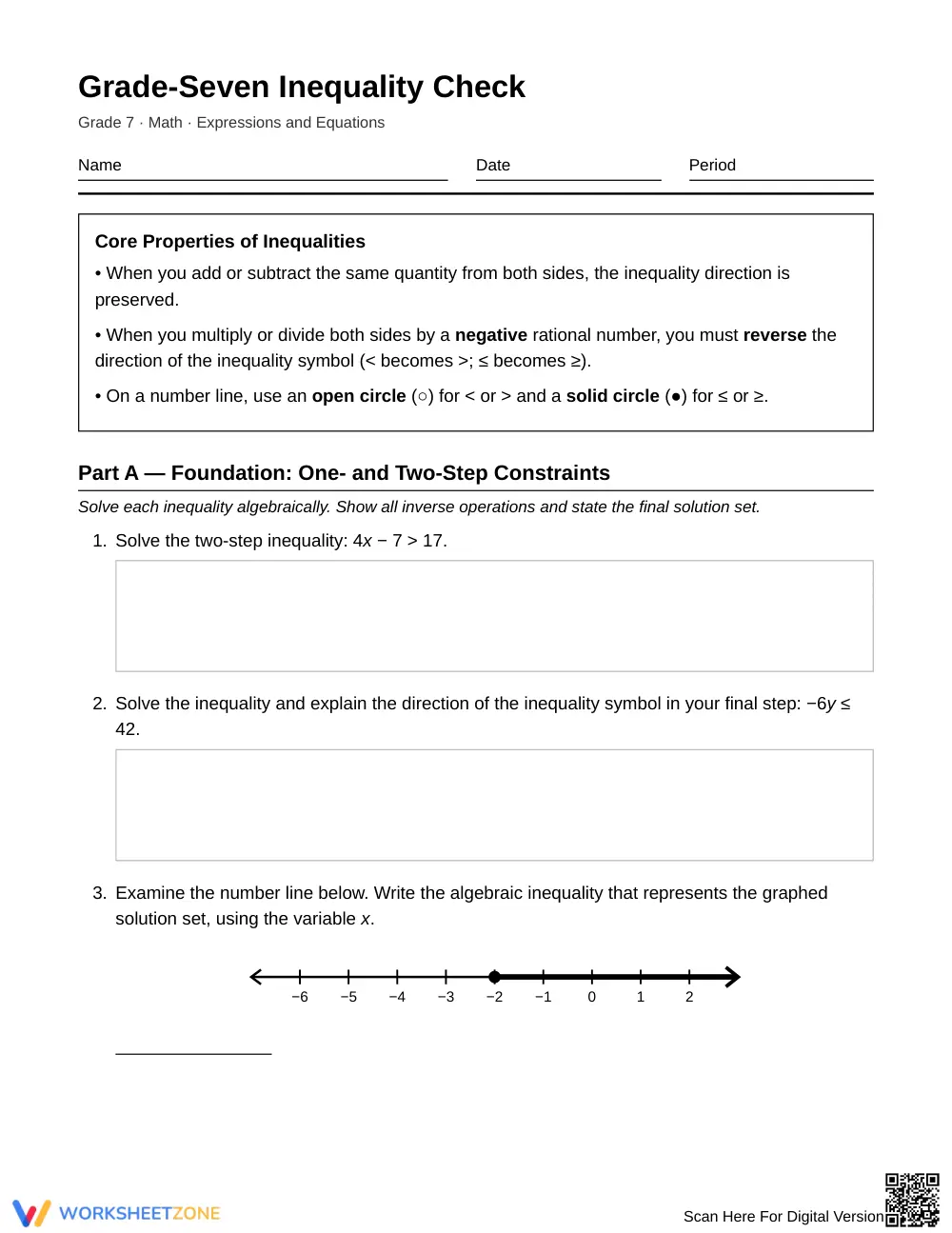
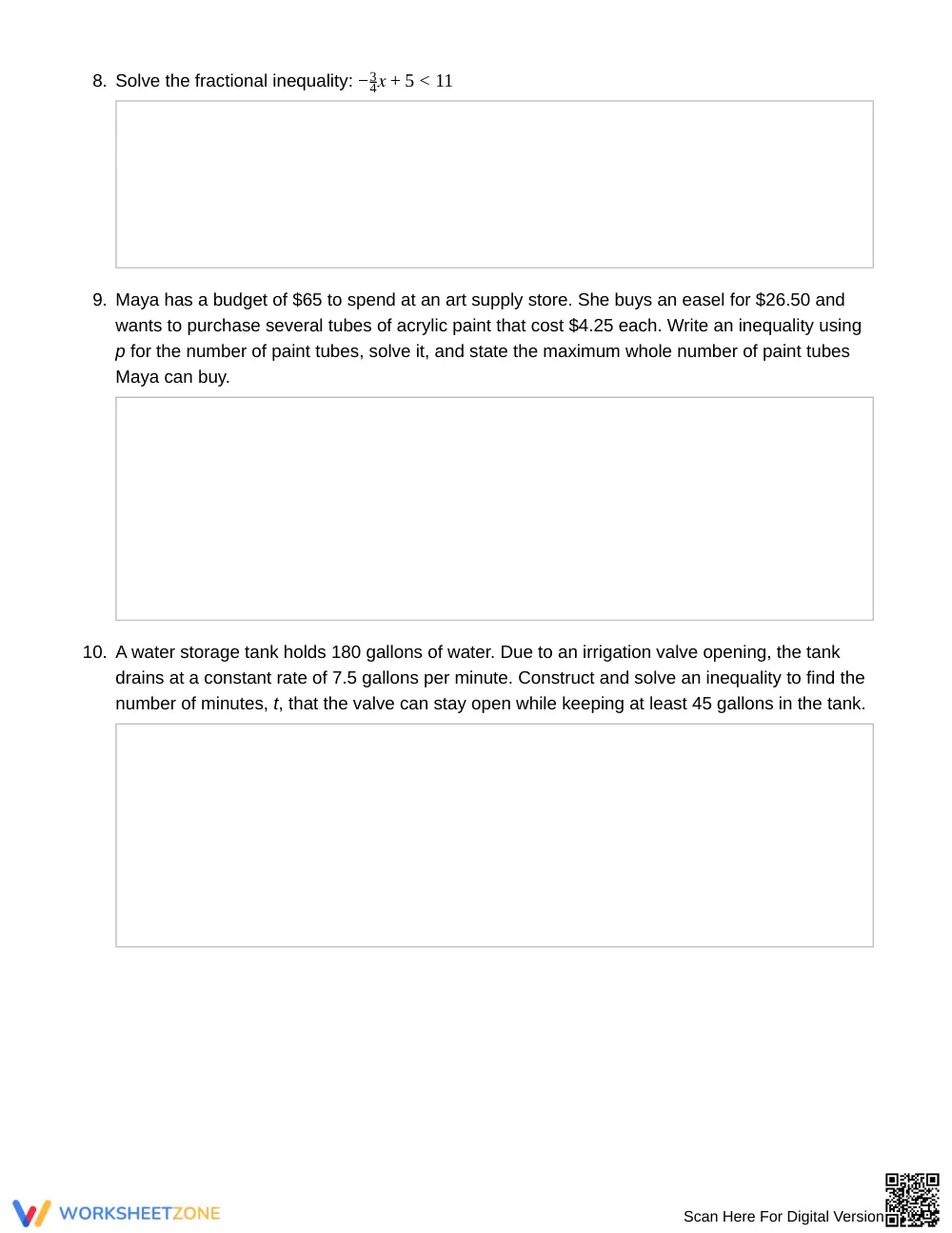
This comprehensive Grade 7 math worksheet equips students to master one-step, two-step, and multi-step algebraic inequalities. Through 16 rigorous problems, learners solve linear inequalities with rational coefficients, reverse inequality symbols when operating with negative numbers, graph solution sets on number lines, and construct algebraic models to solve real-world constraint problems.
At a Glance
- Grade: 7 · Subject: Math
- Standard:
7.EE.B.4— Solve word problems leading to inequalities and graph solution sets- Skill Focus: Solving and graphing linear inequalities with rational coefficients
- Format: 5 pages · 16 problems · Answer key included · PDF
- Best For: Core algebra skill practice and assessment
- Time: 45–60 minutes
This 5-page worksheet includes 16 multi-part tasks, a core properties reference box, number lines, and a full 4-page answer key. Students progress from basic operations and solution set verification to multi-step word problems involving budgets and capacity limits, ending with error analysis and geometric constraints.
Skill Progression
- Guided Practice (Part A, 4 tasks): Students review foundational properties, solve two-step inequalities, read graphs, and test replacement sets.
- Supported Practice (Part B, 8 tasks): Learners handle rational coefficients, fractions, and decimals while modeling real-world constraints and graphing boundary points.
- Independent Practice (Part C, 4 tasks): Students tackle multi-step problems, conduct error analysis on sign reversal, and solve compound geometric constraints.
This gradual-release structure moves students smoothly from procedural reinforcement to independent mathematical modeling.
Standards Alignment
This resource aligns with 7.EE.B.4: "Use variables to represent quantities in a real-world or mathematical problem, and construct simple equations and inequalities to solve problems." It also reinforces 7.EE.B.4.b by requiring students to graph solutions and interpret them in context. Both standard codes can be copied directly into lesson plans, IEP goals, or district curriculum mapping tools.
How to Use It
Deploy this activity after direct instruction on inverse operations and sign-reversal rules. In a 50-minute class, use Part A for guided partner practice, Part B for independent station work, and Part C as an exit ticket. During independent time, check whether students remember to reverse inequality symbols when dividing by negative coefficients.
Who It's For
This resource is designed for Grade 7 general mathematics, pre-algebra classes, and Grade 8 intervention groups. Differentiate by pairing struggling students with a number line anchor chart, while offering Part C as an extension for advanced learners ready for compound constraints.
According to EdReports 2024, standards-aligned middle school mathematics curricula must balance procedural fluency with conceptual reasoning and authentic problem modeling to build lasting mastery. This worksheet directly targets standard 7.EE.B.4 by guiding Grade 7 students to construct algebraic inequalities, manage rational coefficients, and accurately graph solution sets on number lines. Research from RAND AIRS 2024 demonstrates that structured practice sets featuring embedded error analysis substantially improve student retention of operational rules, such as reversing inequality symbols during negative division, compared to conventional drill worksheets alone. By applying inequalities to contextual scenarios involving consumer budgets, drainage rates, elevator capacities, and geometric perimeters, learners develop critical algebraic reasoning skills. The 16 scaffolded tasks and 4-page answer key provide comprehensive support for regular classroom instruction, homework assignments, formative evaluation, and targeted small-group intervention.


