




























Views
Downloads



Essential Scientific Notation Worksheet | Grade 8 Math

Paste this activity's link or code into your existing LMS (Google Classroom, Canvas, Teams, Schoology, Moodle, etc.).
Students can open and work on the activity right away, with no student login required.
You'll still be able to track student progress and results from your teacher account.
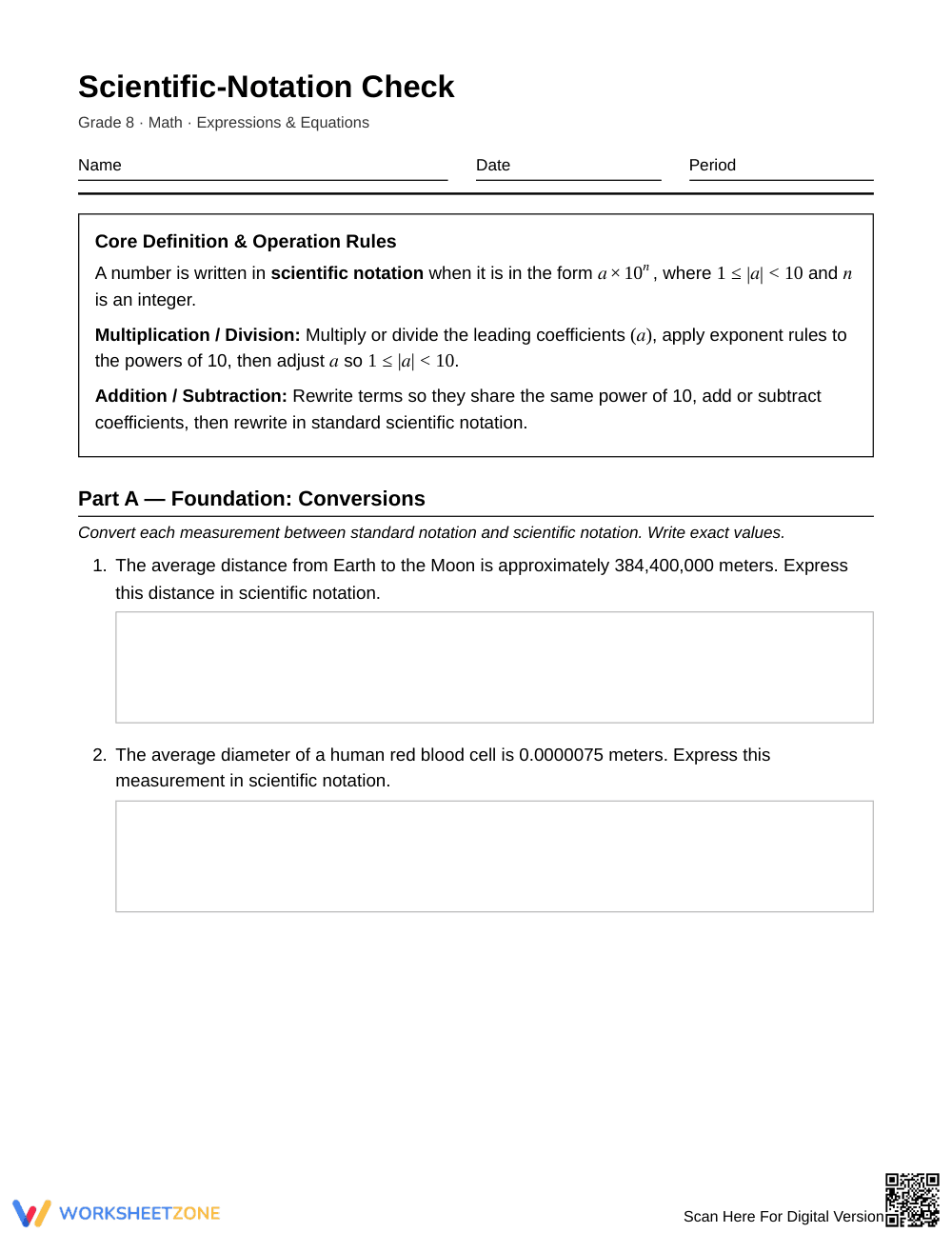
Master scientific notation conversions and operations with this comprehensive Grade 8 math worksheet. Students convert standard numbers, execute arithmetic operations across scientific contexts, and evaluate multi-step mathematical arguments. Designed to build procedural fluency and conceptual understanding, this resource prepares learners to manage very large and small quantities.
At a Glance
- Grade: 8 · Subject: Math
- Standard: Perform operations with numbers expressed in scientific notation and convert forms
- Skill Focus: Scientific notation conversions, comparisons, and arithmetic operations
- Format: 5 pages · 16 problems · Answer key included · PDF
- Best For: Mid-unit practice or assessment review
- Time: 40–55 minutes
What's Inside
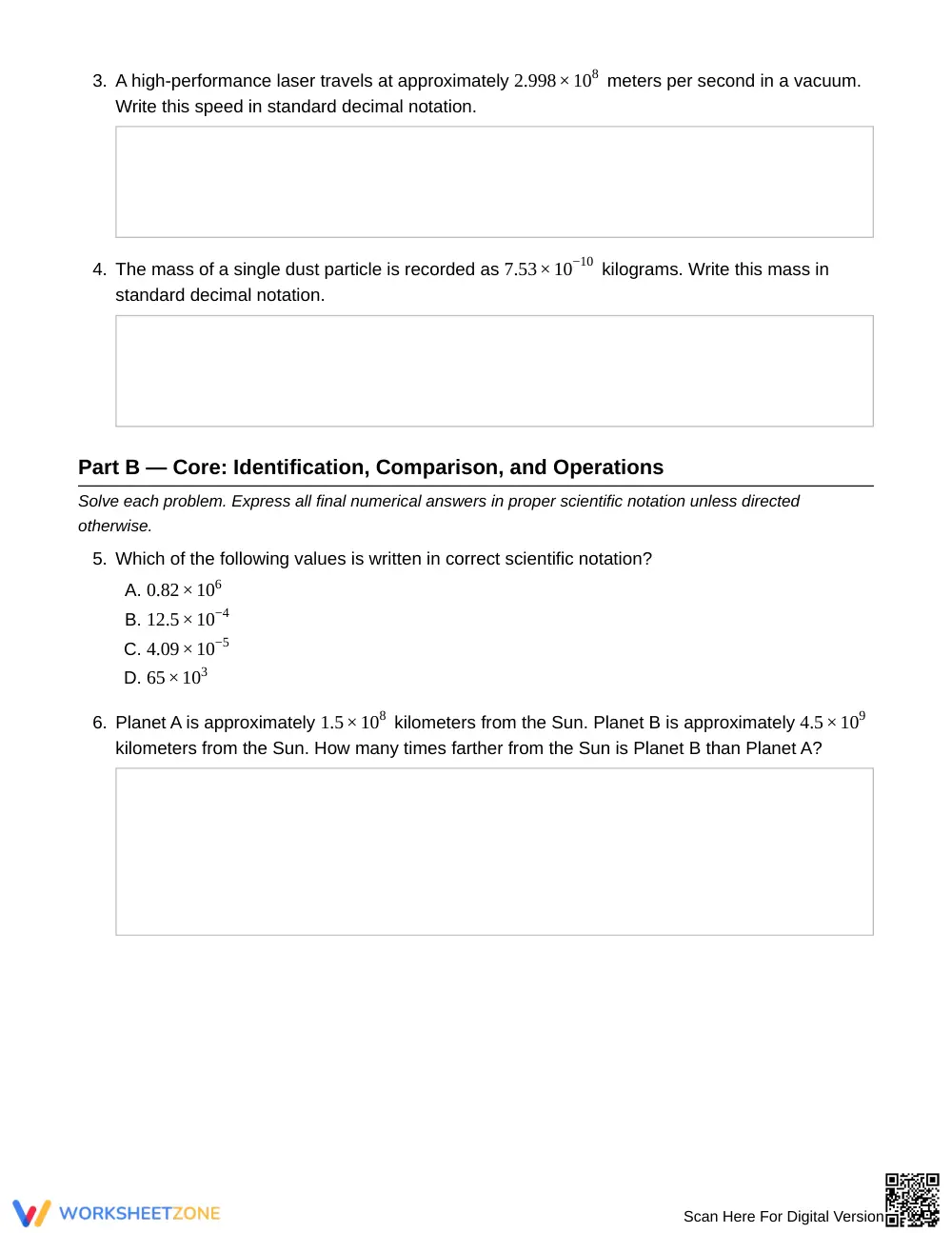
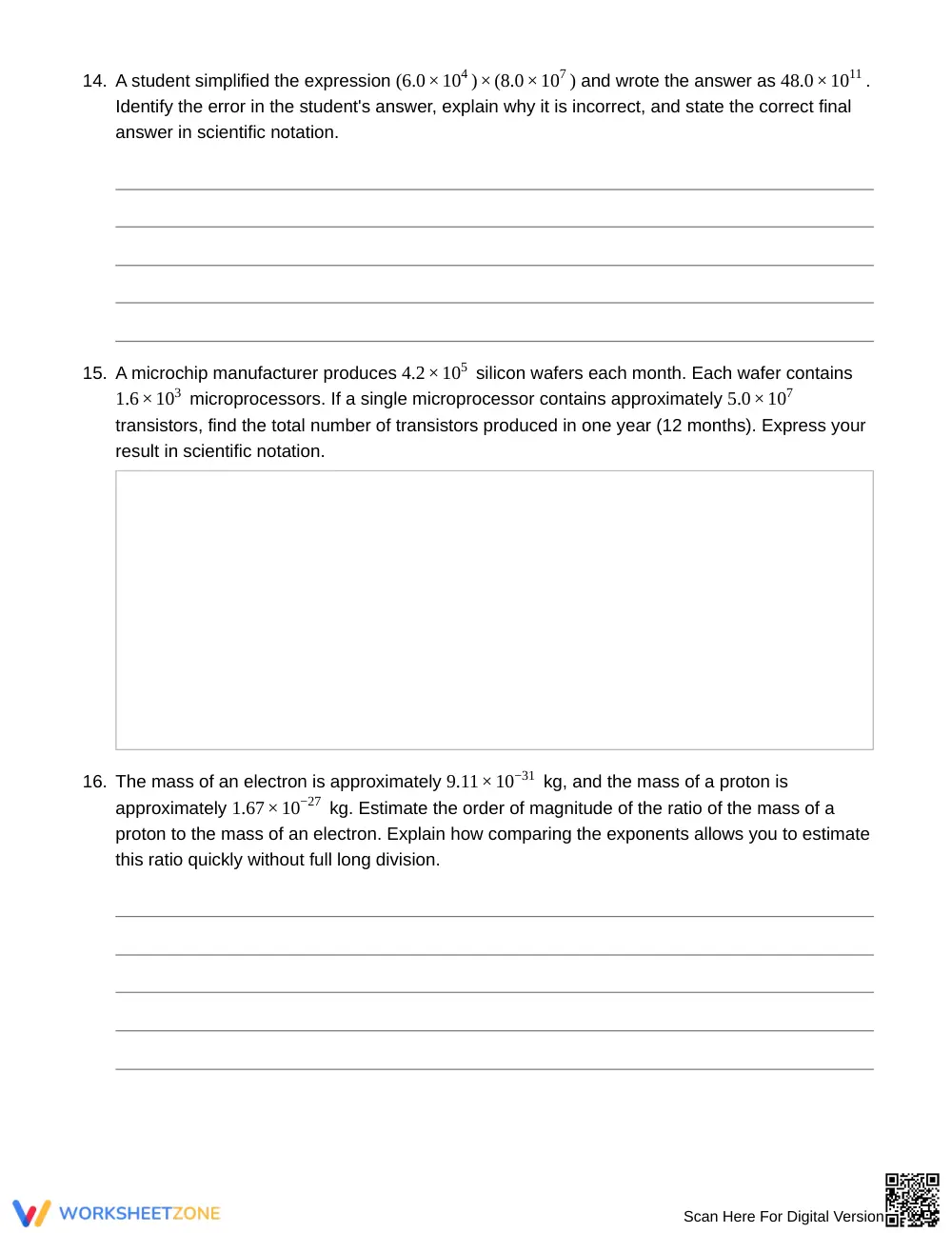
This 5-page worksheet provides 16 rigorous math tasks organized across three sections, supported by a reference rule box. Students encounter conversions, magnitude comparisons, four-operation word problems, error analysis, and order-of-magnitude estimations. A complete 2-page answer key provides step-by-step solutions for immediate checking and self-assessment.
Skill Progression
- Guided Practice (Part A): 4 foundational items convert distances, speeds, and masses between standard and scientific notation using rule-based prompts.
- Supported Practice (Part B): 8 core problems guide learners through identification, comparative ratios, metric conversions, and arithmetic operations.
- Independent Practice (Part C): 4 challenge tasks demand multi-step reasoning, rate calculations, error analysis, and order-of-magnitude justifications.
This structure follows the gradual-release model, transitioning learners smoothly from procedural conversion to independent mathematical reasoning.
Standards Alignment
This resource aligns with Grade 8 mathematics expectations for Expressions and Equations. Students perform operations with numbers expressed in scientific notation, select appropriate units of measure, and estimate extreme physical quantities. This alignment can be copied directly into lesson plans, IEP goals, or district curriculum mapping tools.
How to Use It
Deploy this worksheet after direct instruction on exponent rules and scientific notation operations, or assign it as a mid-unit review. Formatively assess student work by observing whether learners correctly readjust leading coefficients to satisfy 1 ≤ |a| < 10 after adding or multiplying. Expected completion time is 40 to 55 minutes.
Who It's For
This resource serves Grade 8 math classrooms, accelerated Grade 7 learners, and high school science students needing exponent review. Differentiate by utilizing the built-in rule box or pairing students for collaborative problem-solving. Pair naturally with an astronomy or physical science anchor lesson.
According to EdReports 2024 instructional materials criteria, high-quality middle school mathematics resources must balance procedural skill, conceptual understanding, and real-world application. This Grade 8 scientific notation worksheet directly addresses these mathematical shifts by moving students systematically from basic base-ten place value conversions to complex, multi-step scientific modeling. Learners do not simply memorize exponent rules; they apply them to calculate astronomical distances, microscopic cell lengths, and computer processing rates. Furthermore, the inclusion of non-routine tasks—such as finding coefficient errors and estimating ratios of physical constants by comparing magnitude exponents—cultivates analytical precision. By integrating structured scaffolding with authentic scientific contexts and complete reference solutions, this 16-task resource ensures that learners attain the deep conceptual fluency required for advanced high school algebra and physical sciences.


