




























Essential Science Cycles Worksheet | Grades 9-12 Science
Paste this activity's link or code into your existing LMS (Google Classroom, Canvas, Teams, Schoology, Moodle, etc.).
Students can open and work on the activity right away, with no student login required.
You'll still be able to track student progress and results from your teacher account.
This high school science worksheet trains students to critically analyze misconceptions and model errors across interconnected Earth and physical science cycles. Learners evaluate authentic peer claims, trace matter and energy pathways, calculate conservation of mass in chemical reactions, and synthesize cycle dynamics across atmospheric, biological, and geological systems.
At a Glance
- Grade: Grades 9–12 · Subject: Science
- Standard: High School Physical and Life Sciences — Construct explanations for cycling of matter and energy flow
- Skill Focus: Misconception critique and matter-energy conservation analysis
- Format: 4 pages · 17 problems · Answer key included · PDF
- Best For: Mid-unit formative check or review
- Time: 40–50 minutes
What's Inside
Across four rigorous pages, students work through 17 diagnostic and constructed-response tasks. Structural supports include seasonal atmospheric carbon data tables, chemical stoichiometry balancing charts, and rock formation reference panels. A complete four-page model answer key provides exact sample explanations, balancing verification, and targeted pedagogical rationale for every item.
Skill Progression
- Guided Practice (Part A): Students examine carbon cycle pathways, using model arrows and monthly Keeling-style data sets to refute the claim that plants exclusively take in carbon dioxide.
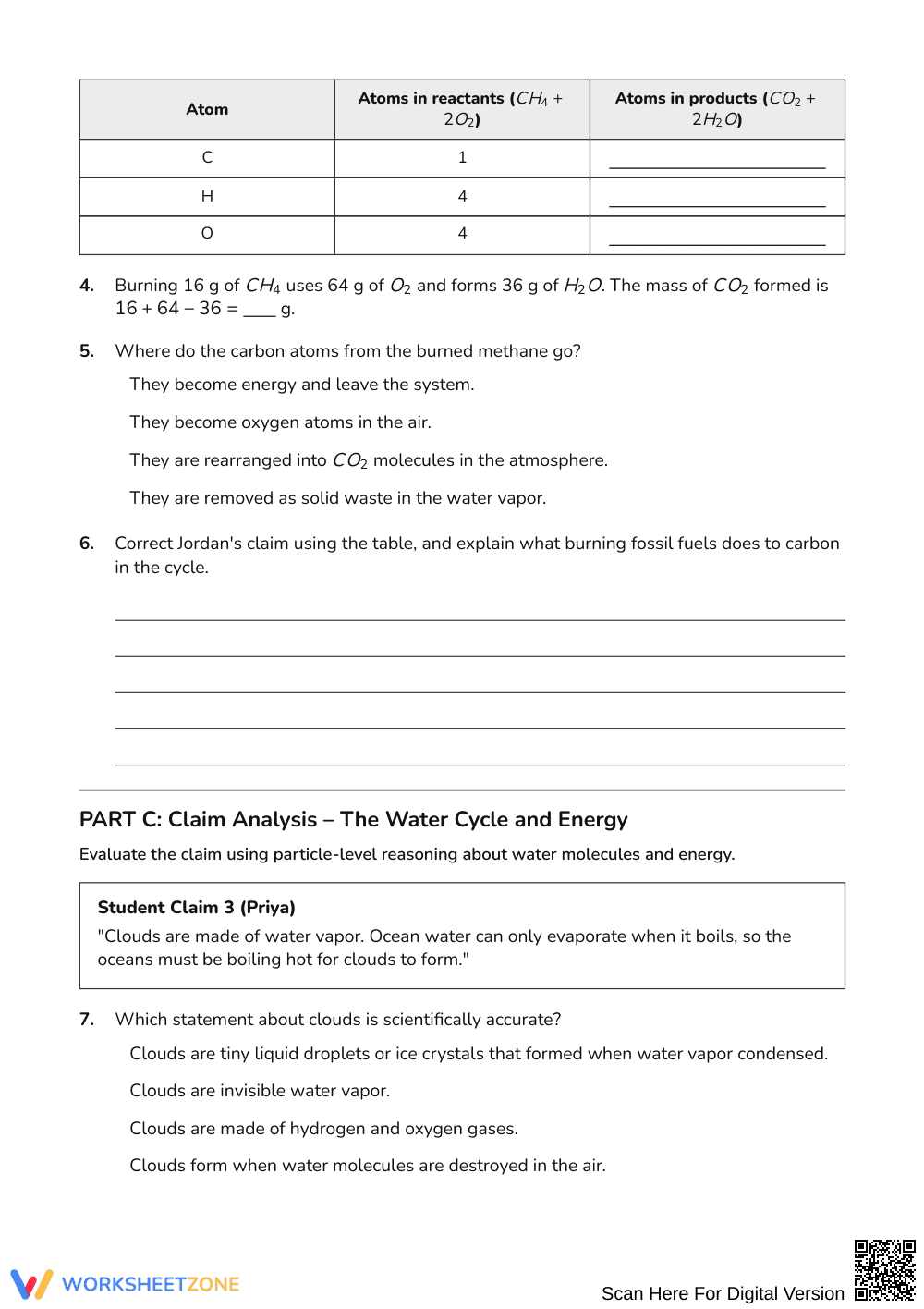
- Supported Practice (Parts B & C): Learners audit methane combustion using atom counts to prove mass conservation, followed by particle-level kinetic explanations of ocean evaporation below boiling temperatures.
- Independent Practice (Part D): Students independently correct rock cycle definitions and compose a unified synthesis contrasting conserved matter against continuous energy transformations across systems.
This sequence follows a gradual-release framework, transitioning students from scaffolded model interpretation to self-directed scientific argumentation.
Standards Alignment
This resource aligns with high school standards requiring students to develop models illustrating the cycling of matter and energy flow through Earth systems and living organisms. It emphasizes the conservation of atoms in chemical transformations. Standard descriptions can be copied directly into lesson plans, IEP goals, or district curriculum mapping tools.
How to Use It
Deploy this worksheet after initial direct instruction on biogeochemical cycles and thermodynamics. As an active learning activity, have students complete Parts A and B collaboratively before writing individual responses for Part D. During circulation, check whether students confuse thermal energy release during condensation with energy destruction. Typical completion requires 40 to 50 minutes.
Who It's For
This activity is designed for high school biology, chemistry, and environmental science students addressing persistent conceptual traps. Tiered graphic organizers support emerging bilingual learners, while rigorous reaction tables challenge advanced placement students. Pair this activity with a physical molecular modeling lab or direct instruction on equilibrium.
According to research from Fisher & Frey (2014) on close reading and structured analytical argument in STEM disciplines, confronting pre-existing intuitive fallacies accelerates conceptual consolidation. By examining flawed student claims, secondary learners must explicitly reconcile observed data with foundational conservation laws rather than passively reiterating definitions. This 4-page worksheet guides high school science students through 17 rigorous critique items spanning photosynthesis respiration dynamics, hydrocarbon combustion balancing, and atmospheric thermal phase changes. Students calculate exact atom conservation metrics, interpret real-world monthly atmospheric trend curves, and resolve kinetic molecular dynamics at liquid-vapor interfaces. Teachers gain immediate formative evidence regarding student ability to distinguish between matter cycling and unidirectional energy flow. This comprehensive instructional tool establishes verifiable conceptual mastery across core biological, chemical, and planetary science standards.


