































Essential Science Cycles Worksheet | Grade 9-12 Science

Paste this activity's link or code into your existing LMS (Google Classroom, Canvas, Teams, Schoology, Moodle, etc.).
Students can open and work on the activity right away, with no student login required.
You'll still be able to track student progress and results from your teacher account.
This comprehensive science worksheet guides high school students through constructing, testing, and revising scientific models of Earth's carbon and rock cycles. Students balance chemical equations, evaluate historical atmospheric data, and connect energy transfers across Earth systems. Through structured tasks, learners master conservation laws and biogeochemical flows.
At a Glance
- Grade: Grades 9–12 · Subject: Science
- Standard: Construct and revise models showing matter cycling and energy flows across Earth systems
- Skill Focus: Integrated Earth and life science cycle modeling
- Format: 4 pages · 20 problems · Answer key included · PDF
- Best For: High school cycle modeling, review, and assessment
- Time: 45–60 minutes
What's Inside
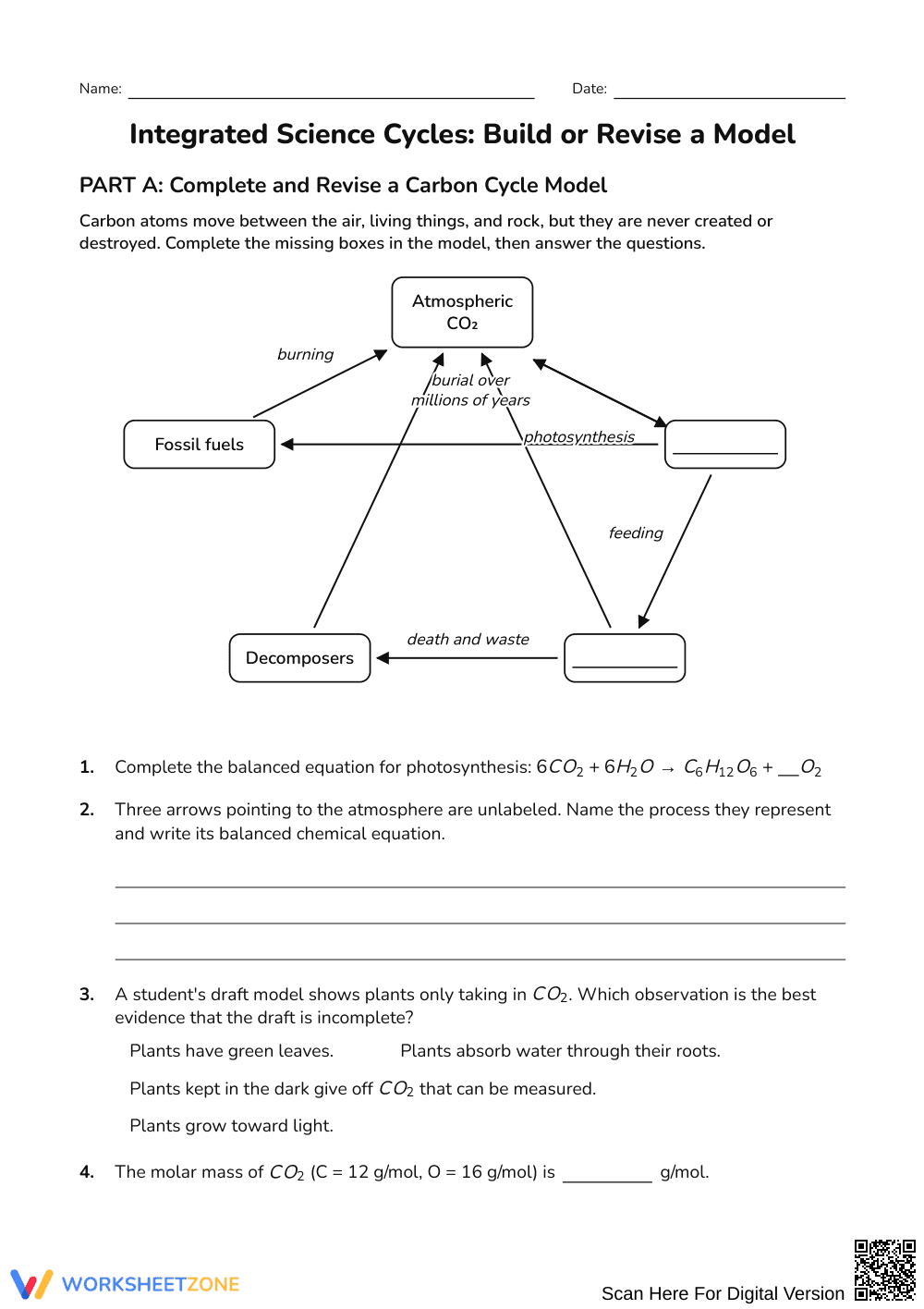
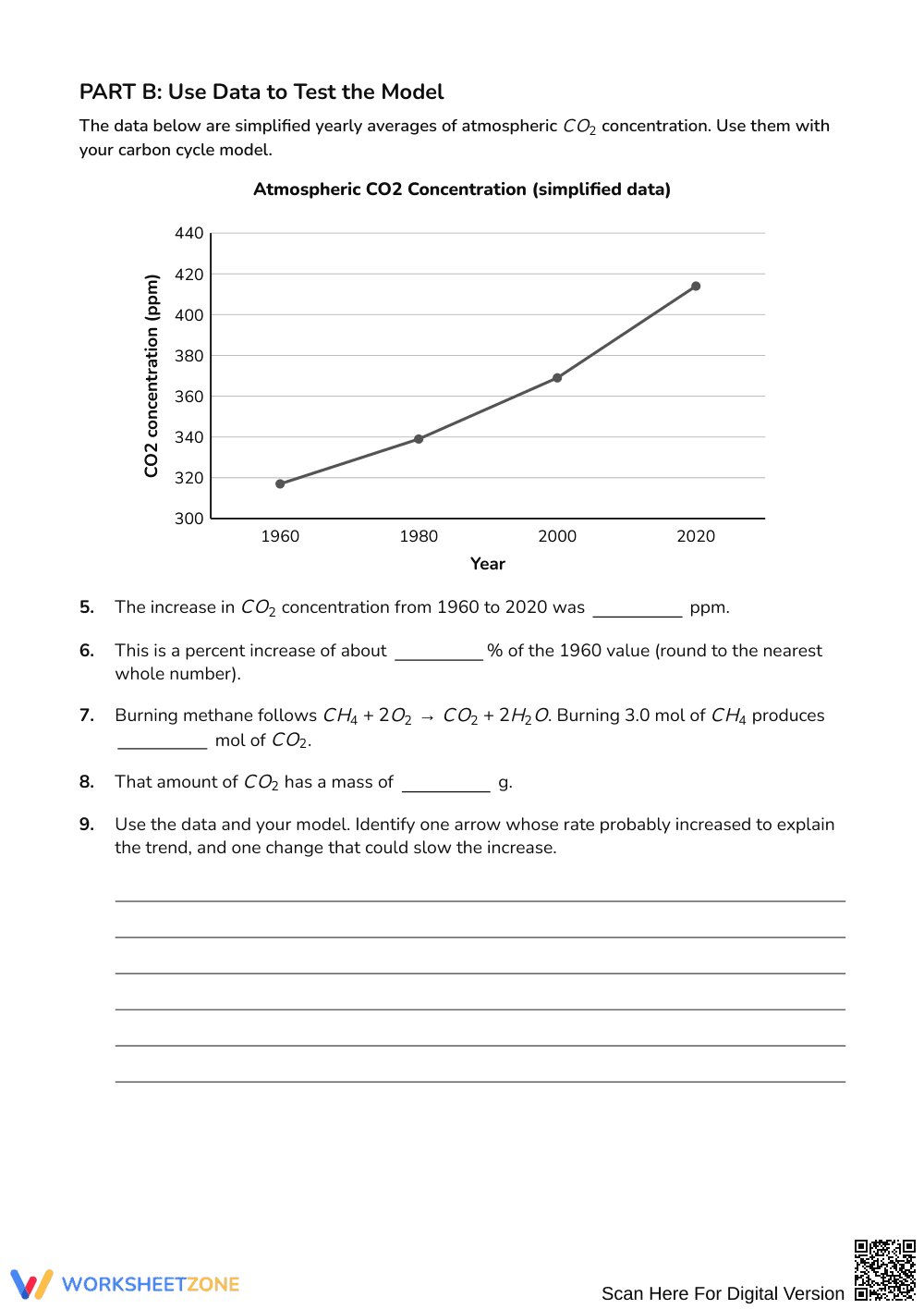
Spanning 4 student pages, this resource provides 20 tasks organized into 4 modules. Part A covers carbon cycle diagrams and balanced equations for respiration and photosynthesis. Part B analyzes 1960–2020 atmospheric data with stoichiometry. Part C examines rock cycle phase changes and energy transfers, while Part D prompts a claim-evidence-reasoning argument. A full 4-page answer key is included.
Skill Progression
- Guided Practice: Students complete carbon diagrams and balance photosynthetic and cellular respiration equations with scaffolded chemical cues.
- Supported Practice: Learners calculate carbon dioxide data trends and stoichiometry, then categorize thermal energy changes across rock cycle processes.
- Independent Practice: Students write an evidence-based scientific explanation defending the conservation of matter during combustion.
This sequence follows the gradual release of responsibility model, guiding students toward self-directed systems synthesis.
Standards Alignment
This worksheet aligns with high school standards requiring students to develop and revise models illustrating matter cycling and energy flows across Earth systems. Students trace atomic rearrangement in photosynthesis and rock formation, confirming matter conservation. These standards can be copied directly into lesson plans, IEP goals, or district curriculum mapping tools.
How to Use It
Assign this worksheet after direct instruction on biogeochemical cycles as a mid-unit check. Alternatively, use Parts A and B for peer collaboration and Parts C and D as independent work. Check whether students identify cellular respiration as the missing atmospheric carbon arrow. Completion time is 45 to 60 minutes.
Who It's For
This activity serves high school biology, chemistry, and environmental science students mastering cycles of matter. Provided molar masses and equation skeletons support striving learners, while stoichiometry and argument writing extend advanced students. Pair this activity with an interactive biogeochemical simulation or rock classification lab.
High school science modeling requires learners to synthesize abstract chemical equations, macroscopic Earth system interactions, and quantitative empirical data into coherent explanatory frameworks. According to research on structured disciplinary literacy and guided problem-solving by Fisher & Frey (2014), instructional scaffolds that transition students from supported diagram labeling to independent evidence-based scientific argumentation significantly enhance long-term retention of complex systemic concepts. This 4-page, 20-problem science worksheet systematically operationalizes that pedagogical framework across carbon and rock cycles. Students balance chemical reactions for photosynthesis and cellular respiration, calculate atmospheric carbon trends across a 60-year timeline, evaluate endothermic and exothermic phase changes in Earth materials, and write formal claim-evidence-reasoning explanations defending the law of conservation of mass. By integrating quantitative stoichiometry with dynamic multi-cycle system interactions, the resource provides educators with robust formative evidence of high school physical and Earth science conceptual mastery.


