



























Essential Science Cycles Worksheet | Grade 9‑12 Science
Paste this activity's link or code into your existing LMS (Google Classroom, Canvas, Teams, Schoology, Moodle, etc.).
Students can open and work on the activity right away, with no student login required.
You'll still be able to track student progress and results from your teacher account.
Students explore the water, carbon, and rock cycles through guided cause‑and‑effect questions that require them to predict outcomes when conditions shift, interpret particle models, balance chemical equations, and analyze real data. The worksheet builds confidence in scientific reasoning and explanation.
At a Glance
- Grade: 9‑12 · Subject: Science
- Standard:
— Predict and explain cause‑and‑effect changes in integrated science cycles- Skill Focus: Integrated Science Cycles – particle models, chemical equations, data interpretation
- Format: 4 pages · 18 problems · Answer key included · PDF
- Best For: Cycle unit review, formative assessment, interdisciplinary labs
- Time: 30–45 minutes total
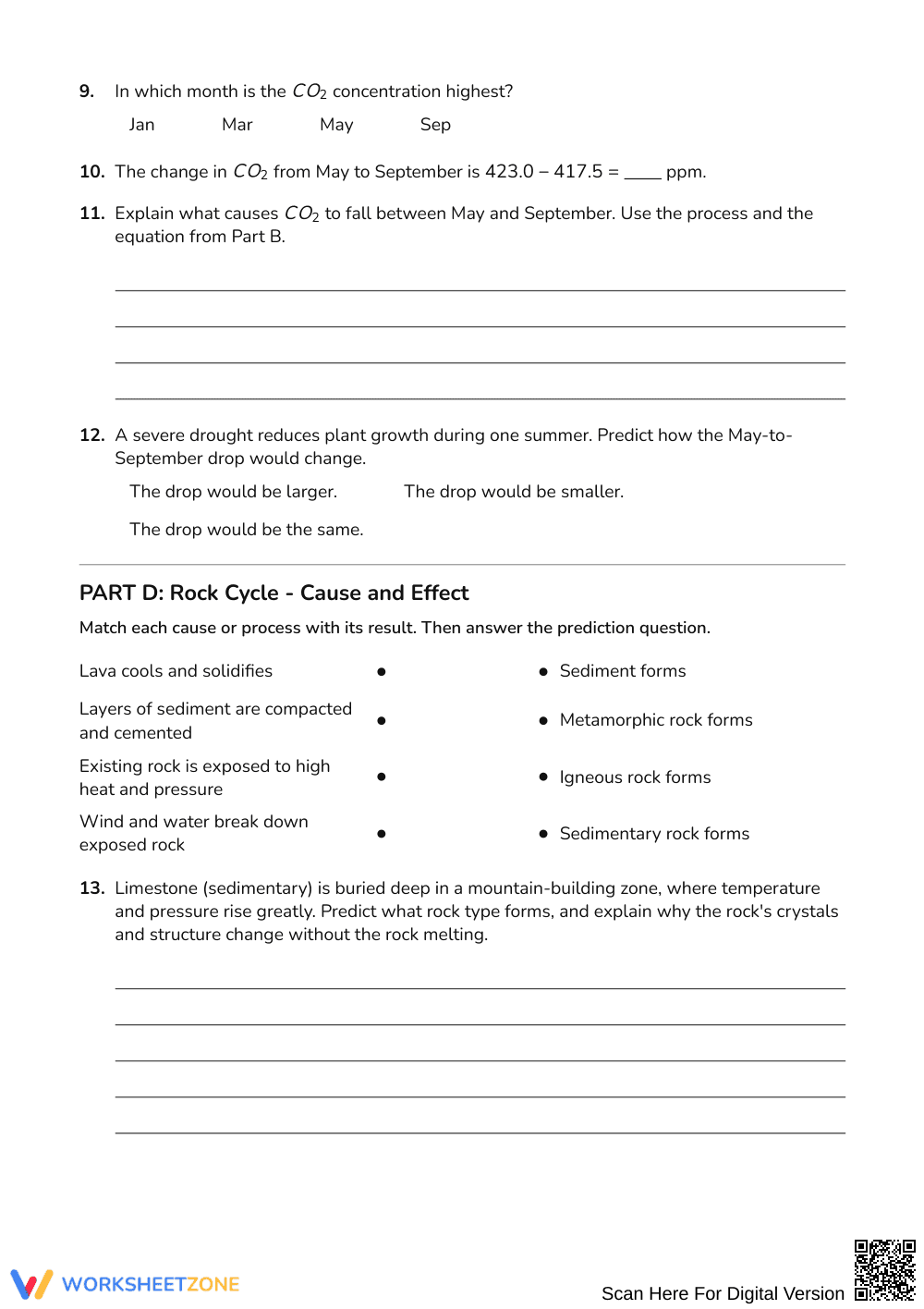
Inside the 4‑page packet you’ll find four parts—Water Cycle, Carbon Cycle, Data Evidence, and Rock Cycle—each containing multiple‑choice predictions, short‑answer explanations, a quantitative energy calculation, and a matching activity. A concise answer key follows the last page, and a worked example appears at the start of Part A to model reasoning.
Skill Progression
- Guided practice – 6 multiple‑choice items with sentence frames and a word bank to model particle‑model reasoning.
- Supported practice – 6 short‑answer and calculation tasks with partial hints, encouraging students to apply equations.
- Independent practice – 6 data‑analysis and matching problems that require full written explanations.
These steps follow the classic I Do, We Do, You Do release model.
Standards Alignment
Students predict and explain cause‑and‑effect changes in integrated science cycles, using particle models, chemical equations, and quantitative data. This aligns with high‑school science standards for systems and energy transformations. Both standard references can be copied directly into lesson plans, IEP goals, or district curriculum mapping tools.
How to Use It
1. Before a unit test, have students complete the worksheet individually to diagnose misconceptions about cycle processes. Observe answer patterns to inform a targeted review.
2. During a lab on evaporation, use Part A as a quick exit ticket; students write a one‑sentence prediction and justification, reinforcing the lesson’s objective.
Who It's For
Designed for high‑school science learners (grades 9‑12) who need practice linking models to real‑world phenomena. The built‑in scaffolds support emerging readers, while the independent section challenges advanced students. Pair with a classroom diagram of the water cycle or an anchor chart of the carbon cycle for seamless integration.
Integrated Science Cycles: Cause and Effect worksheet targets the high‑school standard of predicting and explaining cycle dynamics, a skill echoed in research linking explicit modeling to deeper conceptual understanding. Fisher & Frey (2014) emphasize that structured practice with scaffolded prompts improves students’ ability to transfer scientific reasoning across contexts. By presenting particle‑model predictions, balanced chemical equations, and real data interpretation, the worksheet operationalizes this recommendation, offering 18 varied tasks that move learners from guided to independent application. The inclusion of an answer key supports immediate feedback, a proven factor in reinforcing mastery (RAND AIRS 2024). Teachers report that the clear progression and printable format save preparation time, allowing more class minutes for discussion and inquiry.


