


























Views
Downloads
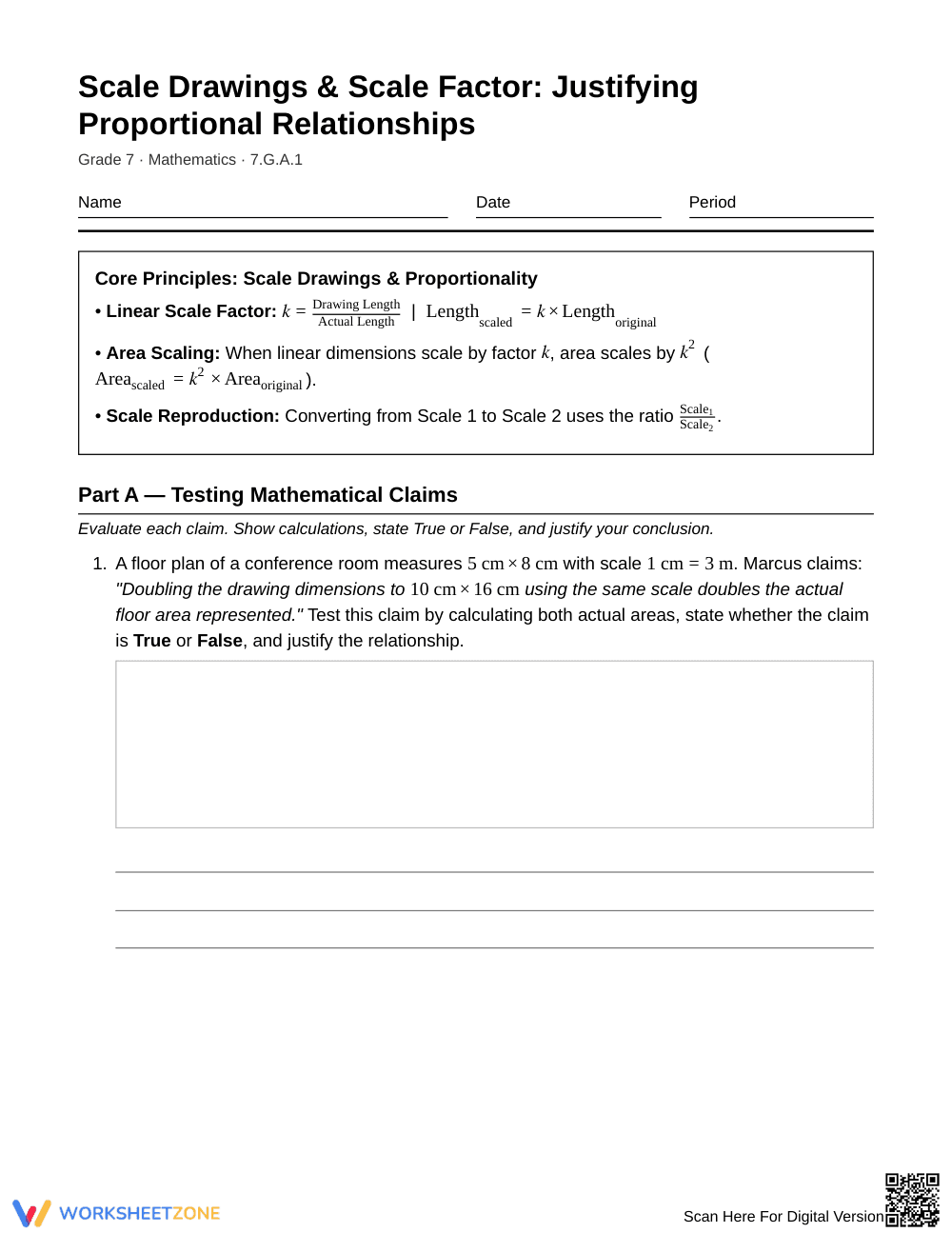

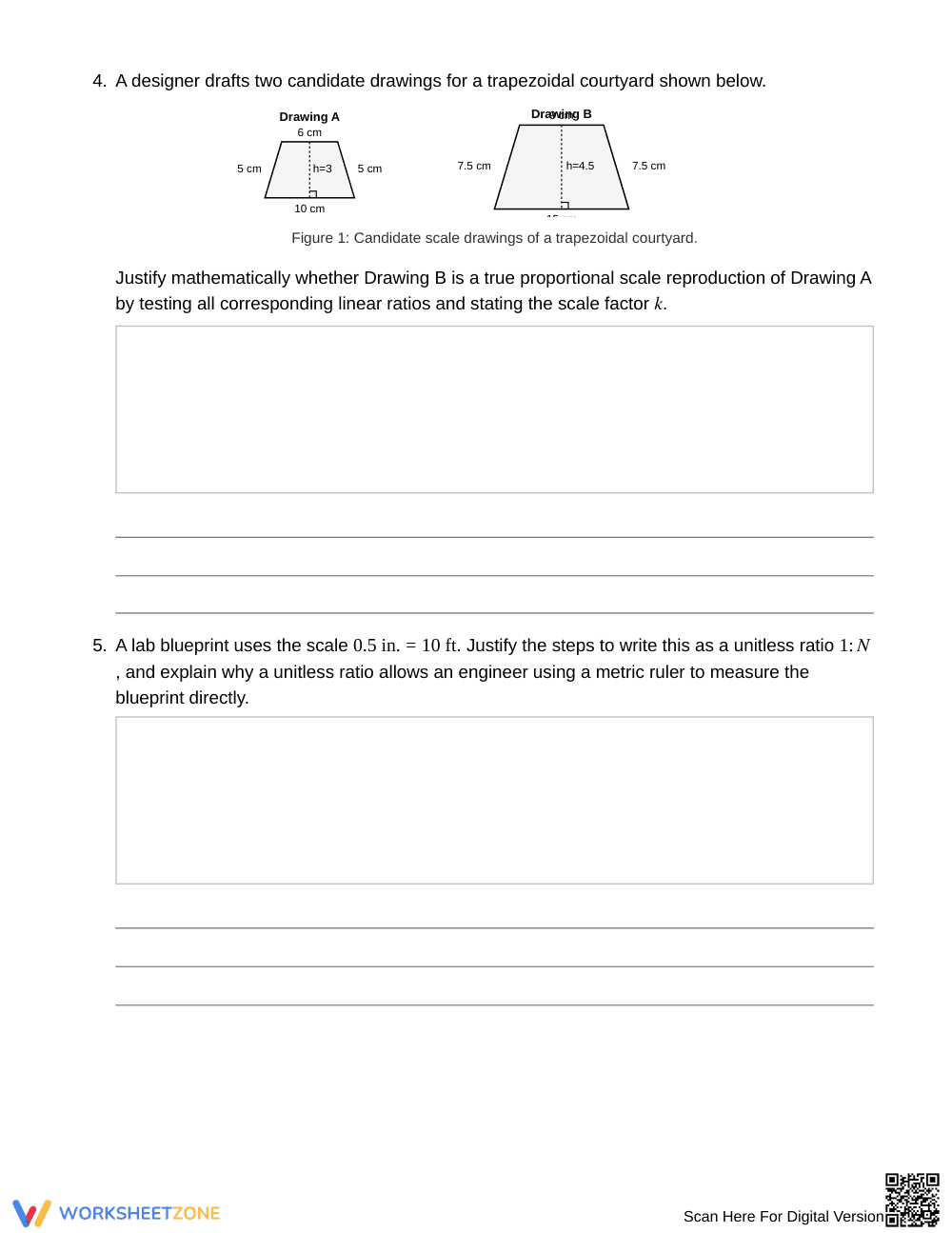
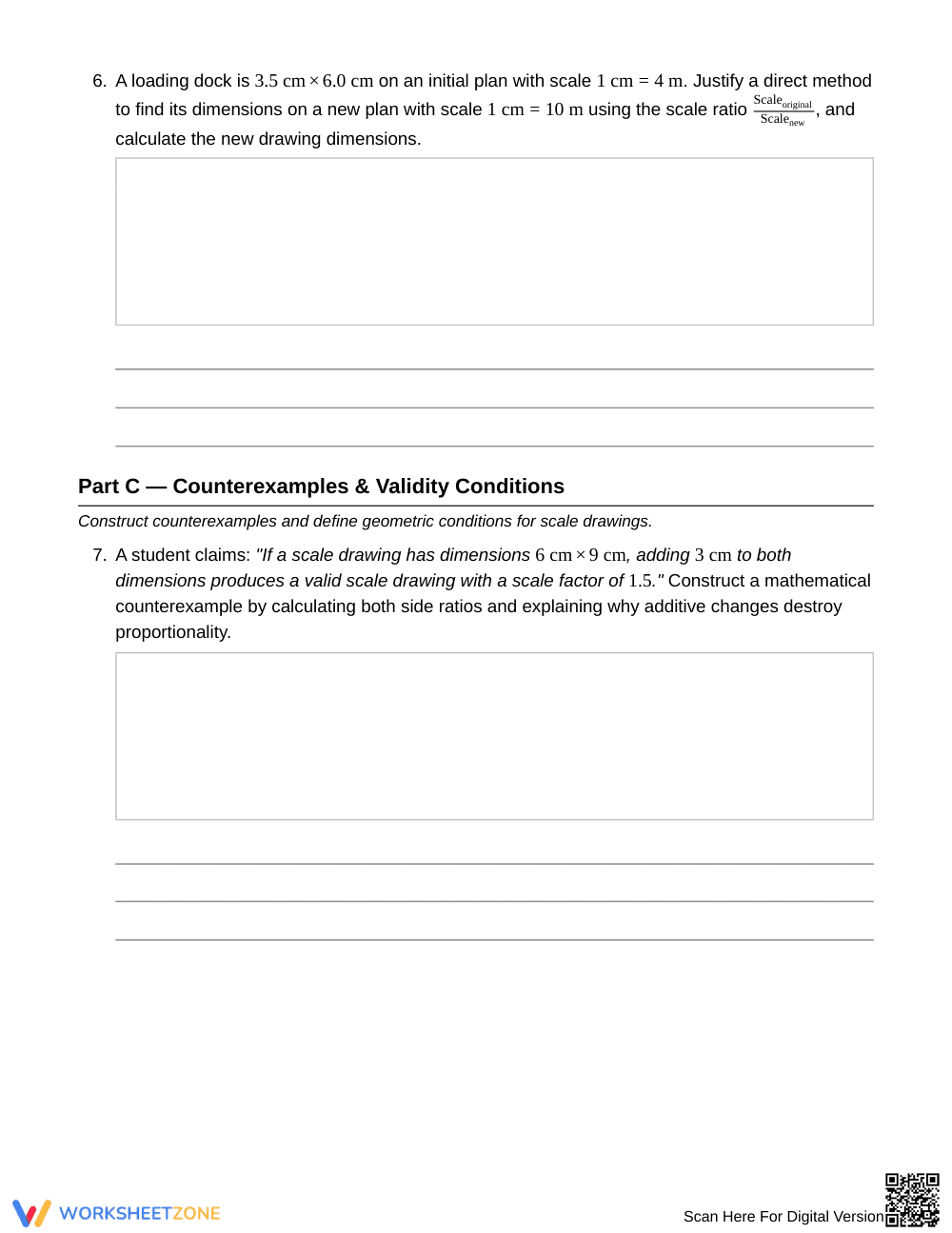


Essential Scale Factor Reasoning Worksheet | Grade 7 Math
Paste this activity's link or code into your existing LMS (Google Classroom, Canvas, Teams, Schoology, Moodle, etc.).
Students can open and work on the activity right away, with no student login required.
You'll still be able to track student progress and results from your teacher account.
This Grade 7 geometry worksheet equips middle school students to mathematically justify scale factor relationships, area scaling, and proportional models. Through 8 rigorous analysis and proof tasks, learners evaluate mathematical claims, calculate multi-step scale conversions, and construct formal counterexamples to solidify geometric reasoning.
At a Glance
- Grade: 7 · Subject: Math
- Standard:
7.G.A.1— Compute actual lengths and areas from scale drawings and justify proportional relationships- Skill Focus: Justify a Scale-Factor Relationship
- Format: 5 pages · 8 problems · Answer key included · PDF
- Best For: Geometric reasoning and conceptual mastery practice
- Time: 35–45 minutes
What's Inside
This 5-page printable resource includes a Core Principles reference header covering linear scale factors, area scaling rules, and unit conversion ratios. The 8 multi-part exercises span error analysis, algebraic area proofs, scale-to-scale conversions, and counterexample constructions. A complete 2-page answer key provides full step-by-step mathematical justifications for every problem.
Skill Progression
- Guided Practice (Part A, 2 tasks): Students evaluate authentic claims involving floor plan area doubling and blueprint scale changes, testing given hypotheses against calculated actual dimensions.
- Supported Practice (Part B, 4 tasks): Learners justify multi-step transformations, including composite L-shaped area scaling, trapezoid similarity verification, unitless ratio conversions, and direct plan-to-plan scaling.
- Independent Practice (Part C, 2 tasks): Students independently build counterexamples showing why additive changes break proportionality and articulate why angle preservation is required for geometric similarity.
This gradual-release structure moves students from evaluating external claims to independently formulating rigorous geometric justifications.
Standards Alignment
This resource aligns directly with 7.G.A.1: "Solve problems involving scale drawings of geometric figures, including computing actual lengths and areas from a scale drawing and reproducing a scale drawing at a different scale." It also reinforces proportional reasoning under 7.RP.A.2 by requiring students to test constant ratios between corresponding side lengths. Both standard codes can be copied directly into lesson plans, IEP goals, or district curriculum mapping tools.
How to Use It
Deploy this worksheet after direct instruction on scale factors and area transformations. Use Part A as a collaborative mid-lesson checkpoint where student pairs debate the validity of each claim before calculating actual areas. As a formative assessment observation tip, monitor whether students square the linear scale factor when calculating area in Part B or mistakenly apply a linear multiplier. Expect students to complete the 8 tasks in 35 to 45 minutes.
Who It's For
This resource serves general education Grade 7 math classes, accelerated Grade 6 geometry clusters, and Grade 8 remedial intervention groups requiring reinforcement of proportional similarity. Pair this worksheet with an interactive geometry sketchpad demonstration or an anchor chart highlighting the difference between additive and multiplicative geometric relationships.
Mastering standard 7.G.A.1 requires students to move beyond procedural calculations to justify scale-factor relationships and explain how linear scaling impacts two-dimensional area. Research from Fisher & Frey (2014) on guided instructional release highlights that providing structured opportunities to test mathematical claims, identify flawed reasoning, and construct counterexamples significantly deepens conceptual retention compared to repetitive computation alone. This 5-page worksheet systematically operationalizes that pedagogy across 8 targeted tasks. By requiring learners to prove why additive modifications destroy proportionality and verify why angle congruence is mandatory for geometric similarity, students internalize the foundational mathematical principles of Euclidean geometry. Consequently, learners build robust mathematical argumentation skills that transfer directly into high school geometry standards and standardized assessment performance.


