


























Views
Downloads



Essential Riemann Sums Worksheet | Grade 12 Calculus
Paste this activity's link or code into your existing LMS (Google Classroom, Canvas, Teams, Schoology, Moodle, etc.).
Students can open and work on the activity right away, with no student login required.
You'll still be able to track student progress and results from your teacher account.
This targeted Calculus worksheet equips high school seniors to compute left and right Riemann sums accurately and connect finite approximations to definite integrals. Through 12 scaffolded tasks, students partition intervals, evaluate function values, calculate rectangular areas, and interpret behavior on increasing and decreasing functions, developing fluency before formal integration.
At a Glance
- Grade: 12 · Subject: Calculus
- Standard:
Calculus AP / Advanced Math— Approximate definite integrals using left and right Riemann sums with partitions- Skill Focus: Calculate Left and Right Riemann Sums
- Format: 3 pages · 12 problems · Answer key included · PDF
- Best For: AP Calculus area approximation unit practice
- Time: 45–55 minutes
What's Inside
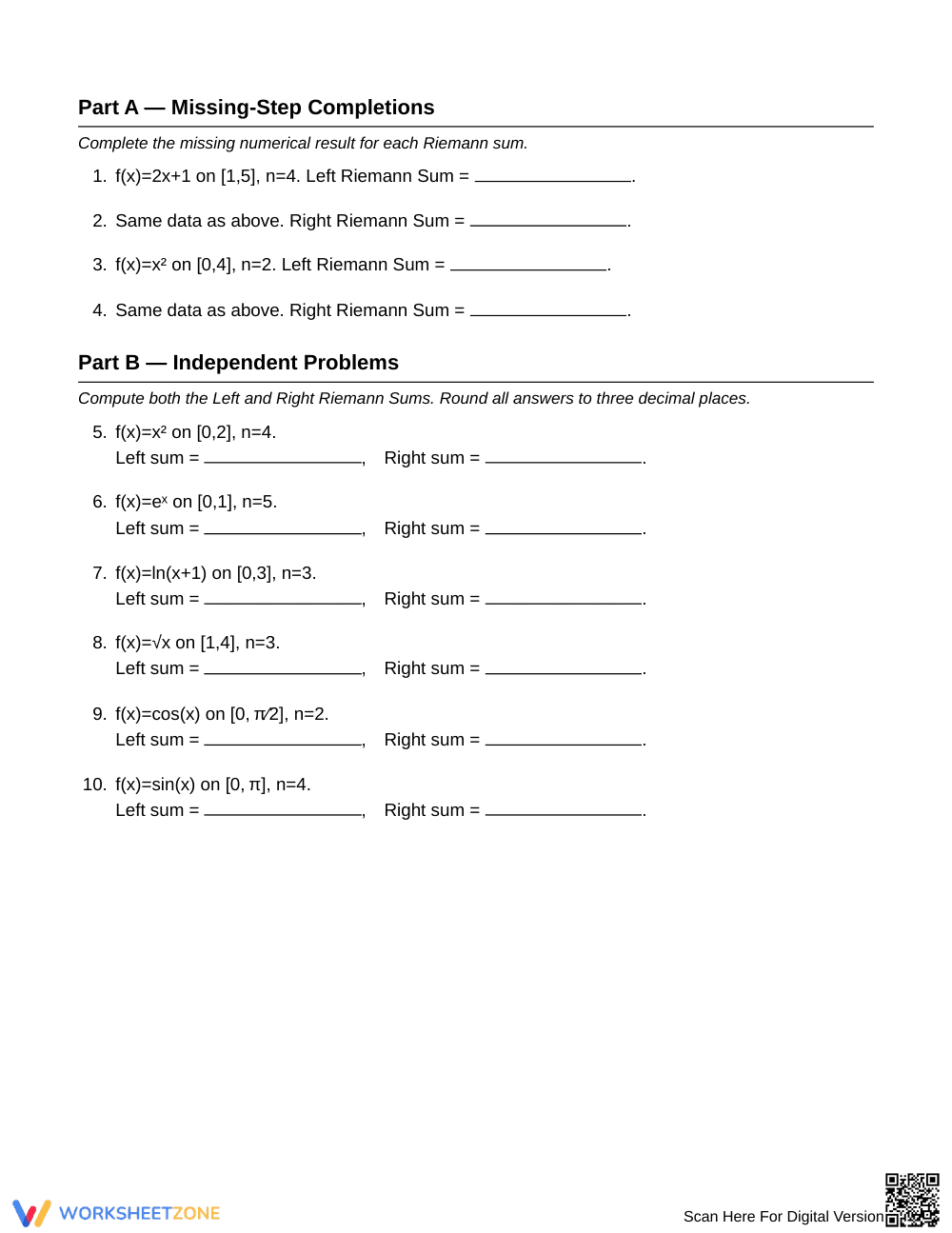
This 3-page printable resource opens with explicit reference formulas for subinterval width and summation rules alongside two fully solved models demonstrating polynomial partitions and Fundamental Theorem connections. Students complete four structured calculations, advance to six multi-function independent problems involving exponential, logarithmic, and trigonometric functions, and finish with two conceptual writing prompts. A comprehensive 2-page answer key provides complete calculations.
Skill Progression
- Guided practice (Part A, Problems 1–4): Students complete missing-step numerical values using pre-partitioned quadratic and linear models, reinforcing formula application with high instructional support.
- Supported practice (Part B, Problems 5–8): Learners calculate both left and right sums across transcendental functions like exponentials and logarithms, managing partition calculation independently while rounding to three decimal places.
- Independent practice (Part B & C, Problems 9–12): Students tackle trigonometric intervals and write rigorous 4-to-6-line analytical justifications about over- and under-estimation based on function behavior.
This progression mirrors the gradual-release framework, guiding students from foundational arithmetic execution to conceptual synthesis.
Standards Alignment
This worksheet aligns with high school advanced calculus standards governing numerical approximations of definite integrals. Students construct Riemann sums using left and right endpoints, calculate uniform subinterval widths, and analyze approximation error relative to monotonic function characteristics. The instructional materials and concepts covered can be copied directly into lesson plans, IEP goals, or district curriculum mapping tools.
How to Use It
Deploy this worksheet immediately after introducing rectangular approximation methods during direct instruction. Use Part A as a collaborative check-for-understanding where pairs verify endpoint indexing. Formative assessment tip: observe whether students select the correct endpoint values when setting up left versus right sums, particularly on zero-inclusive intervals. Students typically finish the 12 problems within 45 to 55 minutes.
Who It's For
This practice set serves Grade 12 students enrolled in AP Calculus AB, BC, or dual-enrollment college calculus. For students needing support, highlight the worked examples and provide coordinate graph paper to visualize rectangular bounds. Pair this resource with dynamic graphing software demonstrations or an area-under-the-curve anchor chart.
Educational research synthesized by Fisher and Frey (2014) highlights that structured gradual-release architectures significantly accelerate procedural mastery and conceptual retention in advanced mathematics classrooms. By transitioning students from fully modeled examples through missing-step numerical scaffolds and into independent analysis of left and right Riemann sums, this worksheet establishes the rigorous conceptual grounding required for introductory integral calculus. High school calculus students who systematically analyze rectangular approximations develop a deeper intuition for the Fundamental Theorem of Calculus, transforming mechanical summation routines into durable mathematical reasoning. Furthermore, cognitive load studies by Sweller demonstrate that deliberate multi-stage problem sequences prevent working memory overload during complex, multi-step algebraic calculations. Grounding area approximations in monotonic behavior patterns fosters critical mathematical discourse, preparing high school learners for rigorous collegiate coursework, cumulative assessments, and standard advanced placement examinations with confidence.


