


























Views
Downloads



Essential Riemann Sums & FTC Worksheet | Grade 12 Calculus
Paste this activity's link or code into your existing LMS (Google Classroom, Canvas, Teams, Schoology, Moodle, etc.).
Students can open and work on the activity right away, with no student login required.
You'll still be able to track student progress and results from your teacher account.
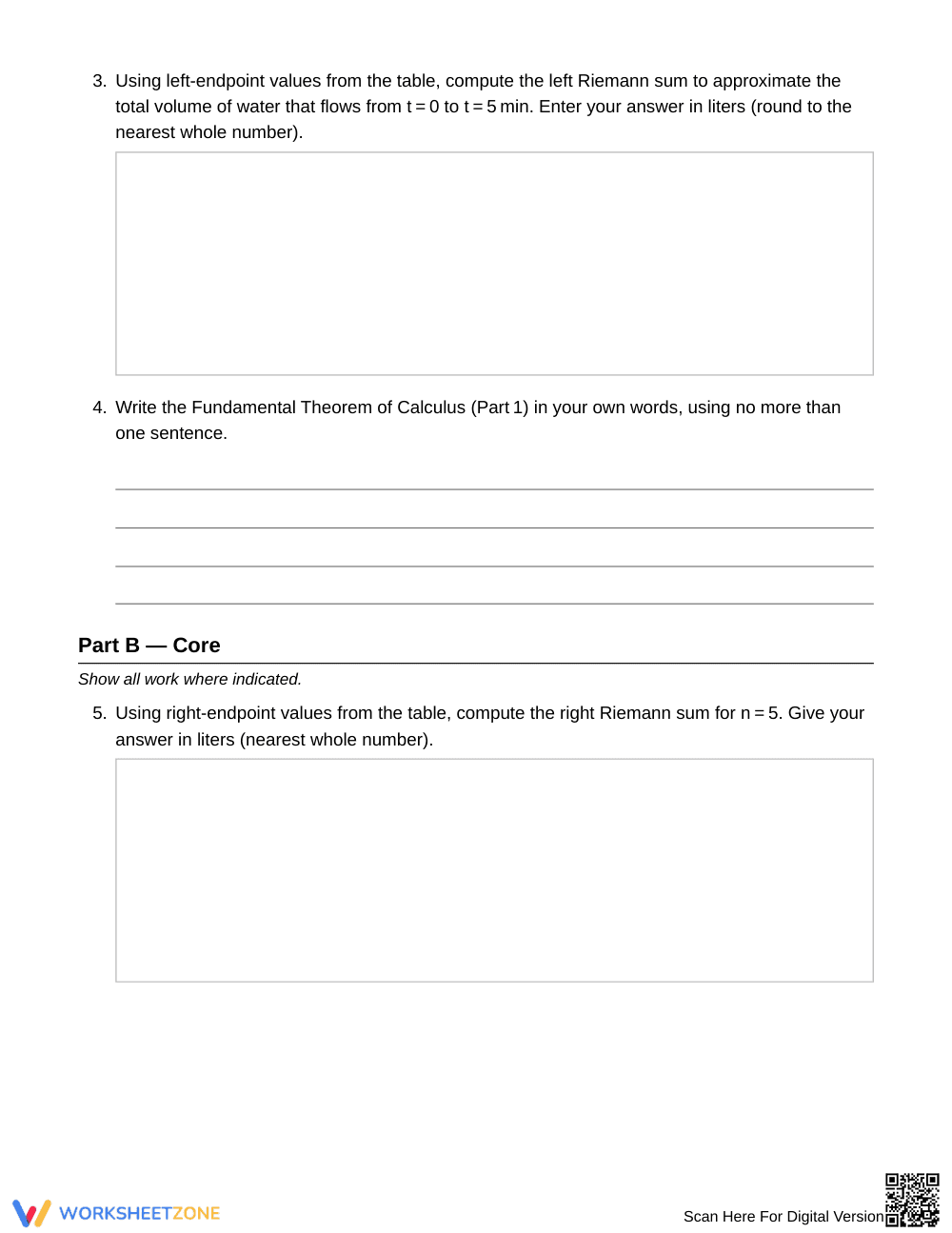
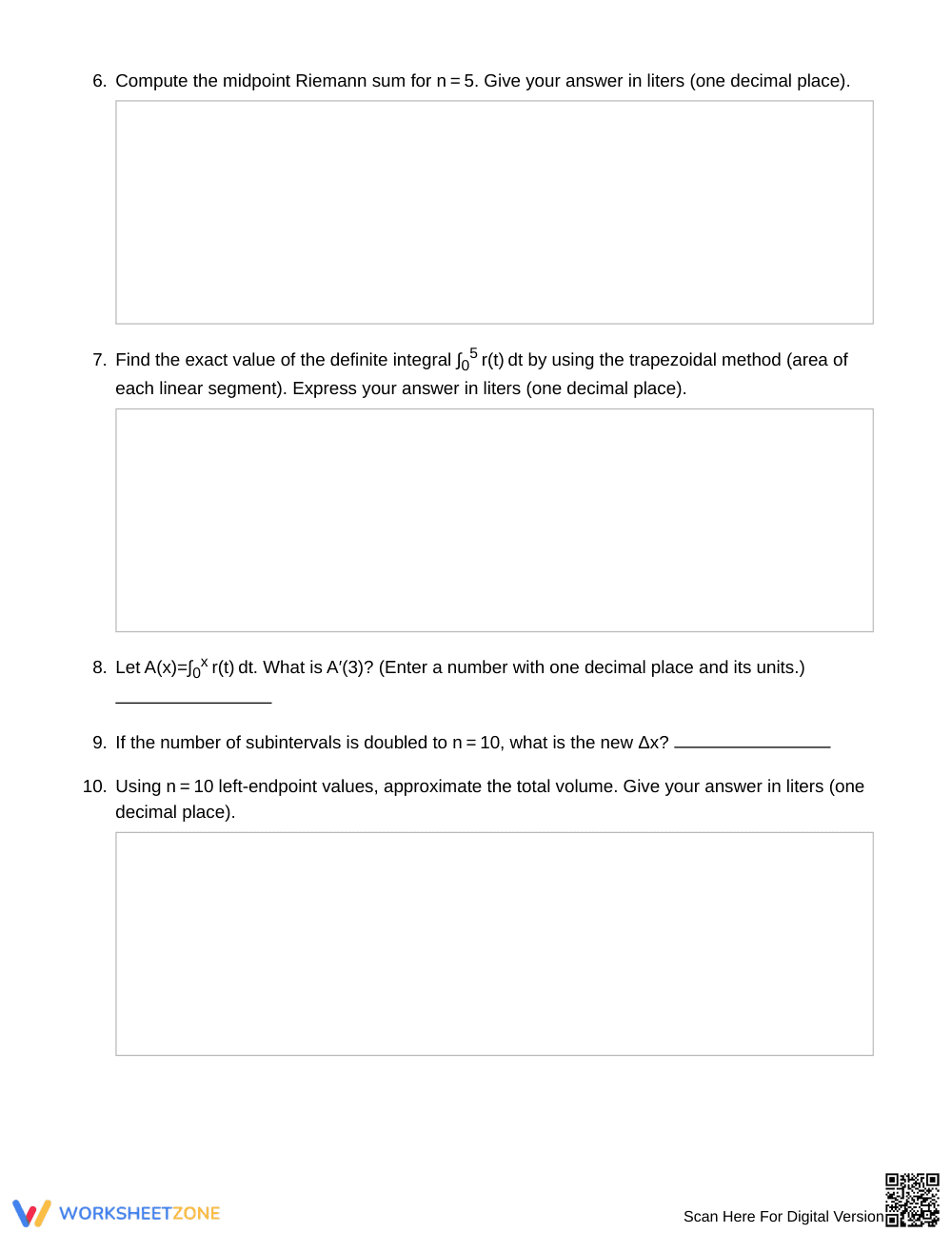
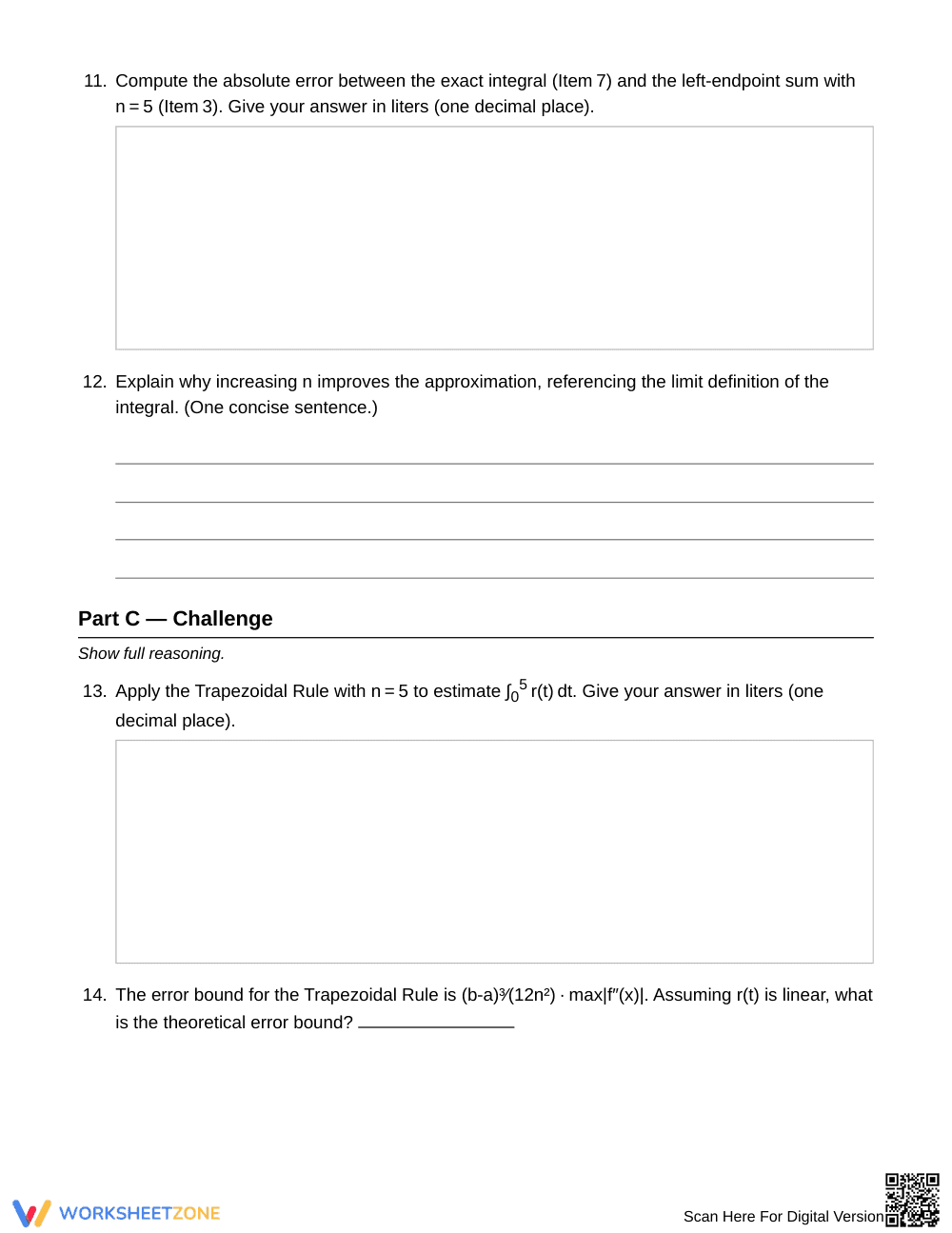
This calculus worksheet strengthens student mastery of Riemann sums and the Fundamental Theorem of Calculus. High school seniors analyze flow rate data to construct left, right, and midpoint approximations, connecting numerical areas to accumulation functions.
At a Glance
- Grade: 12 · Subject: Calculus
- Standard: Approximate integrals with Riemann sums and apply the Fundamental Theorem
- Skill Focus: Riemann sums and FTC
- Format: 5 pages · 16 problems · Answer key included · PDF
- Best For: AP Calculus review and assessment
- Time: 45–60 minutes
What's Inside
This 5-page printable resource delivers 16 sequenced tasks centered on a flow rate data table. Students reference core formulas to complete fill-in definitions, endpoint computations, accumulation derivatives, and theoretical error bound calculations, supported by a 2-page step-by-step answer key.
Skill Progression
- Guided practice (Foundation, Tasks 1–4): Students review core definitions and calculate initial left-endpoint sums.
- Supported practice (Core, Tasks 5–12): Learners evaluate right and midpoint sums, trapezoidal integration, and accumulation derivatives.
- Independent practice (Challenge, Tasks 13–16): Students calculate theoretical error bounds and analyze accumulation rates.
This sequence embodies gradual release (I Do, We Do, You Do), moving from basic substitution to analytical synthesis.
Standards Alignment
This resource aligns with advanced high school calculus standards covering definite integrals and accumulation functions. Students approximate integrals using equal subdivisions and evaluate rate functions using the Fundamental Theorem of Calculus. Both standard codes can be copied directly into lesson plans, IEP goals, or district curriculum mapping tools.
How to Use It
Assign this worksheet after direct instruction on numerical integration. Use Parts A and B for collaborative partner practice. As a formative check, inspect Tasks 8 and 12 to verify understanding of accumulation derivatives and limit behavior. Anticipate completion within 45 to 60 minutes.
Who It's For
Designed for Grade 12 Calculus and AP Calculus AB/BC students, this resource supports diverse learners with built-in formula references and higher-order error analysis. Pair this practice set with an accumulation graph anchor chart or integration lesson.
Calculus students must develop fluency in connecting numerical approximations to exact definite integrals using Riemann sums and the Fundamental Theorem of Calculus. According to research on structured mathematical progression by Fisher & Frey (2014), explicit instructional scaffolding combined with targeted gradual release significantly strengthens conceptual retention in advanced mathematics. When Grade 12 students transition systematically from tabular Riemann sums to rate accumulation models, they develop deeper structural understanding of the limit process. This 16-problem resource provides structured, scaffolded practice across 5 pages to help learners quantify accumulation error, evaluate definite integrals from discrete data, and interpret derivatives of accumulation functions accurately. By guiding students through foundational definitions, core tabular calculations, and rigorous analytical challenges, educators can reliably build mastery in numerical integration, verify procedural fluency, and prepare students for AP-level calculus assessments.


