































Essential Research Scope Worksheet | Grade 12 English IV

Paste this activity's link or code into your existing LMS (Google Classroom, Canvas, Teams, Schoology, Moodle, etc.).
Students can open and work on the activity right away, with no student login required.
You'll still be able to track student progress and results from your teacher account.
This Grade 12 English IV worksheet guides students to evaluate evidence boundaries and revise research questions when empirical data cannot answer an initial hypothesis. Working through an archival dossier, learners identify analytical gaps, eliminate bias, and formulate defensible, qualified inquiries aligned with methodological constraints.
At a Glance
- Grade: 12 · Subject: English IV
- Standard:
W.11-12.7— Conduct research projects to answer questions and narrow or broaden inquiry appropriately.- Skill Focus: Revise Scope When Evidence Cannot Answer Question
- Format: 6 pages · 8 problems · Answer key included · PDF
- Best For: Advanced high school research methodology practice
- Time: 45–60 minutes
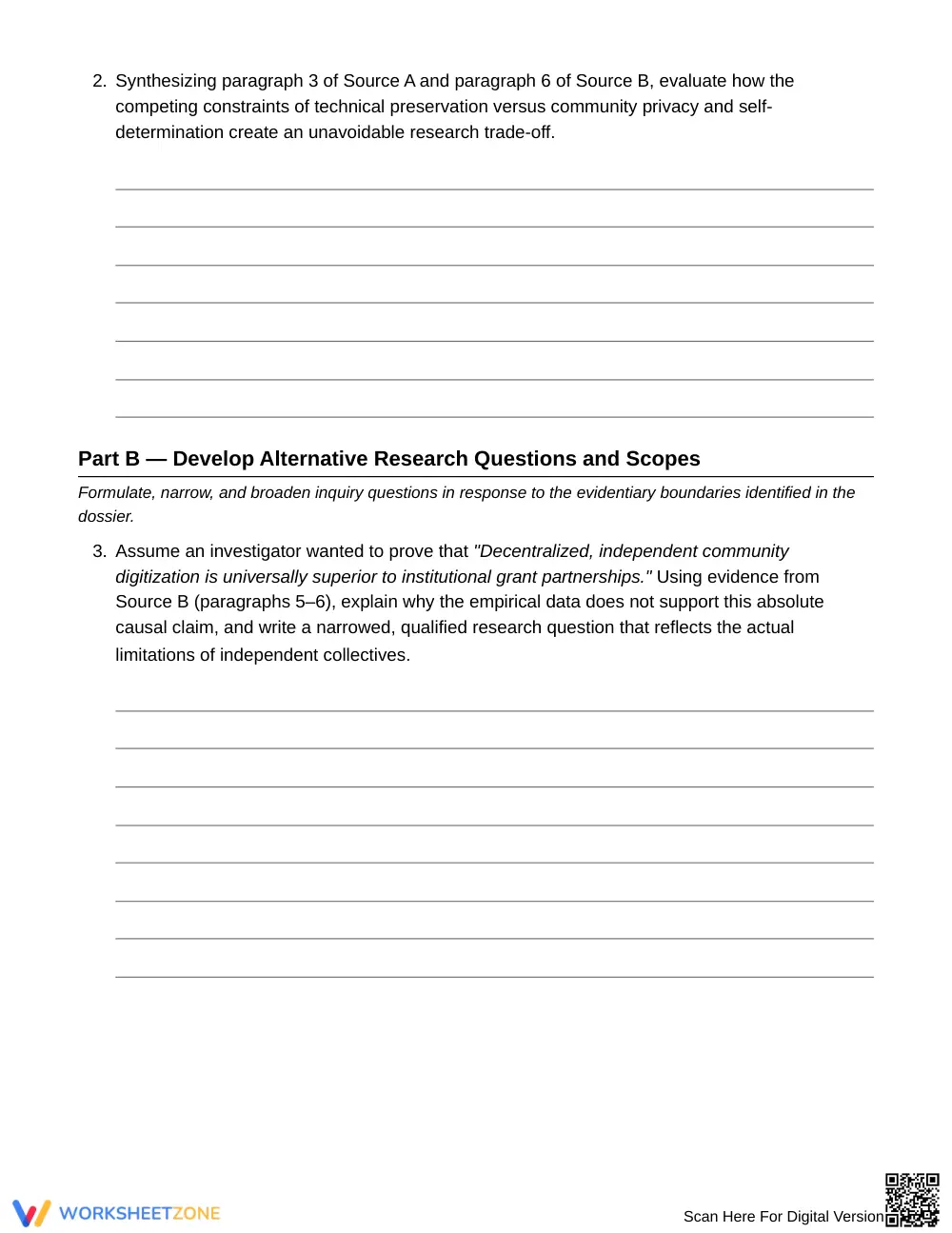
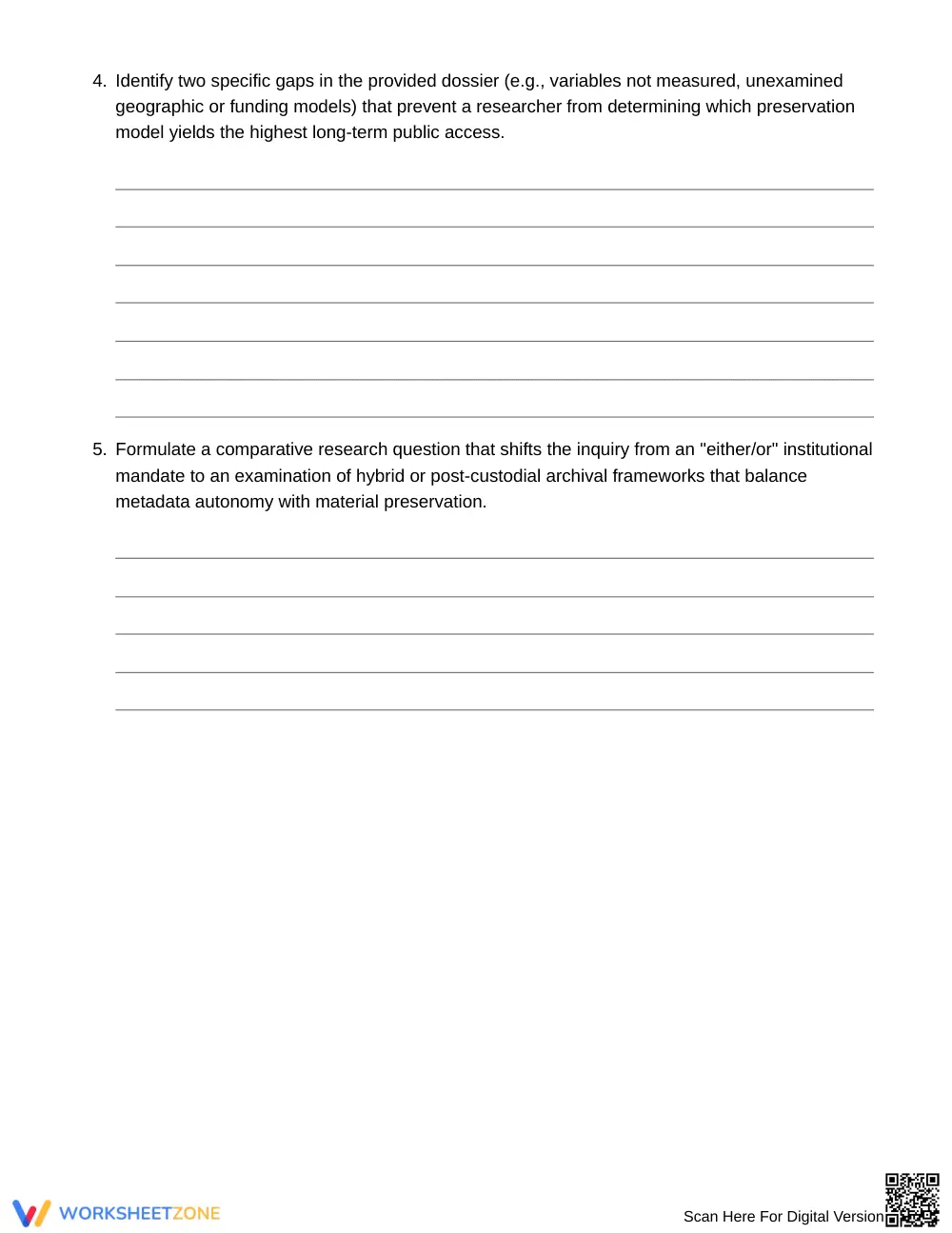
Spanning 6 pages, this resource delivers a dossier with two scholarly excerpts on community archives, a theoretical framework, and 8 analytical tasks. Students analyze structural contradictions, critique flawed inquiry questions, complete an Inquiry Boundary Map, and draft a 450 to 650 word synthesis essay supported by a 5-page answer key.
Skill Progression
- Guided practice (Tasks 1–2): Students analyze competing institutional and ethical constraints across two texts to establish why absolute claims collapse under evidence.
- Supported practice (Tasks 3–6): Learners evaluate evidentiary gaps, eliminate bias, and reformulate four narrowed or comparative research inquiries.
- Independent practice (Tasks 7–8): Students complete an Inquiry Boundary Map and write an evidence-grounded synthesis essay defending a qualified framework.
This sequence follows a gradual-release model transitioning learners from source analysis to independent inquiry formulation.
Standards Alignment
This worksheet directly targets `W.11-12.7`: Conduct short as well as more sustained research projects to answer a question or solve a problem; narrow or broaden the inquiry when appropriate; synthesize multiple sources on the subject, demonstrating understanding of the subject under investigation. It also reinforces `RI.11-12.1` by requiring thorough textual evidence for all evaluations. Both standard codes can be copied directly into lesson plans, IEP goals, or district curriculum mapping tools.
How to Use It
Deploy this worksheet during the inquiry-design phase of a research unit or after direct instruction on source synthesis. For formative assessment, review the Inquiry Boundary Map before students draft their synthesis essays to verify that they have accurately identified evidentiary limits. The entire sequence takes approximately 45 to 60 minutes of instructional time.
Who It's For
Designed for Grade 12 English IV, AP Seminar, or dual-enrollment composition students, this resource supports advanced secondary researchers. For differentiation, provide sentence frames for the inquiry boundary table. Pair this worksheet with direct instruction on archival research methods or academic synthesis writing.
Under standard `W.11-12.7`, Grade 12 students must master the ability to dynamically adjust research inquiry scopes when encountered evidence cannot support initial hypotheses. According to research on secondary literacy acquisition by Fisher & Frey (2014), structured inquiry frameworks that pair high-complexity non-fiction dossiers with explicit scaffolding enable senior high school students to recognize analytical constraints and shift inquiry questions without abandoning rigorous argumentation. This 6-page English IV resource provides 8 targeted tasks structured around an endangered community archives dossier, guiding students through competing evidentiary barriers to draft defensible synthesis papers. By mapping unmeasured variables and reformulating biased research prompts into objective inquiries, learners build critical academic literacy skills necessary for undergraduate-level research writing. The complete instructional package includes an Inquiry Boundary Map and an extensive 5-page reference answer key to support teacher evaluation.


