




























Essential Red Fruits Word Search | Grades 7–8 ELA
Paste this activity's link or code into your existing LMS (Google Classroom, Canvas, Teams, Schoology, Moodle, etc.).
Students can open and work on the activity right away, with no student login required.
You'll still be able to track student progress and results from your teacher account.
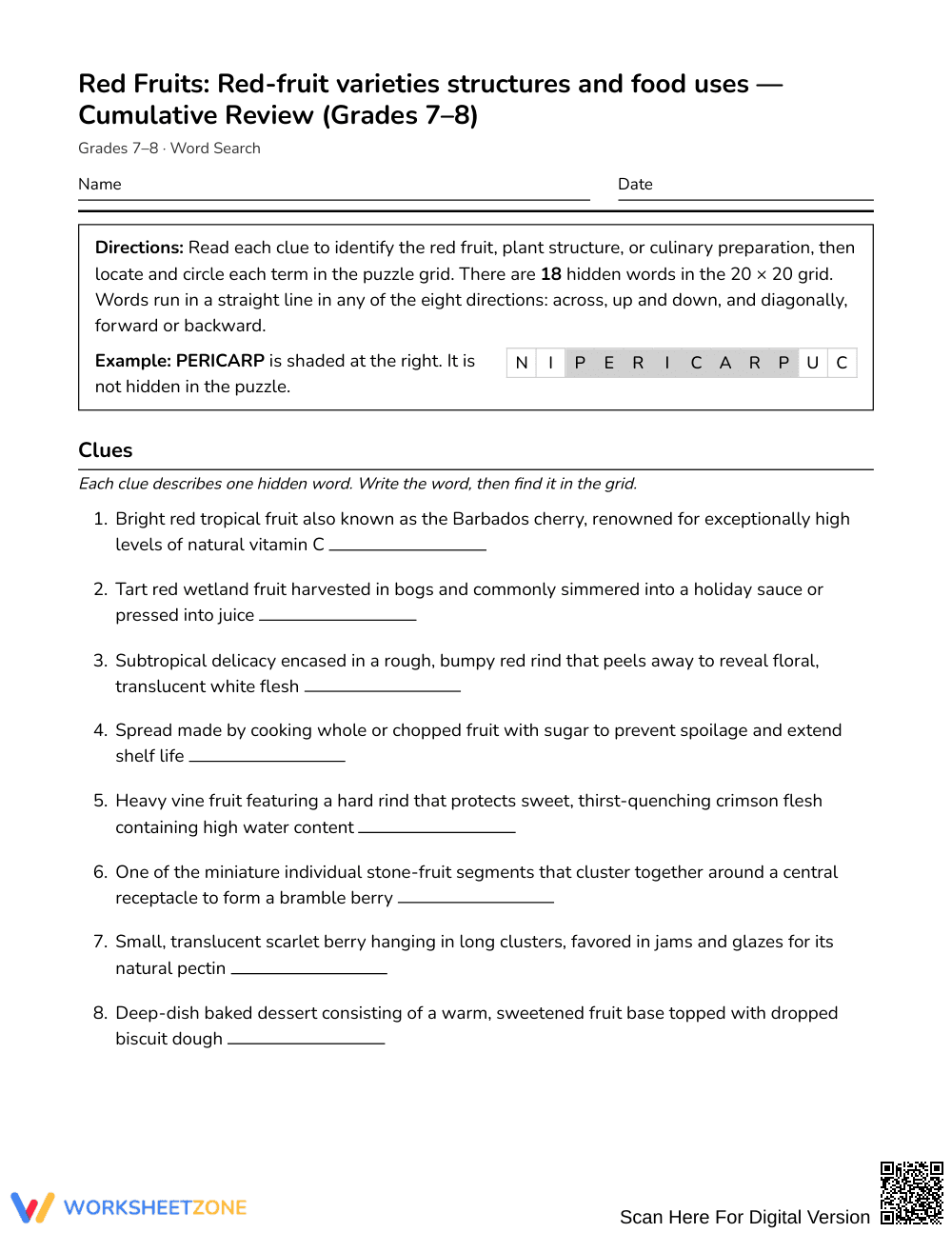
Build domain-specific botanical and culinary literacy with this engaging word search focused on red-fruit varieties, anatomical structures, and culinary preparations. Students read descriptive clues to identify 18 specialized terms before locating them within the grid, reinforcing spelling, morphological awareness, and contextual science vocabulary in Grades 7–8 English Language Arts.
At a Glance
- Grade: Grades 7–8 · Subject: English Language Arts (ELA)
- Standard: Not standards-assessed — vocabulary enrichment
- Skill Focus: Red-fruit varieties structures and food uses
- Format: 3 pages · 18 words · Answer key included · PDF
- Best For: Vocabulary review and early finishers
- Time: 20–30 minutes
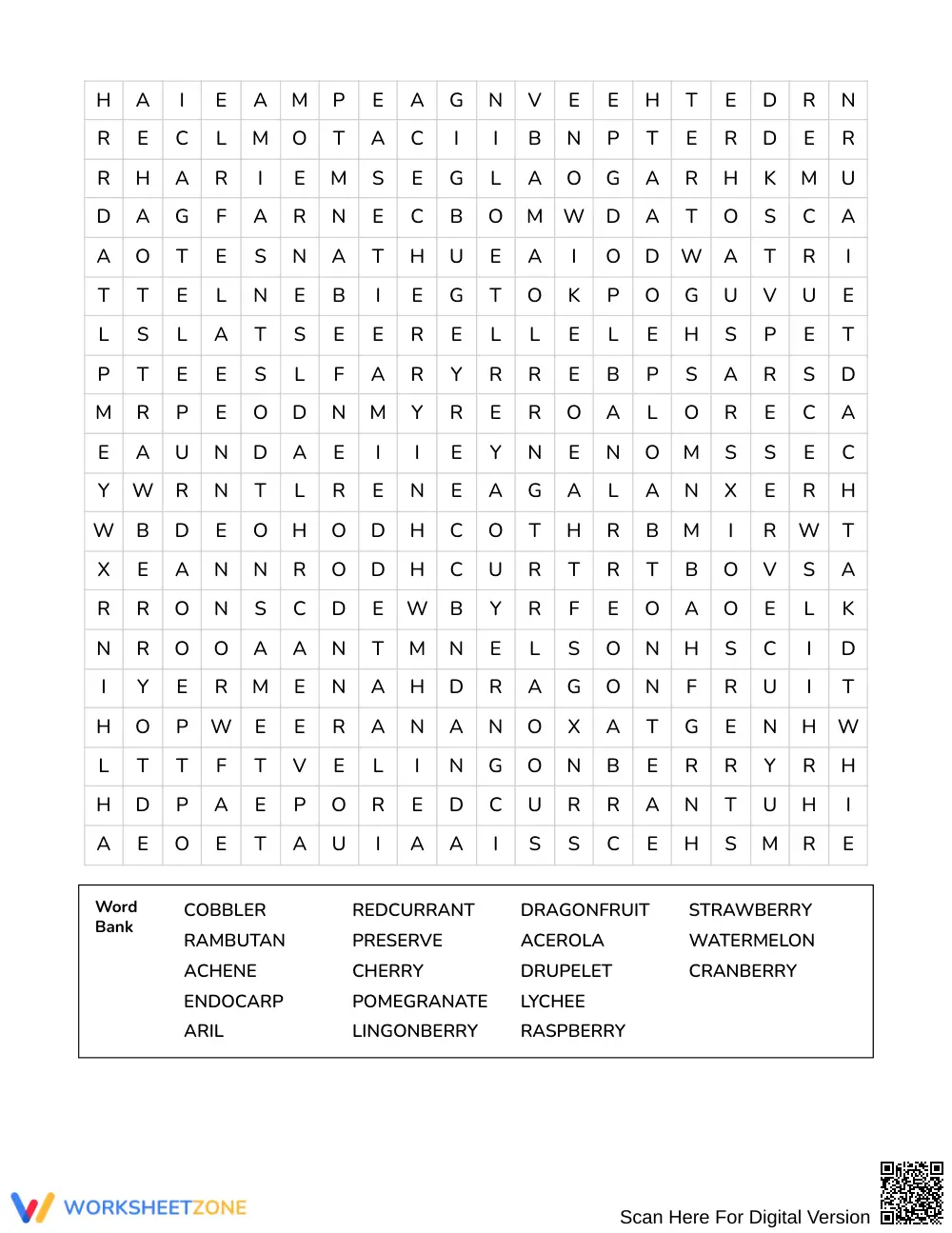
This 3-page printable activity delivers a comprehensive vocabulary challenge without requiring upfront preparation. The package features a clue-driven word bank containing 18 precise botanical and culinary definitions, a spacious puzzle grid, and a full 4-page answer key showing exact letter coordinates and word placement for quick verification.
Students interact with a substantial 20 by 20 letter grid containing 18 hidden terms. Words run in all 8 compass directions: North, Northeast, East, Southeast, South, Southwest, West, and Northwest, including forward and reverse diagonals. Instead of simply hunting for a pre-listed term, students must first read rigorous informational clues to deduce the target vocabulary words—such as aril, achene, endocarp, and rambutan—before tracking them down in the shuffled letter matrix.
This resource serves as targeted vocabulary enrichment and is not aligned to a specific academic standard. It reinforces cross-curricular tier-three science and culinary terminology, strengthening reading comprehension across informational texts and biological classification units.
Deploy this activity after direct instruction on plant anatomy or informational text structures to reinforce technical terms. Alternatively, assign it as a collaborative bell-ringer where student pairs solve the botanical clues together before finding the words. While students work, observe whether they recognize Greek and Latin root patterns in words like endocarp and drupelet to gauge morphological decoding skills. Most middle school learners finish the puzzle within 20 to 30 minutes.
This word search is designed for middle school students in Grades 7–8 who benefit from contextual vocabulary practice and active word-study challenges. It supports English language learners through concrete clue definitions and provides an independent enrichment task for advanced readers. Pair this puzzle with an informational passage on plant biology or fruit classification to deepen conceptual understanding.
Integrating structured word puzzles with informational clues strengthens vocabulary acquisition and orthographic mapping in adolescent learners. According to Fisher & Frey (2014), intentional word-study activities that require students to connect technical definitions with visual and structural letter sequences enhance long-term retention of tier-two and tier-three terms. By actively reading context clues to identify domain-specific words—such as drupelet, achene, and endocarp—students activate prior background knowledge before scanning letter arrays. This bidirectional process reinforces lexical retrieval, morphological pattern recognition, and correct spelling conventions across informational reading domains. Fisher & Frey (2014) emphasize that pairing semantic definitions with interactive orthographic tasks produces significantly higher conceptual mastery than passive memorization drills. Consequently, this 18-word puzzle equips middle school educators with an effective, low-stakes instrument to consolidate complex botanical and culinary vocabulary through structured, student-directed practice.


