


























Views
Downloads




Essential Real Limits Inequality Worksheet | Grade 6 Math
Paste this activity's link or code into your existing LMS (Google Classroom, Canvas, Teams, Schoology, Moodle, etc.).
Students can open and work on the activity right away, with no student login required.
You'll still be able to track student progress and results from your teacher account.
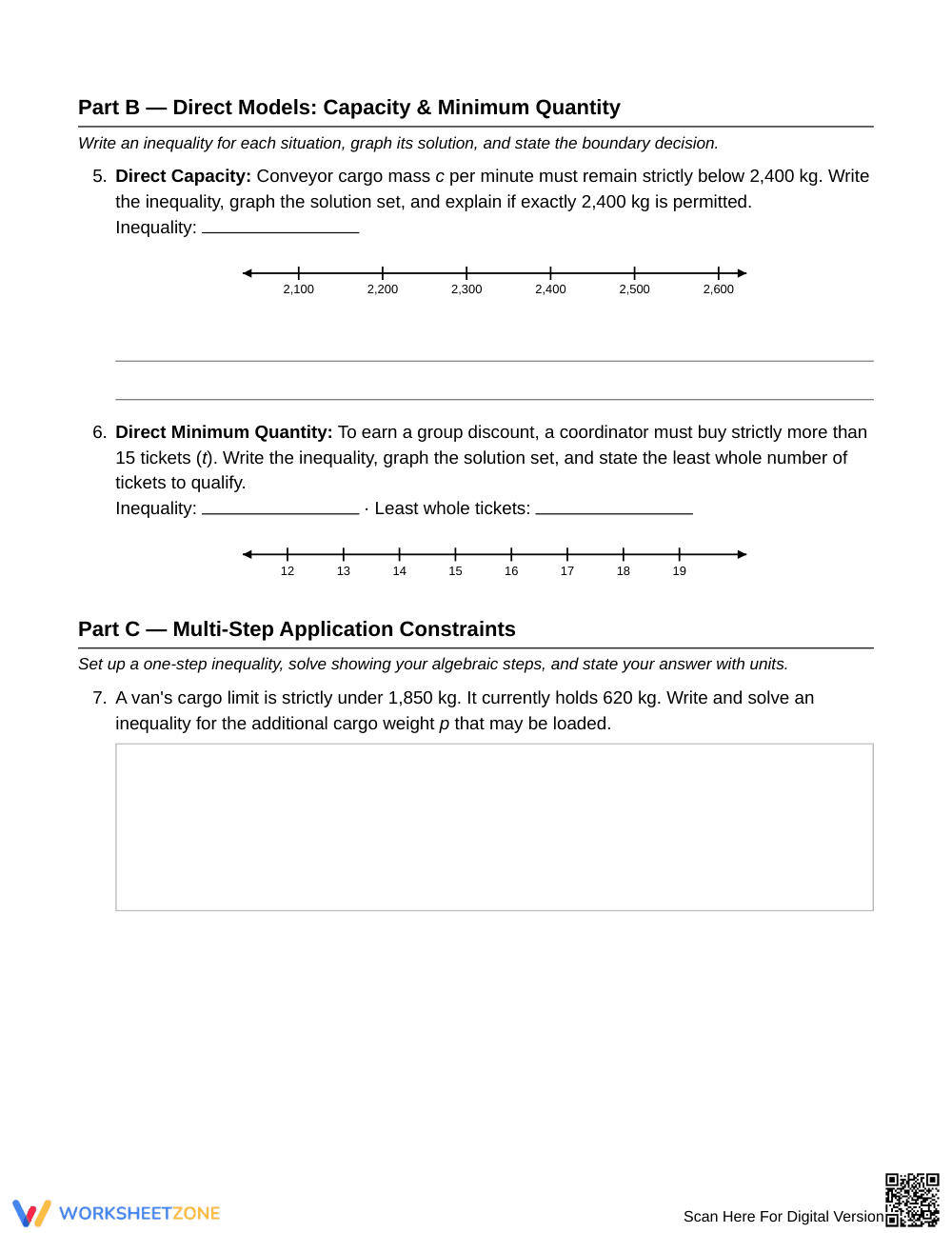
This 5-page expressions and equations worksheet helps Grade 6 students master writing, solving, and graphing inequalities for real-world limits. Students interpret capacity ceilings and minimum thresholds, evaluate whether boundary values satisfy strict conditions, and graph infinite solution sets on number lines.
At a Glance
- Grade: 6 · Subject: Math
- Standard:
6.EE.B.8— Write inequalities for real-world limits and graph their solution sets.- Skill Focus: Write an Inequality for a Real Limit
- Format: 5 pages · 14 problems · Answer key included · PDF
- Best For: Guided practice and independent mastery
- Time: 35–45 minutes
What's Inside
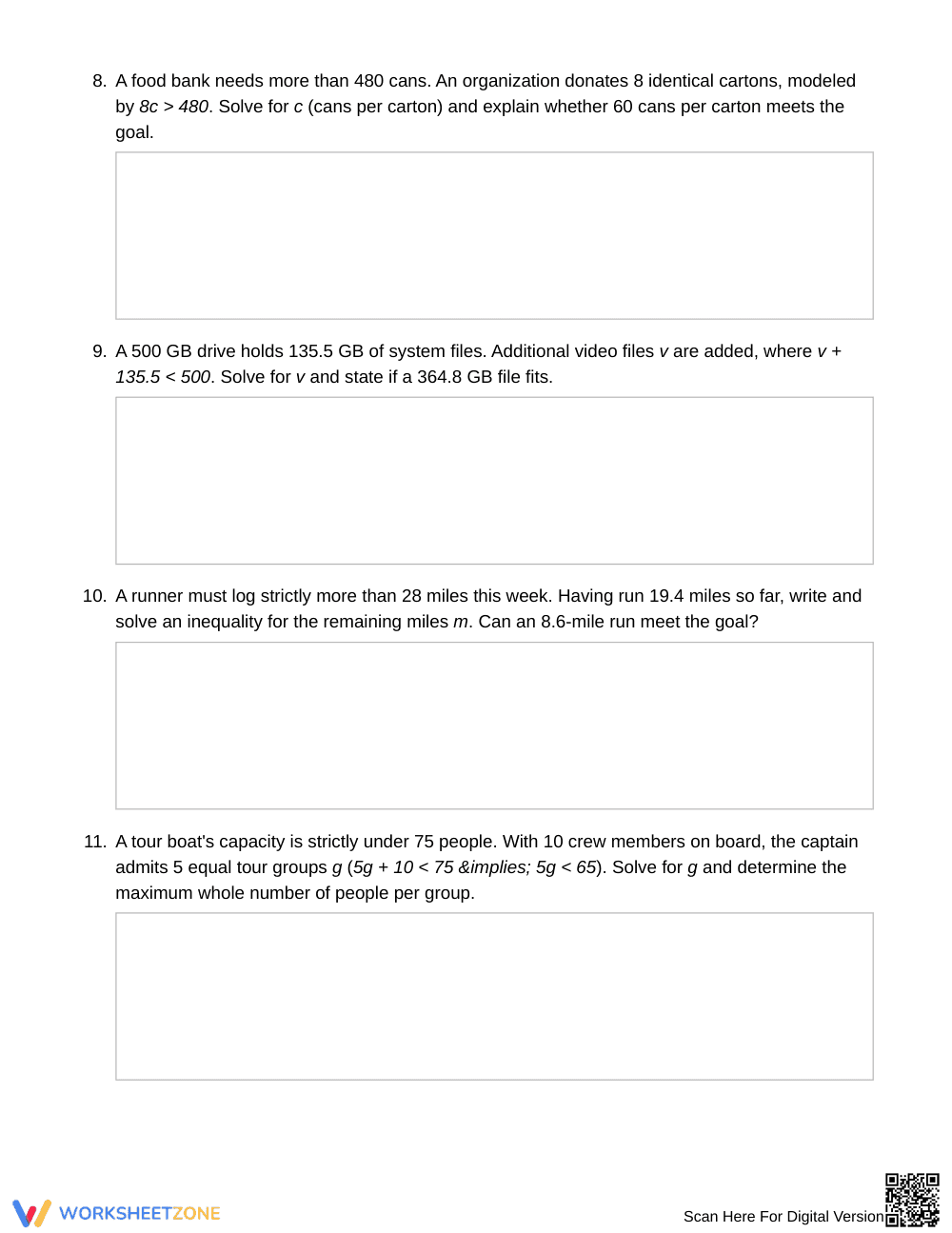
This resource includes 14 scaffolded problems across four parts with a complete 2-page answer key. It features a core concept reference box defining bounds, a worked modeled case on dock capacity, verbal-to-algebraic matching tables, number line graphing items, and real-world constraint scenarios involving decimals and fractions.
Skill Progression
- Guided Practice (Part A, 4 tasks): Establishes foundational concepts through verbal matching, open circle analysis, and solution set reasoning.
- Supported Practice (Parts B & C, 8 tasks): Guides students to write direct inequality models and solve one-step constraints with units.
- Independent Practice (Part D, 2 tasks): Prompts multi-part evaluation of real-world proposals against live-load and fundraising limits.
This structure implements gradual release, moving learners smoothly from modeled examples to autonomous constraint modeling.
Standards Alignment
This worksheet aligns with primary standard 6.EE.B.8: write inequalities of the form x > c or x < c to represent constraints in real-world problems and graph infinite solution sets on number lines. It also supports 6.EE.B.5 through solution testing. Both standard codes can be copied directly into lesson plans, IEP goals, or district curriculum mapping tools.
How to Use It
Use this worksheet after direct instruction on one-step inequalities. For small-group intervention, review the modeled dock example before assigning Part B. During independent practice, observe whether students correctly treat strict bounds as non-inclusive when testing boundary numbers. Completion takes 35 to 45 minutes.
Who It's For
This practice is built for Grade 6 general math, Tier 2 intervention, and advanced Grade 5 students. Scaffolded tables support multilingual learners, while Part D extends critical thinking for high achievers. Pair with an anchor chart illustrating open and closed number line intervals.
According to research by Fisher & Frey (2014), implementing a structured gradual release instructional framework accelerates conceptual understanding and procedural fluency in middle school mathematics. This Grade 6 worksheet directly supports standard 6.EE.B.8 by guiding students to write inequalities for real limits and graph infinite solution sets on number lines. Moving from foundational boundary representations to multi-step constraint evaluations, students build an enduring understanding of how algebraic inequalities model physical capacities, safety limits, and minimum operational thresholds. Explicit graphing tasks and contextual justification prompts ensure learners do not merely execute symbolic manipulation, but actively verify whether specific rational numbers satisfy given constraints. Educators can deploy these 14 scaffolded problems as a targeted diagnostic tool or core practice set to establish lasting student mastery of linear algebraic relationships and real-world mathematical modeling.


