





























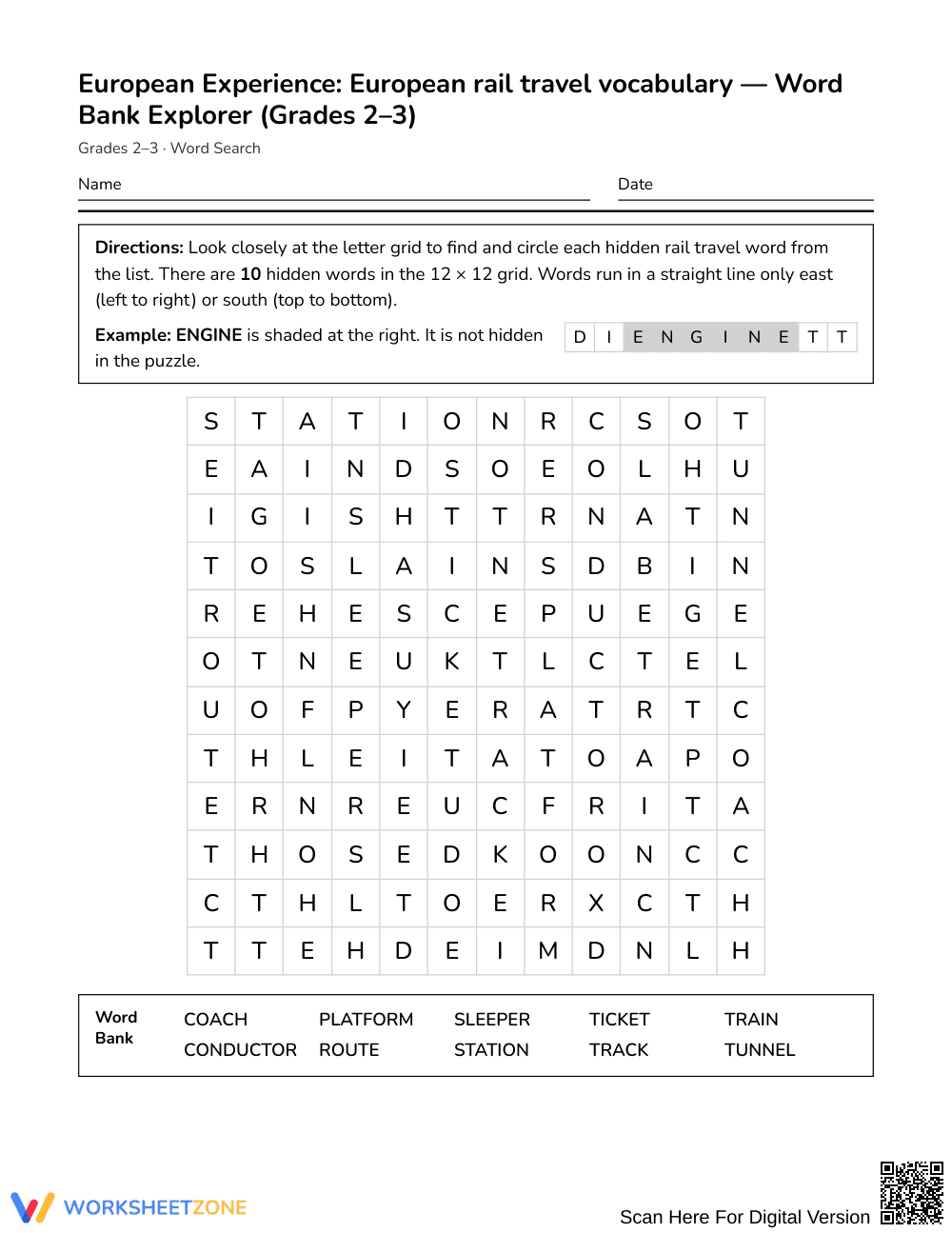


Essential Rail Vocabulary Word Search | Grades 2–3 ELA

Paste this activity's link or code into your existing LMS (Google Classroom, Canvas, Teams, Schoology, Moodle, etc.).
Students can open and work on the activity right away, with no student login required.
You'll still be able to track student progress and results from your teacher account.
This Grades 2–3 word search introduces early elementary learners to foundational European rail travel vocabulary through engaging pattern recognition. Students identify 10 domain-specific terms across a tailored letter grid, building spelling familiarity and thematic background knowledge. The activity provides purposeful independent practice that strengthens word recognition and transport-related language concepts.
At a Glance
- Grade: Grades 2–3 elementary · Subject: English Language Arts (ELA) vocabulary
- Standard: Not standards-assessed — thematic vocabulary enrichment
- Skill Focus: European rail travel vocabulary recognition and spelling
- Format: 1 printable student page · 10 target words · Complete answer key included · PDF
- Best For: Independent vocabulary enrichment, thematic literacy centers, and fast finishers
- Time: 15–20 instructional minutes
What's Inside
This resource contains a single-page student activity featuring 10 essential rail travel vocabulary terms. The layout includes an alphabetical word bank positioned alongside a clean letter matrix, giving second and third graders an organized visual reference as they search. Accompanying the student worksheet is a comprehensive two-page answer key that clearly highlights word placements for rapid checking.
Puzzle Structure and Mechanics
The activity is built on a 12 by 12 letter grid designed specifically for early elementary readability. Hidden words run exclusively East (left to right) and South (top to bottom), avoiding reverse or diagonal orientations to match the developmental reading needs of Grades 2–3 students. Learners locate all 10 target terms using the alphabetical word bank, which reinforces alphabetical scanning and left-to-right visual tracking.
Standards Alignment
This worksheet is designed as vocabulary enrichment rather than formal standards assessment and does not align to an assessed Common Core code. It supports broader language development by building domain-specific transportation vocabulary and encouraging careful orthographic processing during independent practice.
How to Use It
Deploy this word search during independent seatwork after direct instruction on transportation themes, or place it in a weekly literacy station. For formative observation, watch whether students systematically scan row-by-row or hunt randomly for initial letter clusters. The task typically takes between 15 and 20 minutes to complete.
Who It's For
This activity is designed for Grades 2–3 students who are practicing sight recognition of multi-syllable nouns. It supports developing readers who benefit from predictable letter orientations and structured word banks. Pair this puzzle with an introductory nonfiction read-aloud about European trains or an illustrated travel anchor chart.
This Grades 2–3 vocabulary enrichment resource reinforces European rail travel vocabulary through structured orthographic word search practice. While designed for thematic language enrichment rather than assessed standards, the activity supports fundamental literacy routines by prompting young learners to recognize spelling patterns and retain domain-specific terminology. According to Fisher & Frey (2014), purposeful word study and focused vocabulary exposure within contextual domains significantly enhance semantic networks and reading comprehension in early elementary grades. By searching for 10 thematic rail travel words across a developmentally appropriate 12 by 12 letter grid with strictly horizontal and vertical word orientations, students engage in active visual tracking without cognitive frustration. The self-contained format pairs an accessible alphabetical reference bank with a 2-page answer key, establishing an efficient, evidence-backed tool for elementary literacy centers, early finisher stations, and cross-curricular social studies exploration.


