




























Views
Downloads



Essential Radius & Diameter Errors Worksheet | Grade 7 Math

Paste this activity's link or code into your existing LMS (Google Classroom, Canvas, Teams, Schoology, Moodle, etc.).
Students can open and work on the activity right away, with no student login required.
You'll still be able to track student progress and results from your teacher account.
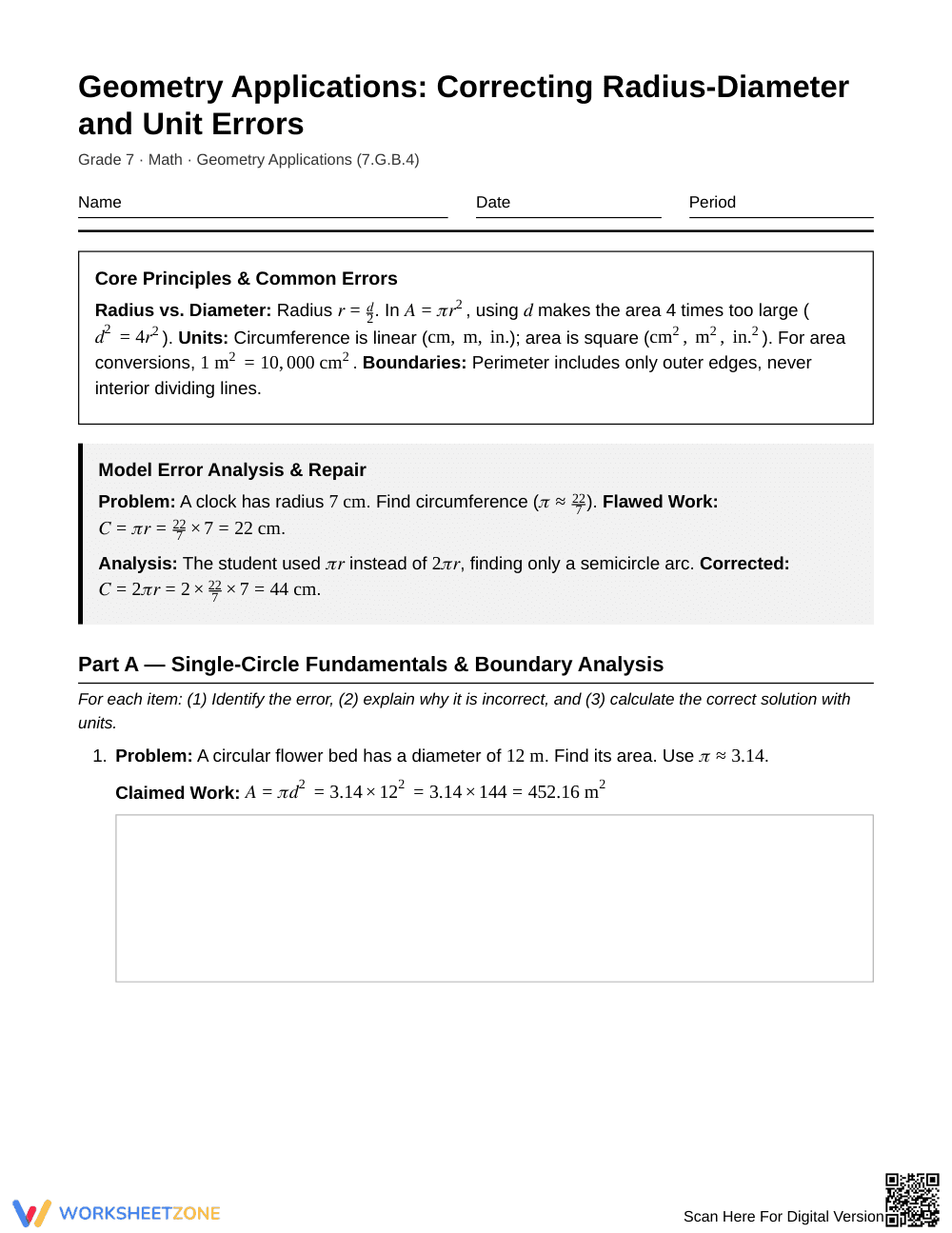
This Grade 7 math worksheet equips students to identify, analyze, and repair common misconceptions in circle geometry. By evaluating pre-solved problems featuring radius-diameter mix-ups, linear versus square units, and boundary confusion, learners build rigorous analytical habits. Students actively defend geometric reasoning while mastering exact area and circumference calculations.
At a Glance
- Grade: 7 · Subject: Math
- Standard:
7.G.B.4— Apply circle formulas to solve area, circumference, and perimeter problems- Skill Focus: Correct Radius-Diameter and Unit Errors
- Format: 5 pages · 10 problems · Answer key included · PDF
- Best For: Error analysis and test review
- Time: 40–50 minutes
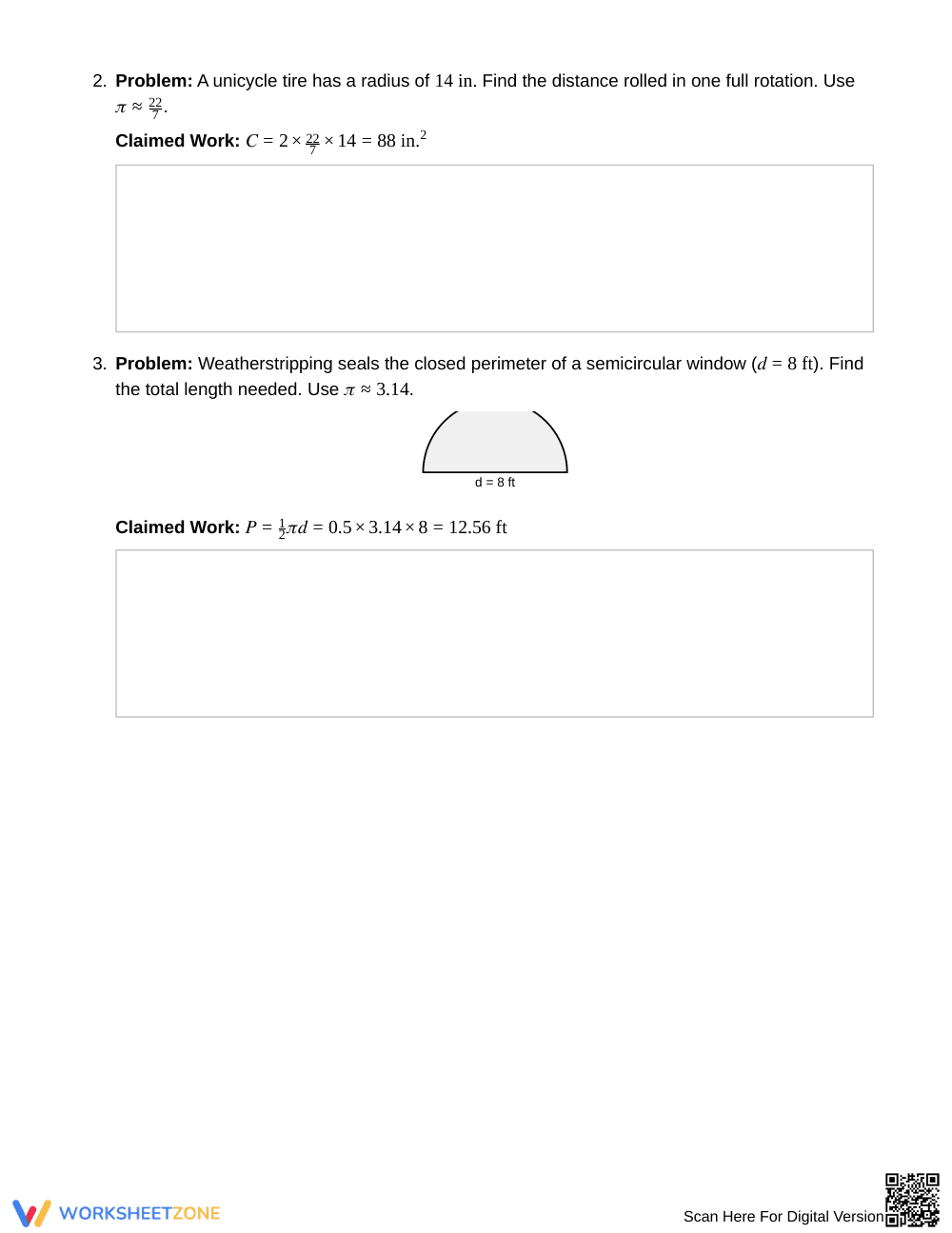
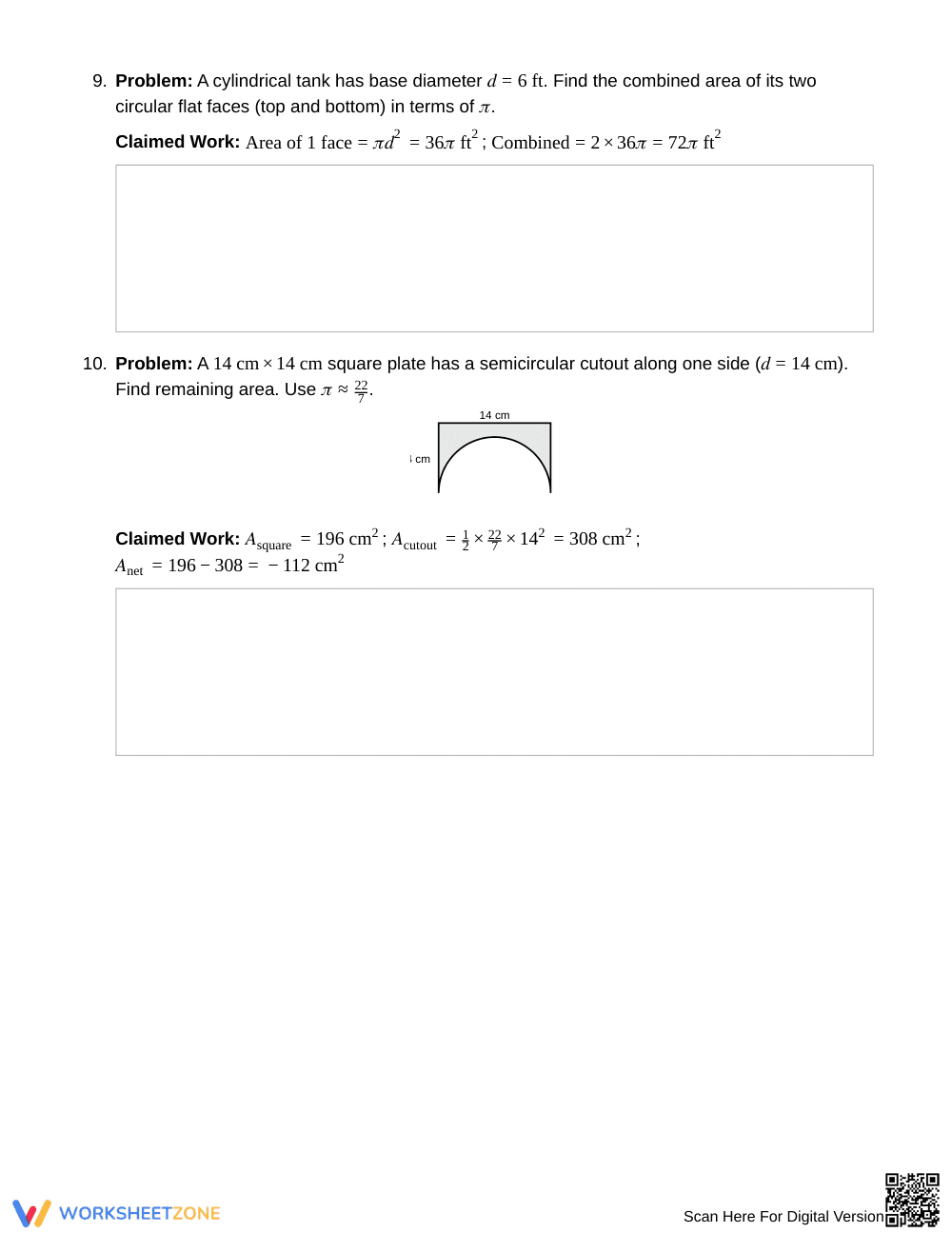
The 5-page resource includes a reference box of core geometric principles, a modeled error analysis example, 10 multi-part student tasks, and a detailed 2-page answer key. Tasks span single circles, composite shapes, sector areas, and dimensional conversions. Students evaluate flawed work, explain the underlying mathematical misconception in writing, and compute the correct final answer with exact units.
Skill Progression
- Guided practice (Part A, Problems 1–4): Focuses on single-circle items and boundary perimeters, scaffolded by visual diagrams and explicit checks.
- Supported practice (Part B, Problems 5–7): Challenges students with composite shapes, lawn sectors, and the informal parallelogram circle derivation.
- Independent practice (Part C, Problems 8–10): Demands dimensional unit conversions, cylinder cross-sections, and composite area subtractions.
This gradual-release sequence moves students smoothly from guided error diagnosis to independent problem solving.
Standards Alignment
This worksheet aligns with primary standard 7.G.B.4: Know the formulas for the area and circumference of a circle and use them to solve problems. It also reinforces linear versus square unit reasoning across multi-step tasks. Both standard codes can be copied directly into lesson plans, IEP goals, or district curriculum mapping tools.
How to Use It
Implement this worksheet after direct instruction on circumference and area formulas during an error-analysis workshop or test preparation unit. As a formative assessment observation tip, monitor whether students automatically halve diameter values before squaring in area equations or if they misapply linear circumference units to two-dimensional surfaces. The entire 10-task set takes approximately 40 to 50 minutes to complete.
Who It's For
This activity is designed for Grade 7 general mathematics students, advanced Grade 6 learners, or Grade 8 intervention groups needing remediation in geometric measurement. Teachers can differentiate by assigning Part A for foundational reinforcement or Parts B and C for extension. Pair this resource with a circle formulas anchor chart or a hands-on circular cut-out demonstration.
According to research by Fisher & Frey (2014) on error analysis and formative assessment, examining non-examples and repairing flawed calculations significantly deepens conceptual understanding compared to repetitive procedural drill alone. When middle school students evaluate incorrect mathematical claims, they engage higher-order evaluative reasoning and construct durable schema around formula structures. This Grade 7 worksheet targets standard 7.G.B.4 by requiring learners to distinguish between radius and diameter, convert between metric and imperial linear and square units, and correctly account for perimeter boundaries in composite geometric figures. By diagnosing 10 specific misconceptions across guided and independent tiers, students solidify their command of circle circumference and area formulas while preventing recurrent errors in multi-step measurement tasks. The embedded model problem and structured justification prompts ensure that students not only locate mathematical flaws but also articulate precise corrective explanations that align with standard geometric definitions.


