




























Views
Downloads



Essential Radical Equations Worksheet | Grade 11 Algebra II

Paste this activity's link or code into your existing LMS (Google Classroom, Canvas, Teams, Schoology, Moodle, etc.).
Students can open and work on the activity right away, with no student login required.
You'll still be able to track student progress and results from your teacher account.
Mastering radical equations requires high school mathematicians to isolate variables, apply rational powers, and rigorously check candidate solutions against physical domain limits. This rigorous Grade 11 worksheet equips students to solve real-world radical and rational-exponent models while identifying extraneous roots created by algebraic transformations across physics, engineering, and environmental science contexts.
At a Glance
- Grade: 11 · Subject: Algebra II
- Standard:
HSA-REI.A.2— Solve simple radical and rational equations, showing how extraneous solutions may arise- Skill Focus: Radical equation modeling and extraneous roots
- Format: 5 pages · 10 problems · Answer key included · PDF
- Best For: Independent practice after radical equations lesson
- Time: 45–60 minutes
This 5-page printable resource delivers 10 contextual modeling tasks organized into three distinct tiers of complexity. It features a complete reference model outlining fluid conduit head calculations, clear domain convention rules, structured engineering decision tables, and an extensive 3-page step-by-step answer key displaying complete algebraic derivations and domain verifications.
Skill Progression
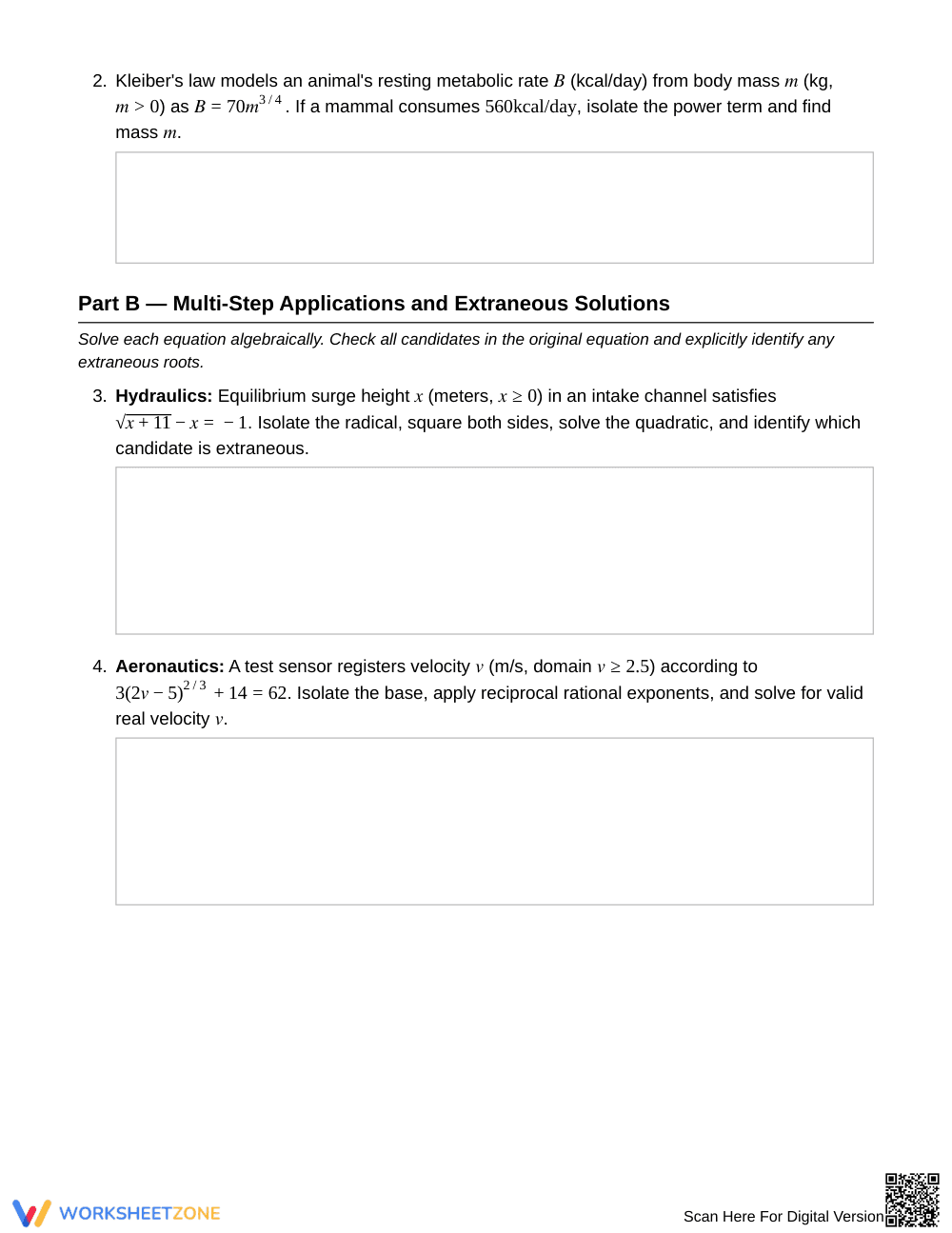
- Guided Practice (Part A, 2 problems): Direct single-radical modeling tasks focusing on car skid mechanics and metabolic rates with explicit domain constraints.
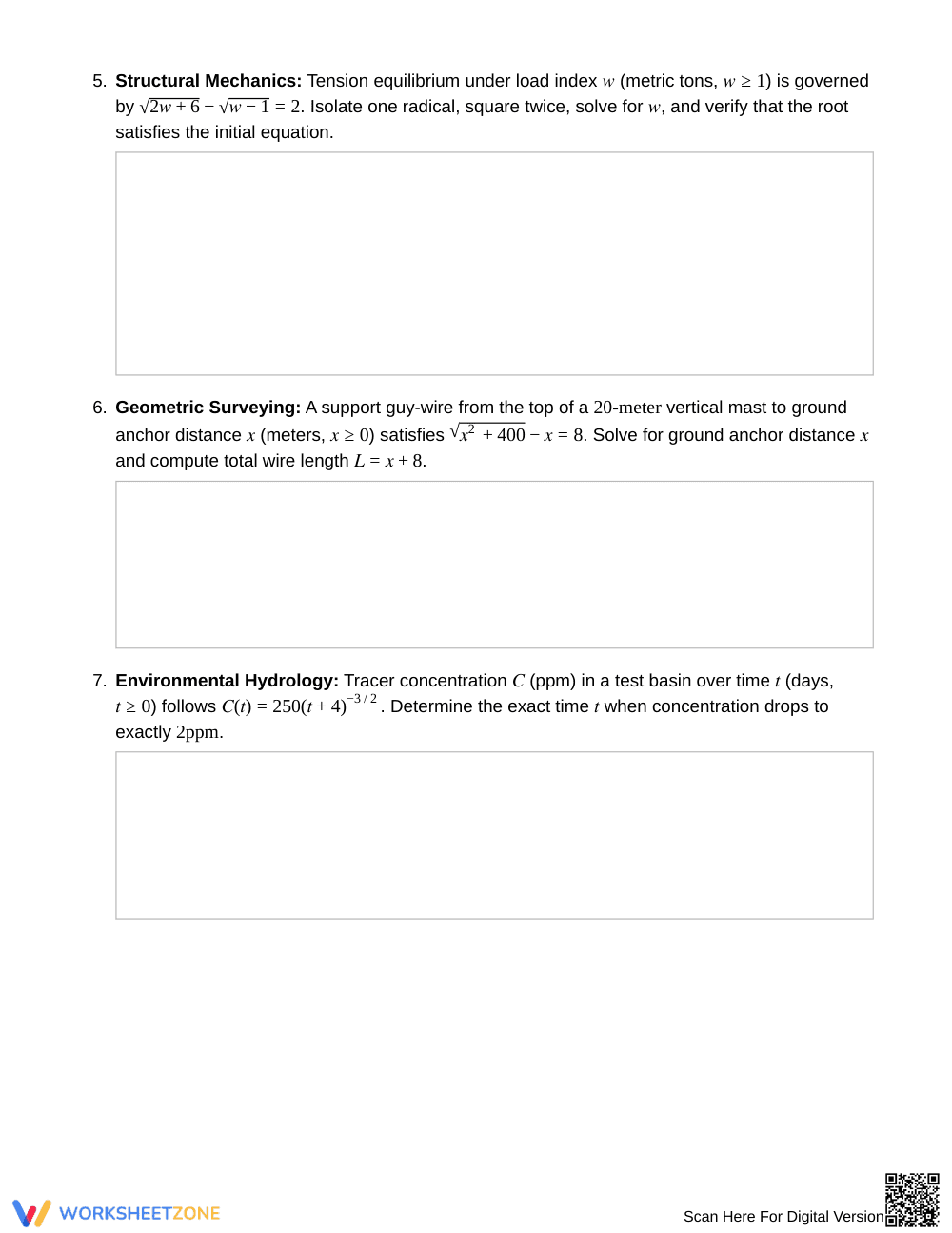
- Supported Practice (Part B, 6 problems): Multi-step modeling applications across hydraulics, aeronautics, structural mechanics, and hydrology requiring students to isolate powers and identify algebraic extraneous roots.
- Independent Practice (Part C, 2 problems): Real-world engineering decision scenarios where students evaluate candidate roots to select certified joists and governor control settings.
This sequence mirrors the gradual-release model, transitioning learners from guided single-variable isolation to independent constraint evaluation.
Standards Alignment
This worksheet directly aligns with primary standard `HSA-REI.A.2`: solve simple radical and rational-exponent equations in one variable and give examples showing how extraneous solutions may arise. Additionally, the modeling scenarios support `HSF-IF.B.4` by requiring students to interpret key features of radical functions in applied physical contexts. Both standard codes can be copied directly into lesson plans, IEP goals, or district curriculum mapping tools.
How to Use It
Assign this worksheet directly after direct instruction on algebraic power transformations and radical isolation. Use Part A for paired in-class partner work, transition to Part B for individual practice, and reserve Part C as a summative exit task. As a formative check, observe whether students check roots in the original un-squared equation rather than intermediate steps. Expected completion time is 45 to 60 minutes.
Who It's For
This resource is tailored for Grade 11 Algebra II, Pre-Calculus, and integrated STEM students mastering rational exponent models. Advanced learners can explore the rate-of-change implications in Part C, while developing students benefit from the provided reference model and explicit domain constraints. Pair this worksheet with an anchor chart detailing power-property restrictions.
According to research by Fisher & Frey (2014), structured problem sets that scaffold complex algebraic procedures within authentic contextual domains significantly increase procedural fluency, mathematical reasoning, and long-term conceptual retention. Under standard HSA-REI.A.2, Grade 11 Algebra II students must not only manipulate radical and rational-exponent equations algebraically, but they must also critically evaluate candidate solutions against mathematical and physical domain restrictions to identify and discard extraneous roots. By situating radical equations directly inside practical engineering, hydrology, aeronautics, and mechanics contexts, this 10-task worksheet reinforces the precise analytical thinking necessary to distinguish valid physical outputs from extraneous algebraic artifacts. The built-in reference model, systematic domain verification prompts, and multi-step progression provide essential instructional scaffolding that supports high school student autonomy during independent problem-solving sessions, ensuring rigorous alignment with state and national mathematics curriculum expectations across all secondary classrooms.


