

































Essential Question Repair Worksheet | Grade 12 English IV

Paste this activity's link or code into your existing LMS (Google Classroom, Canvas, Teams, Schoology, Moodle, etc.).
Students can open and work on the activity right away, with no student login required.
You'll still be able to track student progress and results from your teacher account.
This Grade 12 research and writing worksheet trains students to identify and correct presuppositional bias in research questions before synthesizing competing source arguments. High school seniors analyze paired archival perspectives, diagnose logical fallacies in flawed drafts, and compose an evidence-based synthesis that sustains open academic inquiry.
At a Glance
- Grade: 12 · Subject: English IV
- Standard:
W.11-12.7— Conduct sustained research projects based on focused, open inquiry questions synthesizing multiple viewpoints- Skill Focus: Repairing presuppositional research questions and synthesizing countervailing archival evidence
- Format: 6 pages · 10 problems · Comprehensive answer key included · PDF
- Best For: Advanced research paper preparation and argumentative writing units
- Time: 50–70 minutes
What's Inside
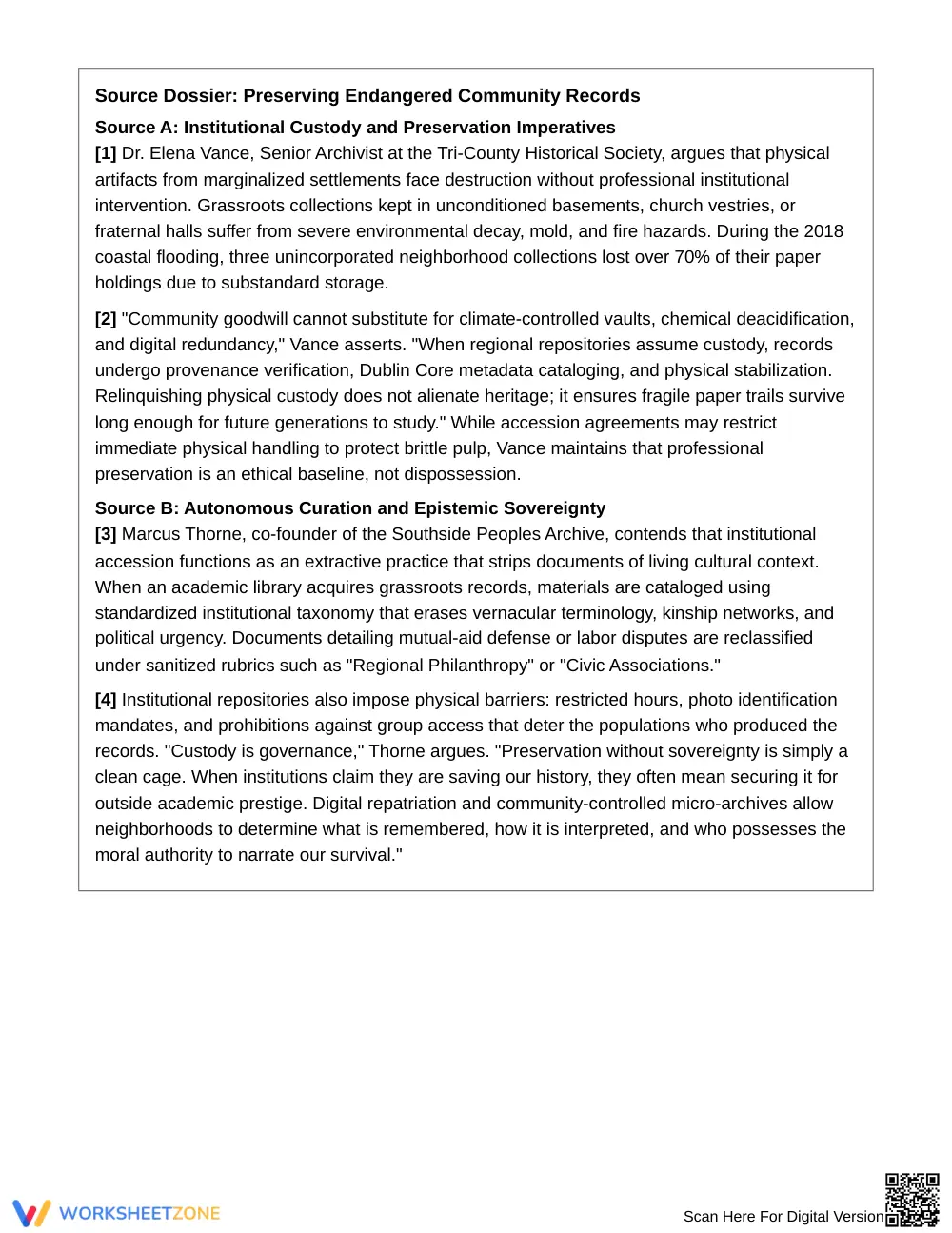
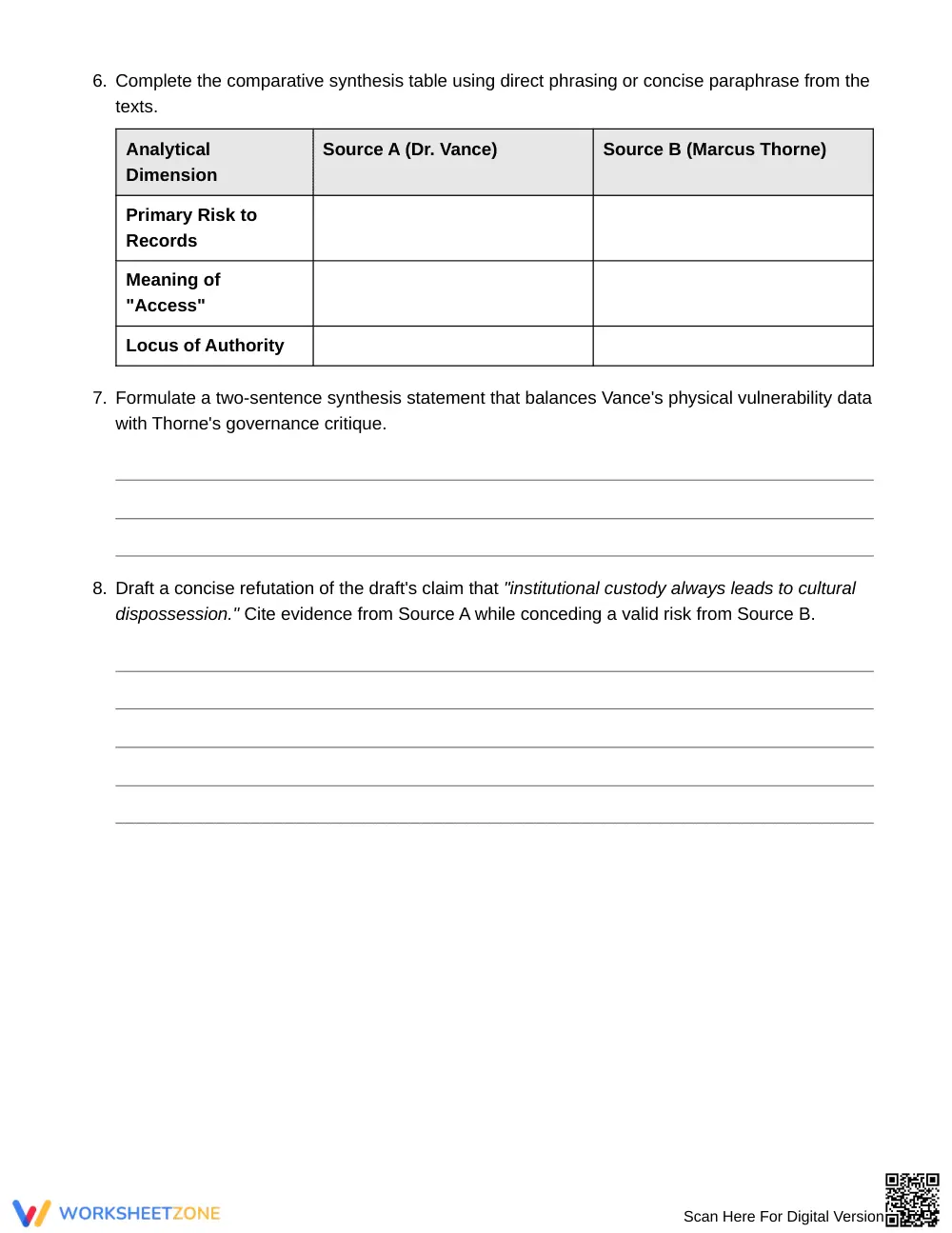
The 6-page worksheet package centers on a two-source archival case study examining community record preservation and institutional custody. It features a theoretical framework explaining confirmation bias, an authentic flawed student draft with embedded fallacies, a structured analytical comparison matrix, and a thorough 4-page answer key with exemplar student responses and grading criteria.
Skill Progression
- Guided Practice (Items 1–3): Students diagnose presupposition in a loaded research question and identify logical fallacies within a flawed sample draft.
- Supported Practice (Items 4–8): Learners select and defend unbiased research questions, complete a two-perspective synthesis matrix, and draft targeted refutations using textual evidence.
- Independent Practice (Items 9–10): Students write a 450–650 word synthesis essay resolving archival tensions and articulate an unresolved empirical question to sustain ongoing scholarship.
This structured progression reflects the gradual release of responsibility model, guiding seniors from analytical critique to sophisticated academic writing.
Standards Alignment
This resource aligns directly with `W.11-12.7`: Conduct short as well as more sustained research projects to answer a question or solve a problem; narrow or broaden the inquiry when appropriate; synthesize multiple sources on the subject, demonstrating understanding of the subject under investigation. It also supports `RI.11-12.8` by requiring students to evaluate the premises, purpose, and rhetorical reasoning of competing informational texts. Both standard codes can be copied directly into lesson plans, IEP goals, or district curriculum mapping tools.
How to Use It
Deploy this worksheet during the mid-unit drafting phase of a research project or as an intensive workshop after introducing source synthesis. Teachers should monitor Part A to verify that students spot the straw-man fallacy before they proceed to draft their independent synthesis essays. Allocate 50 to 70 minutes for complete individual completion or paired collaborative analysis.
Who It's For
This exercise is designed for Grade 12 English IV, AP Seminar, and AP English Language students preparing for college-level research writing. Scaffold the assignment for developing writers with the structured comparative table, or challenge advanced students to incorporate post-custodial archival theory into their essay revisions. Pair this dossier with lessons on avoiding confirmation bias in academic theses.
Research by Fisher & Frey (2014) demonstrates that students develop higher-order evaluative writing skills most effectively when analytical critique precedes independent composition within a gradual-release instructional sequence. Aligned to standard `W.11-12.7`, this instructional resource trains twelfth-grade students to repair presuppositional research questions, interrogate flawed evidential claims, and synthesize countervailing archival perspectives into balanced academic arguments. When high school seniors learn to detect loaded premises within inquiry prompts, they actively counteract confirmation bias and build capacity for nuanced college-level research. The ten structured tasks guide learners from deconstructing biased text to drafting comprehensive, multi-perspective syntheses backed by specific textual data. By providing explicit practice in transforming closed polemics into open inquiry frameworks, this curriculum dossier equips secondary educators with a rigorous tool for measuring student mastery of complex source integration, objective argumentation, and empirical research design.


