





























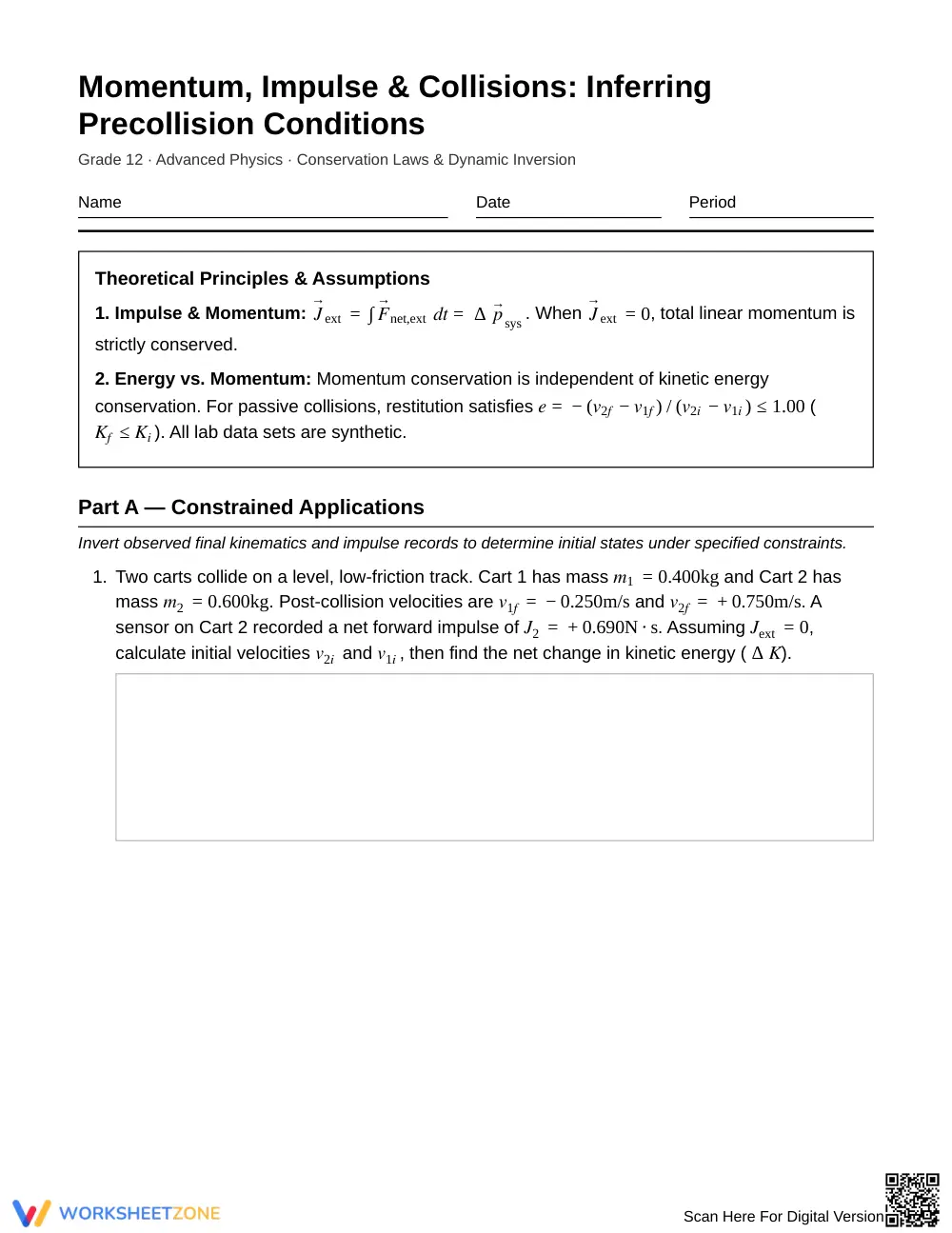





Essential Precollision Motion Worksheet | Grade 12 Physics

Paste this activity's link or code into your existing LMS (Google Classroom, Canvas, Teams, Schoology, Moodle, etc.).
Students can open and work on the activity right away, with no student login required.
You'll still be able to track student progress and results from your teacher account.
Mastering dynamic collision analysis requires students to work backward from observed outcomes to reconstruct initial kinematic states. This 4-page Grade 12 physics worksheet challenges learners with 6 multi-step problems, guiding them to apply linear momentum conservation, restitution boundaries, and impulse integrals to infer precollision conditions.
At a Glance
- Grade: 12 · Subject: Physics
- Standard: Advanced Mechanics — Apply conservation of momentum to analyze and reconstruct physical collisions
- Skill Focus: Infer Precollision Conditions from Final Motion
- Format: 4 pages · 6 problems · Answer key included · PDF
- Best For: AP Physics C and advanced mechanics practice
- Time: 45–60 minutes
This instructional resource features 6 rigorous analytical tasks organized into three targeted sections. It begins with theoretical principles governing impulse vectors and coefficient of restitution limits. Students navigate constrained numerical calculations, competing-model hypothesis evaluations, and multi-stage dynamic reconstructions. The document includes a comprehensive 2-page worked answer key detailing vector proofs and energy dissipation steps.
Skill Progression
- Guided practice (Part A, Problems 1–2): Students apply constrained equations to calculate initial velocities from final kinematics and barrier impulse force profiles with heavy structural framing.
- Supported practice (Part B, Problems 3–5): Students evaluate competing dynamic models, verify 2D explosion trajectory vectors, and analyze multi-stage vehicle skid reconstructions with intermediate support.
- Independent practice (Part C, Problem 6): Students perform an unassisted multi-stage spring-release and inelastic collision inversion while writing formal theoretical defenses of energy versus momentum conservation.
This structured sequence follows the gradual-release model, transitioning students from formulaic inverse calculations to rigorous, autonomous dynamic modeling.
Standards Alignment
This resource aligns with high school physics and advanced mechanics standards for linear momentum, impulse, and energy conservation. Students calculate vector momentum in two dimensions, evaluate elastic and inelastic restitution conditions, and apply the impulse-momentum theorem to isolated and non-isolated systems. Both standard concepts and learning targets can be copied directly into lesson plans, IEP goals, or district curriculum mapping tools.
How to Use It
Deploy this activity during the synthesis phase of your momentum and collisions unit, immediately following direct instruction on the impulse-momentum theorem and coefficient of restitution. It serves as an effective small-group problem set or summative assessment review. During completion, monitor how students track energy loss versus momentum conservation across multi-stage interactions to quickly identify misconceptions regarding restitution limits. Expected completion time is 45 to 60 minutes.
Who It's For
Designed for Grade 12 physics, AP Physics C, and introductory college mechanics students who possess strong algebraic and vector manipulation skills. It provides rigorous extension opportunities for advanced learners exploring collision forensics. Pair this worksheet with a dynamic cart laboratory demonstration or force-time sensor experiment to bridge concrete empirical data with inverse mathematical modeling.
According to Fisher & Frey (2014), implementing structured inverse problem-solving within science instruction significantly deepens conceptual mastery by moving beyond rote forward-calculation algorithms. This advanced physics resource addresses collision reconstruction by requiring students to infer precollision conditions from final motion states using fundamental conservation laws. Students synthesize impulse-momentum integrals, 2D vector kinematics, and restitution boundaries across 6 complex scenarios. Grounded in cognitive apprenticeship and gradual-release frameworks, the progression scaffold enables twelfth-grade physics learners to systematically unpack multi-stage interactions, test competing analytical hypotheses, and defend dynamic conservation principles with rigorous quantitative evidence. Educational research confirms that structured progression sequences combined with detailed answer keys enhance metacognitive monitoring and problem-solving resilience in STEM disciplines, making this document a reliable tool for standards-based kinematic evaluation and targeted collision analysis in high school mechanics classrooms.


