

































Essential Polynomial Forms Worksheet | Grade 9 Algebra I

Paste this activity's link or code into your existing LMS (Google Classroom, Canvas, Teams, Schoology, Moodle, etc.).
Students can open and work on the activity right away, with no student login required.
You'll still be able to track student progress and results from your teacher account.
This Grade 9 Algebra I worksheet guides students to compare expanded and grouped polynomial forms through structural analysis and operations. Learners discover how standard forms display degrees and intercepts while factored forms reveal dimensions and zeros. By evaluating 12 rigorous problems, students master distributive multiplication and algebraic equivalence.
At a Glance
- Grade: 9 · Subject: Algebra I
- Standard:
HSA-APR.A.1— Multiply and compare polynomials, understanding closure across equivalent standard and grouped algebraic representations- Skill Focus: Compare Expanded and Grouped Forms
- Format: 5 pages · 12 problems · 4-page answer key included · PDF
- Best For: Polynomial equivalence and distributive operations
- Time: 45–60 minutes
What's Inside
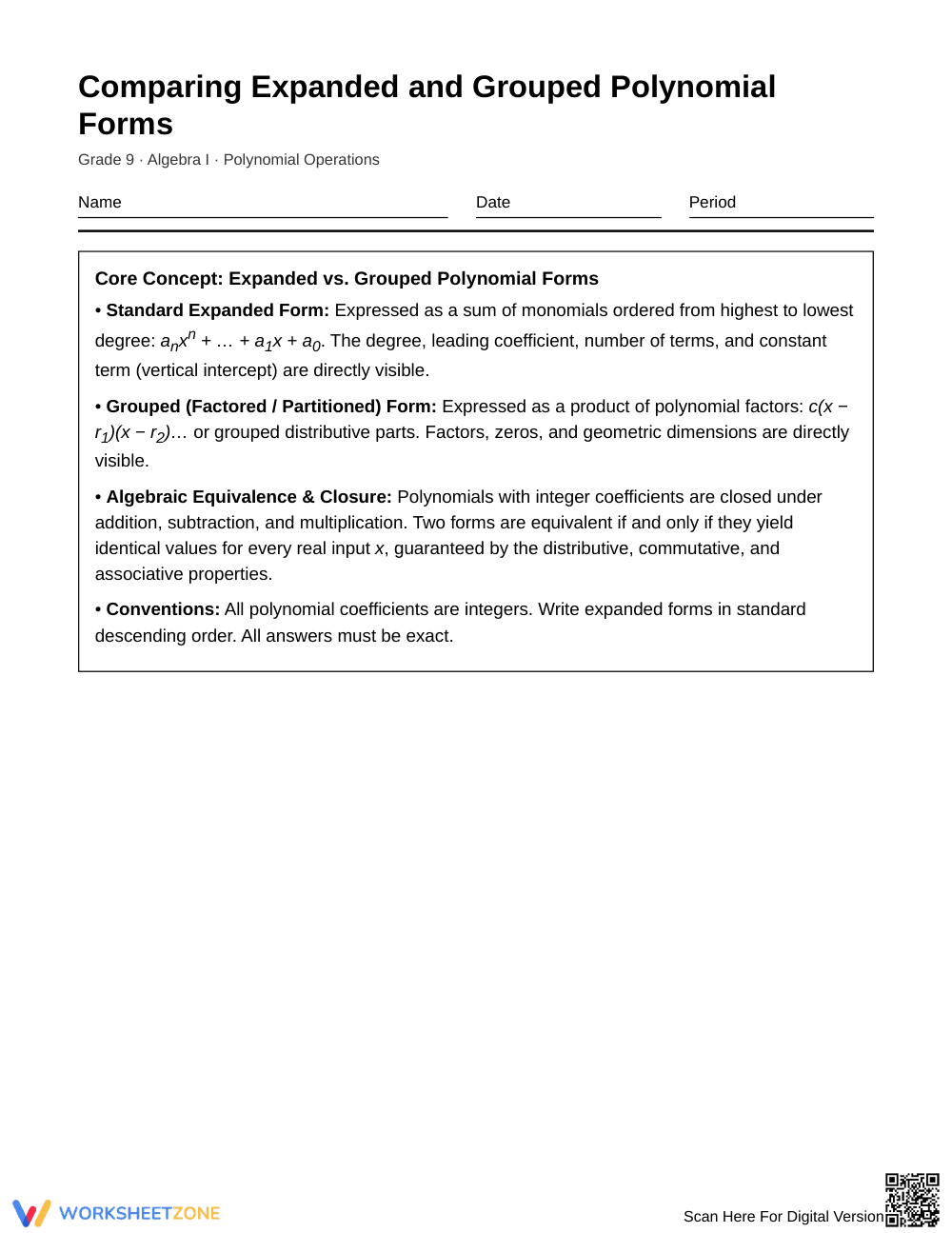
This 5-page worksheet provides 12 multi-step exercises linking geometric area models to symbolic polynomial algebra. Students analyze structural comparison tables, multiply binomials and trinomials, and identify algebraic misconceptions. A Core Concept reference box summarizes standard form conventions and polynomial closure. A 4-page complete answer key details every intermediate distributive step and proof explanation.
Skill Progression
- Guided practice (Problems 1–3): Students inspect polynomial properties and geometric area models to identify degree, intercepts, and side dimensions without manual expansion.
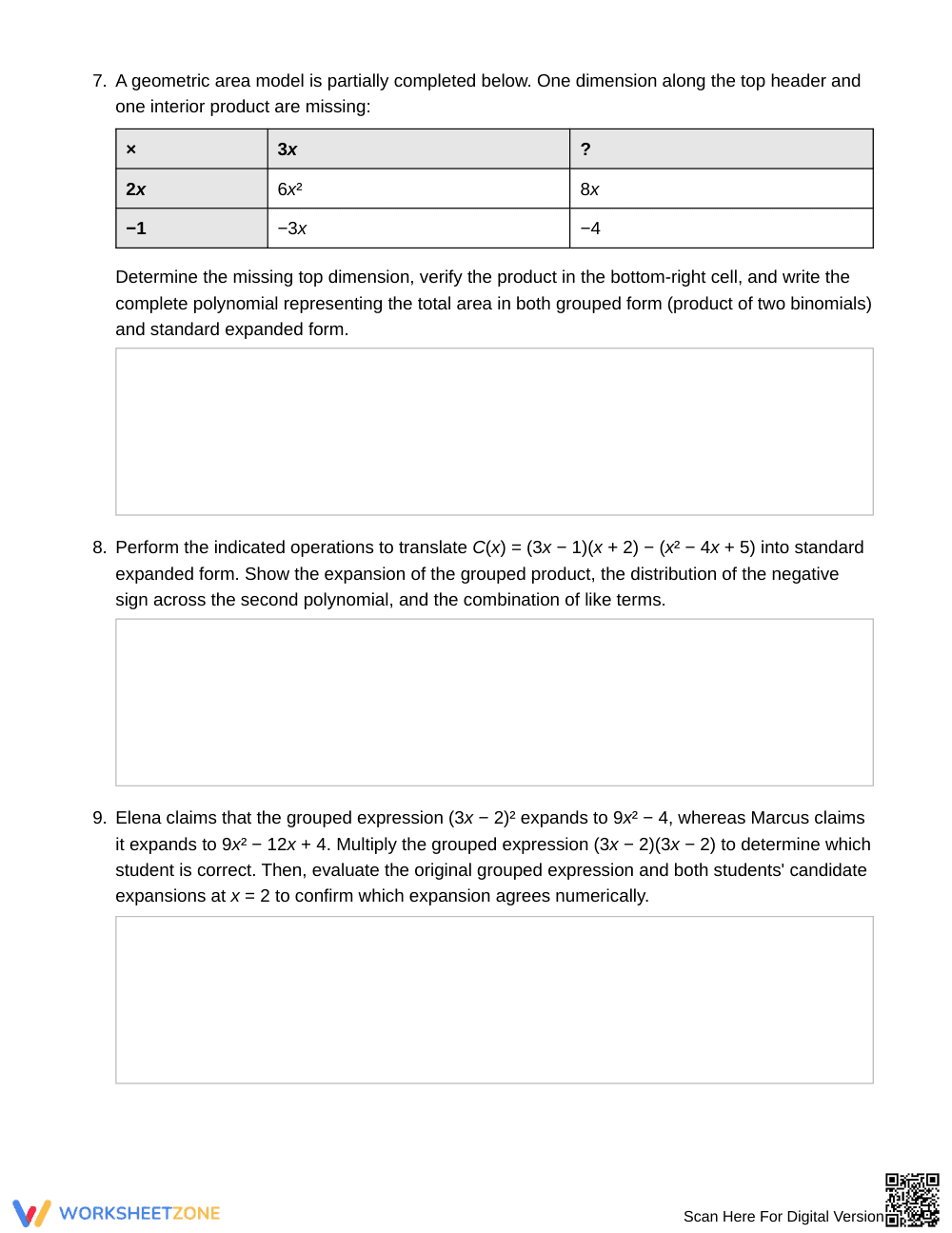
- Supported practice (Problems 4–9): Learners translate grouped expressions into standard form using distributive multiplication, solve missing tile dimensions, and test student claims with numerical substitution.
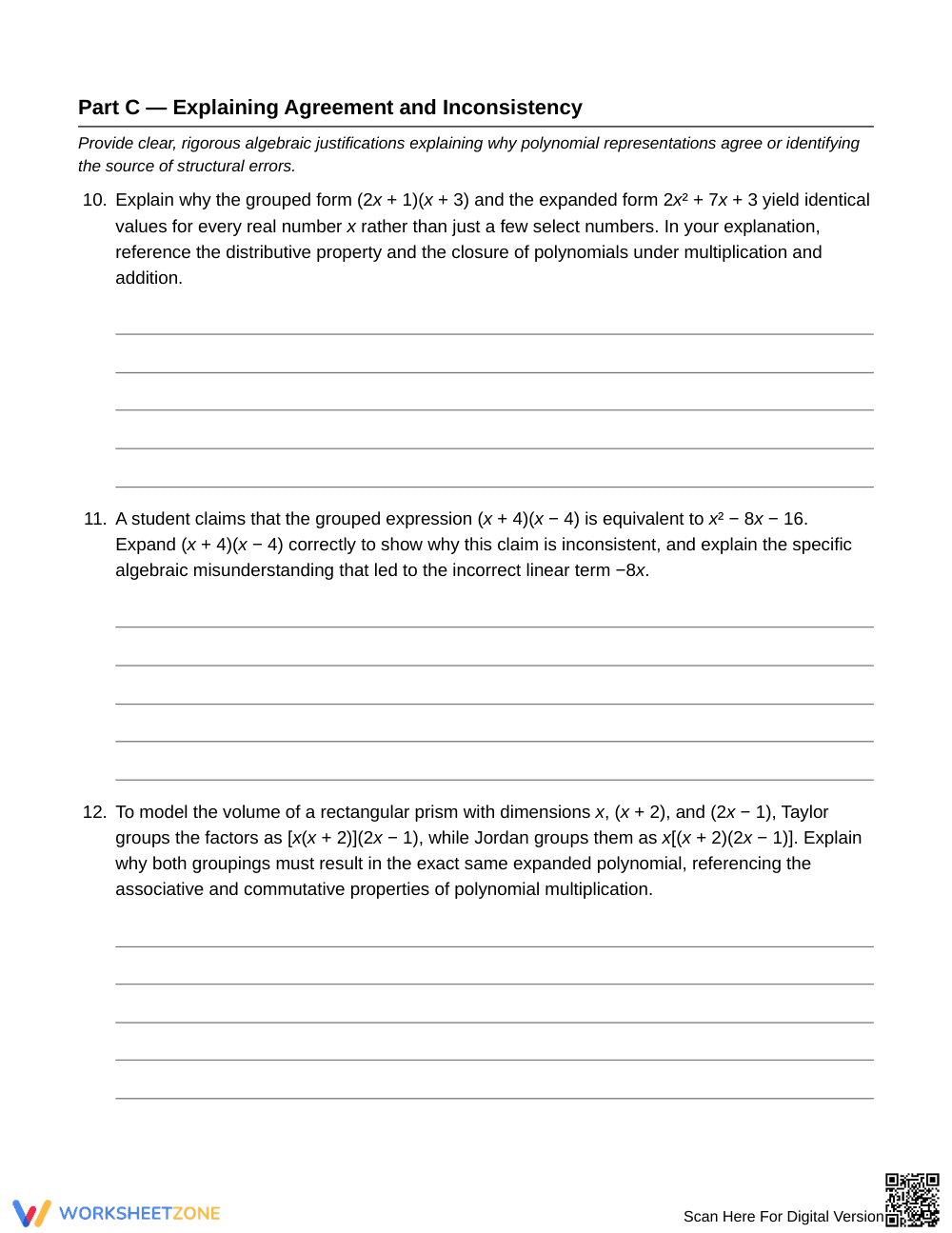
- Independent practice (Problems 10–12): Students write algebraic proofs of equivalence, explain squaring errors, and apply associative and commutative properties to 3D volume expressions.
This scaffolded sequence follows the gradual-release model, transitioning students from visual inspection to fluent symbolic operations and theoretical explanations.
Standards Alignment
This resource aligns directly to HSA-APR.A.1: Understand that polynomials form a system analogous to the integers, namely, they are closed under addition, subtraction, and multiplication; add, subtract, and multiply polynomials. In support, HSA-SSE.A.2 guides students to use expression structure to identify equivalent forms. Both standard codes can be copied directly into lesson plans, IEP goals, or district curriculum mapping tools.
How to Use It
Use Part A during direct instruction to connect polynomial vocabulary to area models. Assign Parts B and C after direct instruction for collaborative practice. During classwork, observe whether students distribute the negative sign across all terms in Problem 8 to identify common sign errors early. Students typically finish these 12 tasks in 45–60 minutes.
Who It's For
This worksheet serves Grade 9 Algebra I students learning polynomial operations and Grade 10 students requiring targeted remediation. Provide algebra tiles or grid paper for students needing concrete tactile support during expansions. Pair this activity with an anchor chart comparing expanded and factored quadratic expressions.
According to research from Fisher & Frey (2014) on structured instructional design, secondary mathematics students achieve higher conceptual retention when lessons deliberately scaffold tasks from explicit modeling to independent justification. This Grade 9 polynomial worksheet addresses standard HSA-APR.A.1 by guiding learners to compare expanded and grouped polynomial forms through structural analysis and distributive operations. By integrating visual area models with symbolic algebraic manipulation across 12 targeted problems, the activity reinforces polynomial closure under addition and multiplication while systematically dismantling common misconceptions surrounding squared binomials. Students progress from observing directly visible properties—such as intercepts, leading coefficients, and geometric dimensions—to writing rigorous algebraic justifications establishing functional equivalence. This balanced architecture ensures high school learners master both computational fluency and deep structural reasoning, providing educators with concrete diagnostic data on pupil readiness for advanced quadratic functions and polynomial factorization.


